
International Law and the Israeli–Palestinian Conflict
International law has long served as a central framework for regulating state power, territorial control, and the use of military force. Although its effectiveness has often been limited by political interests and unequal distributions of power, international legal institutions have increasingly become important arenas for defining the boundaries of state behavior. The Israeli–Palestinian conflict provides a particularly significant example of the complex relationship between law and power.
Since the beginning of the twenty-first century, the conflict has increasingly moved beyond conventional military confrontation and diplomatic negotiations. Issues such as occupation, settlement expansion, territorial control, civilian protection, and the use of military force have become deeply embedded in international legal debates. Consequently, the conflict is no longer viewed solely as a regional territorial dispute but also as a major test of the authority and effectiveness of the international legal order.
This transformation has been particularly visible through the growing involvement of the United Nations and international courts. The International Court of Justice (ICJ) and the International Criminal Court (ICC) have created institutional arenas in which questions concerning state responsibility and individual criminal responsibility can be examined. The conflict has therefore become increasingly connected with broader debates over sovereignty, human rights, accountability, and the credibility of the rules-based international order.
The Rise of International Judicial Accountability
The expanding role of international courts represents an important development in the relationship between Israel and international law. Earlier international responses to the conflict were largely dominated by diplomatic negotiations and political resolutions. More recently, however, judicial institutions have increasingly addressed the legal consequences of Israeli policies and military actions.
The ICJ played an important role through its 2004 Advisory Opinion on the Legal Consequences of the Construction of a Wall in the Occupied Palestinian Territory. The Court examined the relationship between occupation, territorial control, international humanitarian law, and human rights law. The opinion demonstrated that policies implemented within occupied territory could produce broader legal consequences under international law.
The Court’s July 2024 Advisory Opinion concerning the legal consequences arising from Israel’s policies and practices in the Occupied Palestinian Territory, including East Jerusalem, expanded this legal scrutiny further. It addressed the broader consequences of prolonged occupation and emphasized the legal significance of policies affecting the status and future of the territory.
The ICC has introduced a different dimension of accountability. Unlike the ICJ, which primarily addresses questions concerning states, the ICC examines the individual criminal responsibility of persons accused of international crimes. Its involvement in the situation in Palestine has therefore expanded the legal debate from state conduct to the potential criminal responsibility of political and military leaders.
Together, these developments indicate an important transformation: international accountability is increasingly moving beyond diplomatic criticism toward formal judicial mechanisms capable of producing significant legal consequences.
Occupation, Settlements, and Military Power
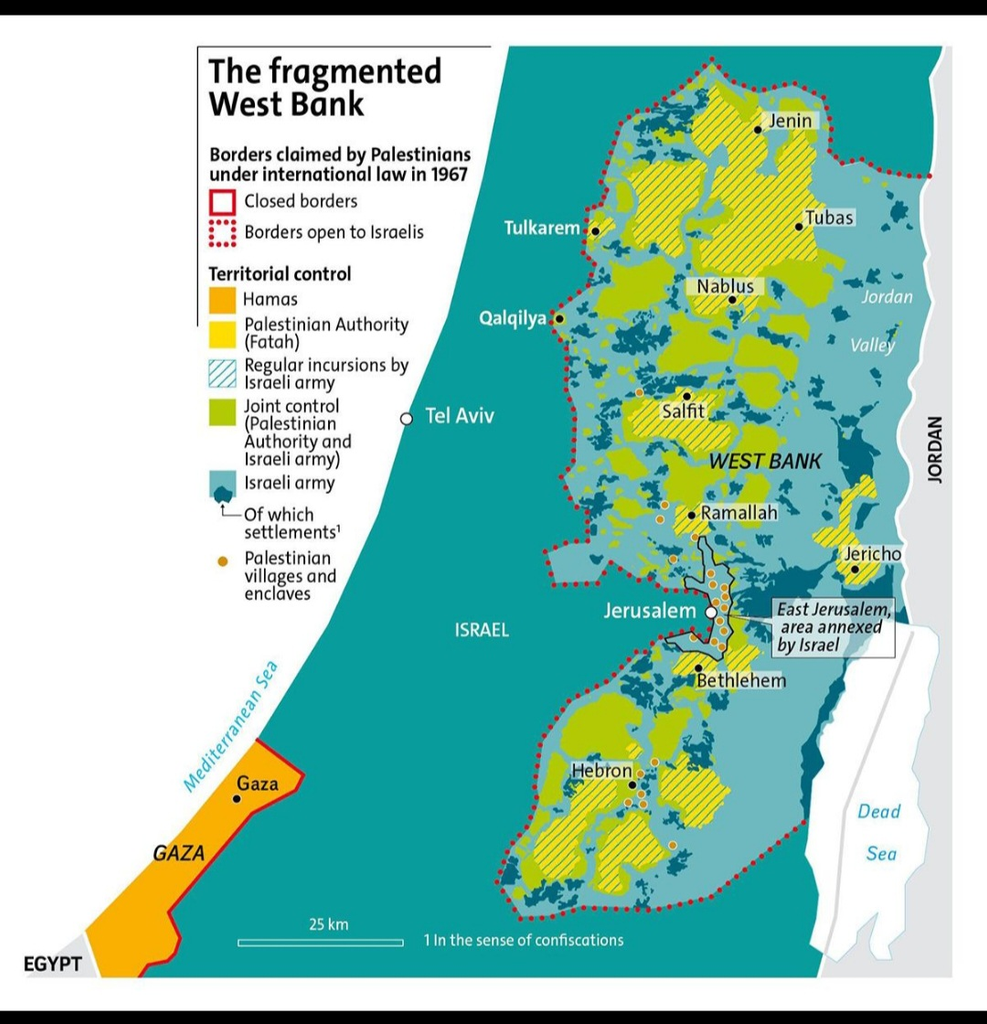
The expansion of Israeli settlements has fundamentally affected the territorial structure of the Israeli–Palestinian conflict. Since 1967, settlement activity in the West Bank and East Jerusalem has altered patterns of land use, population distribution, and territorial control.
Article 49 of the Fourth Geneva Convention prohibits an occupying power from transferring parts of its own civilian population into occupied territory. Settlement activity has consequently become a central issue of international humanitarian law as well as a major political dispute.
This legal position was reaffirmed by UN Security Council Resolution 2334, adopted in December 2016. The resolution stated that Israeli settlements in the Palestinian territories occupied since 1967, including East Jerusalem, have no legal validity under international law and constitute a major obstacle to the achievement of a two-state solution.
The importance of settlements extends beyond their individual legal status. Their expansion and the resulting fragmentation of Palestinian territory have complicated efforts to establish a geographically contiguous and politically viable Palestinian state. Control over territory and natural resources is therefore closely connected to the broader question of Palestinian self-determination and sovereignty.
The issue of military force became even more prominent following the escalation of the conflict in October 2023. Israel has invoked the right of self-defense under Article 51 of the UN Charter in response to armed attacks. At the same time, the exercise of military power remains subject to international humanitarian law.
Three principles are particularly important. First, the principle of distinction requires parties to distinguish between civilians and combatants and between civilian objects and military objectives. Second, the principle of proportionality prohibits attacks where expected civilian harm would be excessive in relation to the anticipated concrete and direct military advantage. Third, international humanitarian law requires the protection of civilians and regulates the provision of essential supplies during armed conflict and occupation.
The conflict therefore illustrates a fundamental principle of international law: legitimate security concerns do not eliminate legal obligations concerning the conduct of hostilities and the protection of civilians.
Future Prospects and the International Legal Order
The increasing involvement of international courts has consequences extending far beyond Israel and Palestine. The conflict has become an important test of whether international law can effectively constrain powerful states and whether international institutions can maintain credibility in situations involving major geopolitical interests.
The ICJ has provided authoritative interpretations concerning occupation, territorial control, and the legal consequences of state policies. The ICC, meanwhile, has established a framework for examining individual criminal responsibility. These developments demonstrate the growing institutionalization of international accountability.
Nevertheless, international courts face significant structural limitations. Their decisions, advisory opinions, and arrest warrants depend to a considerable extent on state cooperation and political will. The gap between legal authority and practical enforcement therefore remains a fundamental problem. International law may establish what is legally permissible, but its ability to change behavior depends on the willingness and capacity of states and international institutions to implement those legal standards.
The Israeli–Palestinian conflict consequently raises a broader question about the future of the rules-based international order. If international law is perceived as being applied selectively according to geopolitical interests, confidence in international institutions may decline. Conversely, consistent application of legal principles could reinforce the idea that international law represents a genuine constraint on state power.
Ultimately, the conflict represents a broader test of the international legal order established after 1945. Its significance lies not only in the Israeli–Palestinian dispute itself but also in what it reveals about the capacity of international law to regulate power. The future credibility of the rules-based international order will depend increasingly on whether legal authority can be translated into consistent and meaningful enforcement.