Kazakhstan’s Dependence on Russian Infrastructure and Strategic Shifts
The emergence of the Trans-Caspian International Transport Route as a central element of Kazakhstan’s foreign economic strategy cannot be understood in isolation from the depth of the country’s existing dependency on Russian transit infrastructure. This dependency is both extensive and multidimensional. Most of Kazakhstan’s oil exports are transported to global markets via Russian territory. Russian companies also own a substantial share of the Caspian Pipeline Consortium, which serves as the main export for Kazakh hydrocarbons. This arrangement gives Moscow not only a financial interest in Kazakhstan’s export revenues but also an operational instrument of influence that has been deployed for political purposes. Russia suspended Kazakhstan’s oil exports through the Novorossiysk terminal four times in 2022. On one occasion, the suspension lasted only a single day and followed Tokayev’s public offer to help stabilize European energy supplies. Many saw this pattern as intentional economic signaling by Moscow, rather than a mere technical issue.
Kazakhstan’s dependency goes beyond the energy sector to include digital infrastructure, much of which is routed through Russian territory. This arrangement constitutes an additional form of leverage that parallels transport and energy dependencies but has received less scholarly attention. Kazakhstan’s vulnerability to Russian sanctions became clear after the invasion of Ukraine, when the country’s re-exports of microchips to Russia rose sharply. This development has forced Astana to engage in ongoing compliance talks with Western partners. Deputy Prime Minister Zhumangarin acknowledged that Kazakhstan’s compliance with Western sanctions is motivated by economic benefit rather than political solidarity. This dynamic illustrates Kazakhstan’s structural entanglement with Russia across multiple infrastructural domains, while also highlighting the simultaneous pressures exerted by Western partners whose investments and institutional ties are equally critical.
The Corridor’s Evolving Geopolitical Role Since February 2022
Prior to the Russian invasion of Ukraine, the Middle Corridor played a minimal role in Eurasian trade logistics. The Northern Corridor, traversing Russia and Belarus, dominated overland freight between China and Europe, while the Middle Corridor accounted for only a small share of total traffic. Maritime transport remained the primary mode for China-Europe trade. The invasion rapidly altered these dynamics. Western sanctions made Russian and Belarusian transit both legally and reputationally problematic for European operators, resulting in a significant decline in Northern Corridor shipments and increased interest in alternative routes. Consequently, trade volumes along the Middle Corridor rose substantially in the immediate aftermath across all principal transit states. However, maritime shipping accounted for the largest absolute shift from the Northern Corridor, suggesting that the Middle Corridor’s growth shows expansion from a very low baseline rather than a fundamental transformation of the logistics landscape.
By 2025, cargo volumes along the Middle Corridor reached 4.5 million tons annually, a fivefold increase from 2017. Transit times were reduced to thirteen to seventeen days by mid-2026, narrowing the operational gap with the Northern Corridor and reflecting substantive infrastructure improvements rather than only favorable geopolitical conditions. Kazakhstan’s target of 10 million tons, reaffirmed by President Tokayev at the Kazakhstan-Turkey Business Forum in May 2026, aligns with World Bank projections contingent on continued infrastructure investment. In 2026, a separate demand driver emerged when hostilities involving the United States, Israel, and Iran rendered the Strait of Hormuz impassable, disrupting the southern maritime route and increasing demand for overland Eurasian alternatives. This development is significant because it shifts the corridor’s commercial appeal from being primarily linked to the Ukraine conflict and sanctions regime to being rooted in a broader reconfiguration of global trade risk.
Geographic Position and Economic Stakes for Kazakhstan
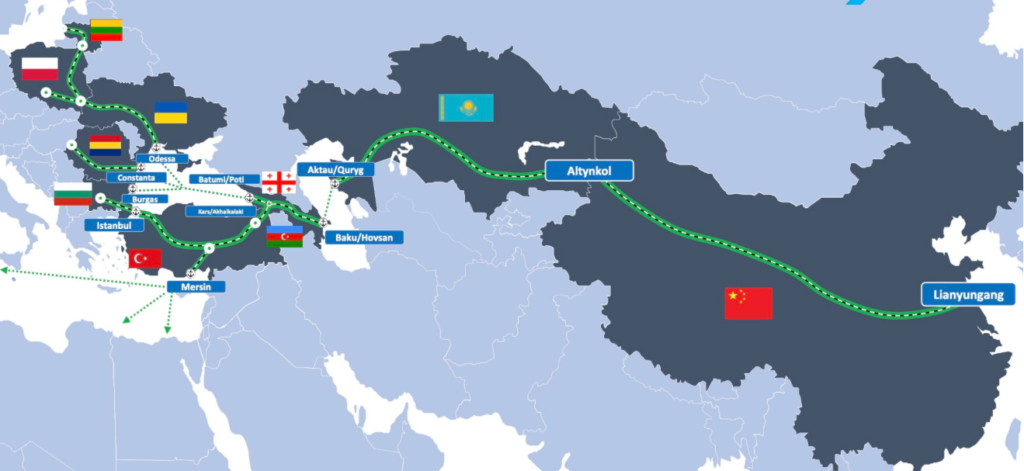
Kazakhstan occupies a structurally indispensable position within the Middle Corridor. As the sole Central Asian state traversed by the route’s principal alignment, Kazakhstan accounts for the majority of the corridor’s freight volume and serves as the essential link between Chinese territory and the Caspian crossing. This geographic advantage is further supported by the country’s port infrastructure at Aktau and Kuryk, whose combined annual capacity significantly goes beyond current utilization. This suggests that the main constraints on corridor throughput are operational rather than physical infrastructure-related. Key operational challenges include vessel availability, cross-Caspian coordination, and digital integration.
The fiscal aspect of Kazakhstan’s position is also significant and remains underexplored in current scholarship. Customs duties collected on Chinese cargo transiting Kazakhstan provide a direct fiscal incentive to maintain route exclusivity, which helps explain Astana’s ambivalence toward the China-Kyrgyzstan-Uzbekistan railway, which is a competing route that could diminish this revenue stream. Kazakhstan’s diversification initiatives extend beyond transport infrastructure. The installation of a fiber-optic cable under the Caspian Sea, in partnership with Azerbaijan, demonstrates an awareness that dependency on Russian infrastructure includes the digital domain and that corridor development should be understood as encompassing broader connectivity beyond freight logistics.
The investment framework supporting the corridor has advanced significantly in recent years. A multilateral financing package, backed by guarantees from the International Bank for Reconstruction and Development and the Asian Infrastructure Investment Bank, aims to attract private capital for Kazakh railway infrastructure, including the construction of a new rail line in the country’s interior. Kazakhstan’s public investment in transport infrastructure rose sharply between 2022 and 2023, and foreign direct investment in the transportation sector became positive for the first time in nearly a decade. The corridor partnership with Turkey has produced economic benefits beyond transit revenues, including joint industrial projects, increased agricultural trade, and Turkish investment in Kazakhstan’s aviation infrastructure. These developments underscore the deepening bilateral economic relationship embodied by the Middle Corridor.
Kazakhstan’s Foreign Policy: Insights from the May 2026 Visits
Kazakhstan’s multi-vector foreign policy, which formally seeks to balance relations with Russia, China, and Western partners, had functioned in practice as a Russia-centered alignment prior to 2022. The post-invasion period has made genuine diversification both more urgent and more apparent. Kazakhstan’s refusal to recognize Donetsk and Lugansk, as publicly stated by President Tokayev at a major international forum in 2022, marked a significant departure from the diplomatic deference previously shown to Moscow. The 2024 decision not to join BRICS, which led Russia to temporarily restrict Kazakh agricultural imports, further demonstrated both Kazakhstan’s evolving orientation and Russia’s capacity to signal its dissatisfaction.
The series of high-level visits to Astana in May 2026 clearly demonstrates Kazakhstan’s diplomatic positioning. President Erdoğan’s mid-May visit, which included both a bilateral strategic council meeting and an Organization of Turkic States summit, placed the Middle Corridor at the forefront of the diplomatic agenda. Thirteen bilateral agreements were signed, a joint electronic logistics documentation system was proposed, a unified digital freight management platform was announced, and President Tokayev called for linking the Middle Corridor to a new US-sponsored connectivity initiative. This approach aimed to position Kazakhstan at the intersection of Turkish, European, and American strategic interests. President Putin’s visit two weeks later, his second state visit to Astana during the current presidential term and an exception to standard diplomatic protocol, was presented by the Kremlin as a deliberate signal of the relationship’s significance. The agreements and infrastructure priorities identified during this visit reflected a different connectivity logic, favoring routes through Russian territory. Kazakhstan engaged with both delegations, reaffirmed its commitment to Western sanctions, and ultimately did not fully satisfy either side. The two-week interval between visits and the mutually exclusive visions of connectivity encapsulate the central tension in Kazakhstan’s current foreign policy.
Dilution, Not Decoupling
Kazakhstan’s engagement with the Middle Corridor is best characterized as a pursuit of strategic optionality rather than alignment. The corridor does not eliminate Russian infrastructural leverage in the short term, nor is it designed to do so. Instead, it enables Kazakhstan to credibly pursue diversification by demonstrating to domestic stakeholders, investors, and Western partners that viable alternatives exist, without calling for a formal break that the depth of Russia-Kazakhstan economic ties would preclude. This is evident in Kazakhstan’s trade structure: China’s share surpassed Russia’s for the first time in 2023, yet the absolute volume of Russia-Kazakhstan trade reached a record high in 2025. Russia’s relative position is declining as other partnerships grow, but it is not being displaced.
A fundamental tension shapes the corridor’s future geopolitical outlook. The route relies heavily on Chinese investment and cargo to justify expansion, but increased association with China generates resistance from Western capitals, whose institutional and financial support is also necessary. Turkey’s NATO membership offers some protection against this perception, while Kazakhstan’s efforts to connect the corridor with US-aligned diplomatic initiatives represent a strategic attempt to diversify its geopolitical backing. The 2026 disruption of the Strait of Hormuz introduced an independent demand driver, reinforcing the corridor’s long-term commercial viability regardless of developments in the Ukraine conflict. This shift grounds the preference for overland Eurasian alternatives in the structural realities of global trade geography rather than in any specific sanctions’ regime.
Several unresolved questions will shape the corridor’s medium-term significance. The most immediate uncertainty is whether its commercial viability can endure a partial normalization of the Northern Corridor, which private-sector operators have indicated they would prefer if geopolitical conditions allowed. The impact of the China-Kyrgyzstan-Uzbekistan railway, now under construction, on Kazakhstan’s route monopoly and strategic leverage will become clearer over the next decade. Additionally, the future construction and ownership of the Anaklia port on Georgia’s Black Sea coast, which is the most contested western point of the corridor, will play a crucial role in determining the route’s overall reliability. If the port is not developed effectively, the corridor may continue to face a significant gap at its European end.
Symbat Zholamanova
Joongbu University