
India’s government-owned company, India Ports Global Limited (IPGL), has suspended its involvement in developing the Chabahar ocean port in south-eastern Iran, transferring its remaining financial commitment to Tehran. This follows the reimposition of sanctions against Chabahar on September 29, 2025 as part of the US’s ‘maximum pressure’ policy against Iran. This undermines India’s strategic plans, as it relies on Iranian transit for overland connections to Eurasia.
New Delhi and Moscow are promoting a joint project to establish the International North-South Transport Corridor (INSTC), with the port of Chabahar earmarked as its vital link. Meanwhile, negotiations to establish a free trade zone with the Eurasian Economic Union have intensified, which would further strengthen India’s trade presence in the CIS (Commonwealth of Independent States). This highlights the importance of improving interregional transport connectivity, a key objective of both the INSTC and the Chabahar Agreement, which was signed by India, Iran and Afghanistan in 2016. The latter considers the port of Chabahar to be the main gateway for Indian goods entering the markets of Afghanistan and Central Asia.
In May 2024, India signed a long-term contract with Iran to operate the Chabahar port, allocating a further $120 million for its modernization in addition to the half-billion dollars already invested. Trade between India and the Central Asian states exceeds $1.7 billion. Kazakhstan accounts for over half of India’s regional imports, consisting primarily of mineral fuels and oil. Uzbekistan is the region’s largest consumer of Indian products.
In 2025, the value of trade between Uzbekistan and India reached $1.3 billion. In order to accelerate this growth, a new multimodal corridor is planned, utilizing the facilities of the Chabahar port, which will connect Uzbekistan, Turkmenistan, Iran and India. Notably, compared to maritime routes through Europe or China, Iranian overland transit reduces the cost and time of transporting cargo from India to Central Asia and back by almost a third. Within the Central Asian segment, the new route could be extended to Kyrgyzstan and Tajikistan, as both countries depend on Uzbekistan for access to the open sea, including the Indian Ocean.
However, the crisis in the Middle East and Washington’s economic pressure on Tehran and its trade partners, who now risk 25 per cent US tariffs, obscure the prospects of the INSTC through Iran for the foreseeable future. This puts India in a vulnerable position, limiting its connectivity with resource-rich Central Asia. Meanwhile, a joint report by the Eurasian Development Bank and the Export-Import Bank of India estimated the untapped trade potential between India and the region at $1.9 billion — double the actual five-year average trade volume between the countries.
One reason for this is the difficulty and high cost of transport accessibility. The situation is further exacerbated by the ongoing military escalation in the Persian Gulf, which is becoming a serious obstacle to the implementation of India’s Eurasian strategy. This shift comes at a time when New Delhi is strengthening its perception of the region as part of its ‘extended neighborhood’ to counterbalance China’s growing ambitions.
Given the current geopolitical situation in the Middle East, which has made it difficult for Iran’s southern seaports to operate, it is timely to draw India’s attention to the Termez-Naibabad-Maidanshahr-Logar-Kharlachi railway project (also known as the Trans-Afghan or Kabul Corridor) as a viable and cost-effective alternative for transport links with Central Asia.
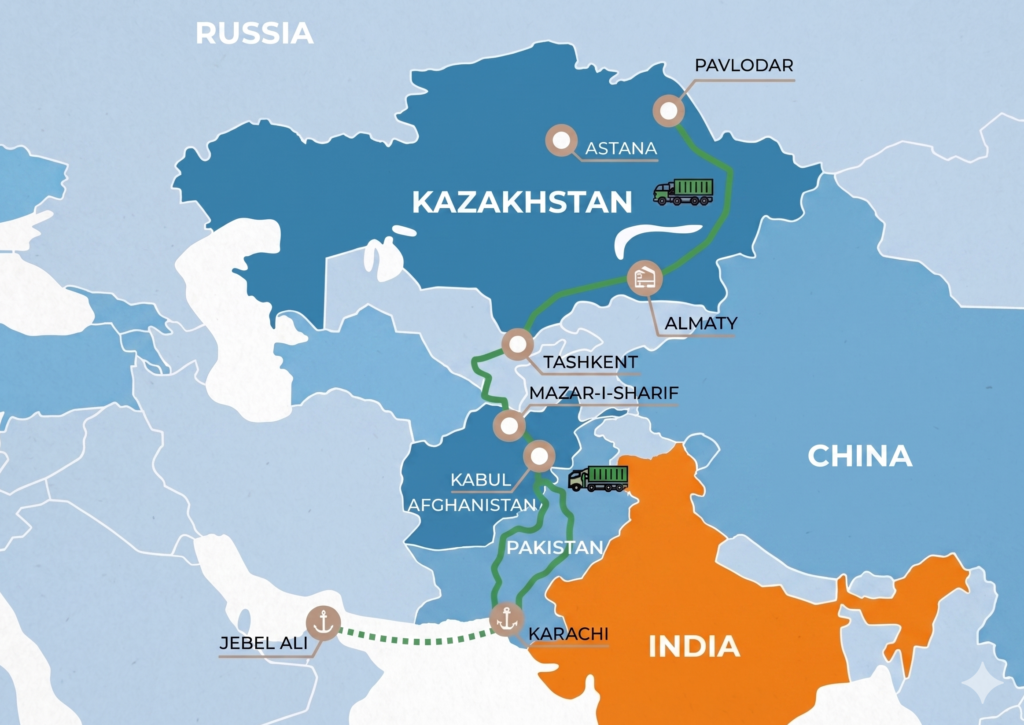
Since 2023, the parties have been developing the 5,532-kilometre Belarus-Russia-Kazakhstan-Uzbekistan-Afghanistan-Pakistan multimodal corridor. This new logistics chain is designed to deliver cargo to South Asia in just 20 days, which is three times faster than by sea. Extending the corridor to Europe and India will create the conditions for the first time to connect two major economic centers of world trade by land. Thanks to the construction of the Trans-Afghan Railway and the subsequent connection of the transport systems of the CIS countries and the Indian subcontinent, the overland route from Belarus to Pakistan will become monomodal, giving it a significant competitive advantage.
Thus, a new transit corridor will be formed along the north-south axis involving Uzbekistan and bypassing Iran. According to preliminary estimates, this corridor will be 1,200 km shorter than the current INSTC. This represents a unique opportunity for dynamically developing India, with a population of 1.4 billion, to gain the shortest possible access to Eurasian markets and transport essential raw materials for its economy from the region relatively quickly.
India’s complicated relations with Pakistan, as well as the ongoing, low-intensity military conflict between Afghanistan and Pakistan, continue to limit New Delhi’s interest in the Trans-Afghan project. Furthermore, China’s Belt and Road Initiative — whose flagship project is the China-Pakistan Economic Corridor (CPEC) — must also be considered.
Beijing has already invested over $70 billion in the CPEC, which focuses primarily on creating modern transport infrastructure in Pakistan. Further extension of the Trans-Afghan Railway to India via Pakistan or to Pakistani ports on the Arabian Sea coast would be in China’s interest. However, New Delhi does not want this due to its conflict-prone relations with its eastern neighbor. Nevertheless, the positive impact of the North-South Transport and Transit Corridor through Uzbekistan, Afghanistan and Pakistan on India is clear.
Therefore, Tashkent should intensify diplomatic dialogue with New Delhi regarding India’s potential participation in the implementation of the Kabul Corridor. The project’s economic viability must be explained, with particular emphasis placed on its potential to mitigate the risks posed by the war in Iran. Regular consultations should also be established with relevant Indian agencies on the development of transport cooperation.