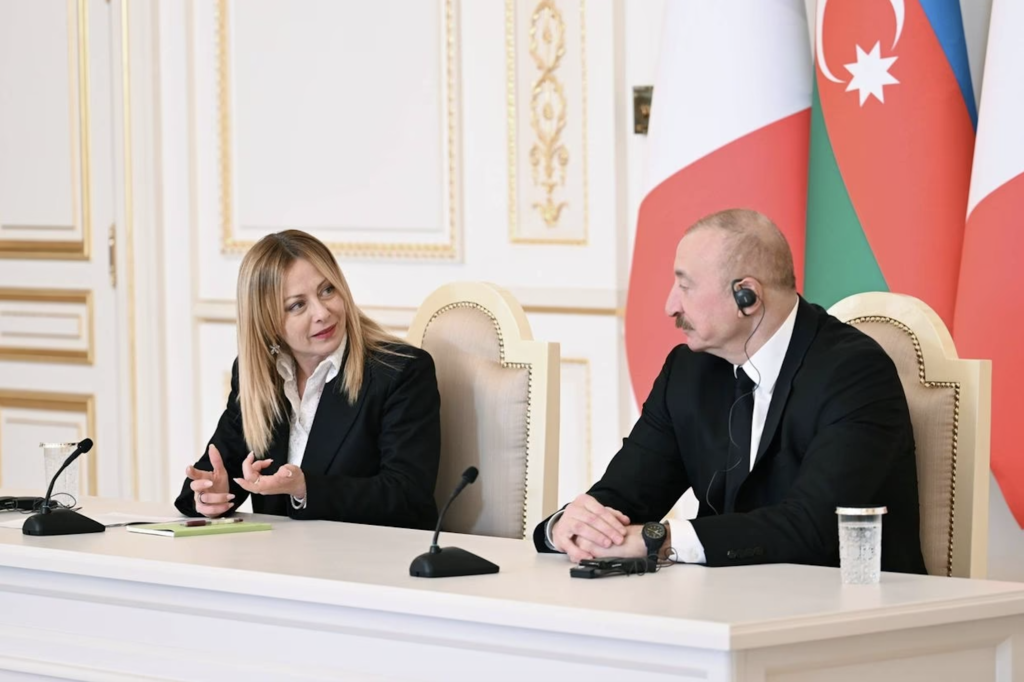
Italian Prime Minister Giorgia Meloni’s official visit to Azerbaijan on 4 May 2026 formalized the transformation of relations between Rome and Baku from a conventional diplomatic relationship into a comprehensive and multidimensional strategic partnership. At a time when Europe is being reshaped by multiple geopolitical shocks, including energy crises, the war in Ukraine, and instability in the Middle East, Italy is positioning itself as a critical security and energy bridge between Europe and Eurasia.
Meloni, the first Italian prime minister to visit Azerbaijan after a thirteen-year interval, framed the closing of this diplomatic gap as a political necessity. The most important political outcome of the visit was the establishment of a mechanism of “permanent political coordination” between the two countries. This mechanism moves bilateral cooperation beyond a conjunctural rapprochement and creates a structured framework through which Rome and Baku can jointly define future priorities.
Energy Security: From Volume to Industrial Synergy
Energy security, which has long formed the backbone of Italy-Azerbaijan relations, has entered a new phase in Meloni’s Baku vision. The prime minister’s statements indicate that the objective is not merely to increase the volume of gas supplied to Italy, but to upgrade the quality of industrial partnership across the entire supply chain. This vision rests on a “dual bridge strategy”: Azerbaijan strengthens its role as a key transit hub between Europe and Asia, while Italy becomes a privileged gateway for Azerbaijani energy and products into the European market.
Energy realities and projections in figures:
Current situation: In the 2025 to 2026 period, Azerbaijan exported 9.5 billion cubic meters of natural gas and 10.34 million tons of oil to Italy. These figures correspond to approximately 16 percent of Italy’s total gas demand and 17 percent of its oil demand. Since the commissioning of the Trans Adriatic Pipeline, the total volume of Azerbaijani gas transported to Italy has reached 45.4 billion cubic meters.
Future outlook: Italy’s annual gas consumption averages around 70 billion cubic meters. If the planned expansion of the Trans Adriatic Pipeline reaches 20 billion cubic meters per year, Azerbaijan’s share of the Italian natural gas market could rise from 16 percent to 28 percent. Under this scenario, Azerbaijan would surpass Algeria, which currently holds around a 25 percent market share, and become Italy’s leading natural gas supplier.
Economic Integration and the 2026 Business Forum
The strength of energy cooperation is also reflected in broader economic indicators. Italy is currently Azerbaijan’s largest economic partner, with bilateral trade amounting to 12 billion dollars. Italy alone accounts for 46.7 percent of Azerbaijan’s total exports.
At present, 130 Italian companies are active in Azerbaijan. Italian firms are particularly visible in the reconstruction of the liberated Karabakh region, where they are involved in 23 separate infrastructure and development projects. To translate the strong political alignment between the two leaderships into concrete commercial opportunities and to diversify investment channels, the two sides agreed to organize a major Business Forum in Baku in the second half of 2026. This forum is expected to deepen the participation of Italian capital in Azerbaijan’s large-scale modernization programs, as well as in joint investment initiatives in third countries.
Defense Industry and Advanced Technologies
One of the most significant new dimensions of the Italy-Azerbaijan partnership is the growing cooperation in security, defense industry, and advanced technologies. Prime Minister Meloni’s description of this field as a “decisive area of partnership” indicates that Rome views defense cooperation not as a secondary component of bilateral ties, but as a strategic pillar of the emerging Italy-Azerbaijan axis. This approach also reflects Italy’s willingness to share its advanced technological and industrial capabilities with Azerbaijan at a time when Baku is seeking to modernize its defense infrastructure, strengthen national resilience, and diversify its security partnerships beyond traditional frameworks.
The main areas of cooperation include aerospace and aviation, maritime security systems, the protection of critical infrastructure, and the application of advanced technologies in strategic sectors. These fields are particularly important for Azerbaijan, given its position as an energy-exporting state, a Caspian maritime actor, and a key transit hub connecting Europe, the South Caucasus, and Central Asia. Enhanced cooperation with Italy can therefore contribute not only to Azerbaijan’s defense modernization, but also to the security of energy infrastructure, transport corridors, and emerging regional connectivity projects. In this context, Italy’s role goes beyond the conventional sale of military or technological products. Rather, it offers a broader strategic model based on technology transfer, know-how sharing, industrial cooperation, and long-term joint development.
Geopolitical Dynamics: Operational Trust and Regional Peace
Italy’s confidence in Azerbaijan on regional security issues has acquired a highly practical and operational dimension.
The Iran crisis and security partnership: During the crisis in Iran, Azerbaijan’s rapid assistance in evacuating Italian citizens at risk, as well as the temporary and secure relocation of Italy’s embassy in Tehran to Baku, demonstrated the depth of operational trust between the two countries.
The Armenia-Azerbaijan peace process: Referring to the mediation efforts of the United States, Meloni underlined Italy’s full support for the normalization process between Armenia and Azerbaijan. The year 2026 is being framed as a potential turning point for unlocking the South Caucasus’s real geo-economic potential, particularly in relation to transport corridors, logistics, and regional connectivity.
Conclusion
The Italian prime minister’s visit to Baku demonstrates that relations between Rome and Baku have moved decisively beyond the traditional “energy supplier and consumer” model. They have now reached the level of a multidimensional and institutionalized strategic partnership.
At a time when Europe faces complex security challenges, Italy regards Azerbaijan not only as a reliable partner in times of energy crisis, but also as a key geopolitical anchor for access to the South Caucasus and Central Asia. Azerbaijan, in turn, strengthens its position within the European Union through Italy, diversifies its economy, and gains direct access to advanced Western technologies.
The launch of a permanent political coordination mechanism and the emergence of new defense industry objectives confirm that the Italy-Azerbaijan axis is likely to play a central role in the coming decade, both in Europe’s energy security architecture and in the geo-economic map of Eurasia.