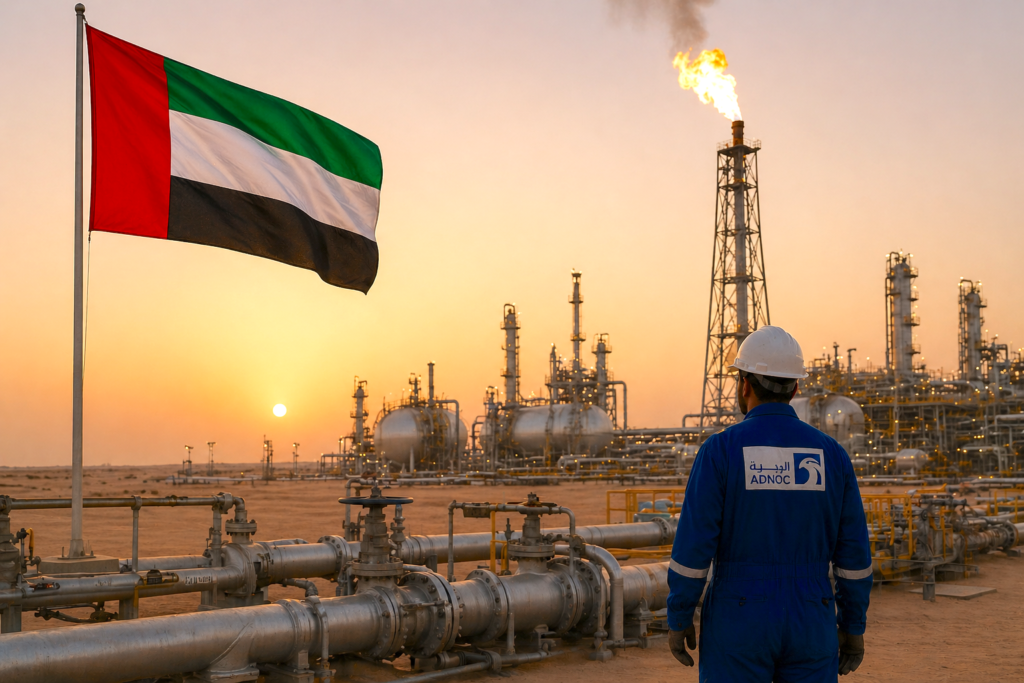

The United Arab Emirates (UAE) has withdrawn from the Organization of the Petroleum Exporting Countries (OPEC), ending decades of membership and directly challenging the cartel’s ability to coordinate global oil supply. This move reflects a clear strategic break: Abu Dhabi no longer accepts production quotas that limit its expanding capacity and revenue potential. The decision comes at a time of heightened regional instability, particularly due to the United States-Iran War, which are already increasing volatility in Gulf energy markets and amplifying the strategic value of flexible, independent production policy.
Structural Friction: Capacity Expansion vs Quota Discipline
At its core, OPEC has historically functioned as a coordination mechanism designed to stabilize prices through production management. For decades, the UAE was a compliant and often constructive member. However, its energy strategy has evolved dramatically over the past fifteen years. Abu Dhabi has invested heavily in upstream capacity, targeting production levels of around 5 million barrels per day by the end of the decade, up from roughly 3.2 to 3.5 million barrels per day in recent years. This places it among the fastest-growing producers within the Gulf.
This expansion created a structural mismatch. The UAE is no longer a marginal producer that benefits primarily from price stability. It has become a capacity-driven exporter seeking volume expansion, market share, and long-term positioning in Asian demand centers such as India, China, and Southeast Asia, which together account an incremental global oil demand growth.
The friction intensified within the broader OPEC framework, where coordination with non-OPEC producers imposed even tighter constraints. For the UAE, these arrangements increasingly translated into opportunity costs. Estimates suggest that production limits may have prevented the country from monetizing several hundred thousand barrels per day of available capacity, representing billions of dollars in foregone annual revenue depending on price levels.
One major factor behind the timing of the exit is the changing demand outlook. While global oil demand still hovers around 102 to 104 million barrels per day, long-term projections remain uncertain due to energy transition policies. For a producer like the UAE, maximizing output in the medium term becomes a rational strategy. Remaining bound to collective output limits in an era of uncertain demand curves risks leaving valuable reserves underutilized.
Geopolitics and Strategic Autonomy in a Fragmenting Gulf
The geopolitical layer is equally decisive. The intensifying confrontation between Iran and the United States has transformed the Gulf into a zone of heightened strategic risk. Roughly 20 percent of global oil supply passes through the Strait of Hormuz, making any disruption a critical shock to international markets. Even limited escalations have historically triggered price spikes of 5 to 10 percent within days.
From Abu Dhabi’s perspective, continued alignment within OPEC could expose it to geopolitical entanglements that do not serve its strategic autonomy. Iran remains a key OPEC member, and its fraught relationship with Washington introduces an additional layer of politicization into OPEC deliberations. The UAE has sought to maintain a diversified foreign policy posture, balancing regional rivalries while deepening economic ties with global partners. Exiting OPEC allows it to decouple, at least partially, from decisions that might be influenced by Iran-related tensions.
The Iran War dynamic also has direct implications for supply expectations. Iran’s oil exports, which have fluctuated between 1.5 and 2 million barrels per day depending on sanctions enforcement, could be severely disrupted under escalation scenarios. In such a case, spare capacity becomes a strategic asset. By leaving OPEC, the UAE gains flexibility to rapidly increase production and capture market share during supply disruptions.
For OPEC itself, the departure is both symbolic and material. The cartel currently accounts for roughly 35 percent of global oil supply and over 70 percent of proven reserves. The UAE’s exit raises questions about internal cohesion at a time when member states face increasingly divergent economic priorities. While smaller members remain dependent on coordinated price support, larger producers are increasingly prioritizing national strategies.
Table 1. UAE vs OPEC: Structural Divergence
| Indicator | United Arab Emirates | OPEC Average |
| Production Strategy | Capacity expansion | Quota-based control |
| Target Output | ~5 million bpd (2030) | No unified long-term target |
| Current Output | ~3.2–3.5 million bpd | Varies by quota |
| Policy Priority | Market share | Price stability |
| Flexibility | High (post-exit) | Limited (quota-bound) |
| Exposure to Iran-US tensions | Strategic hedging | Politically constrained |
The divergence between the UAE and OPEC is rooted in fundamentally different strategic priorities as shown in Table 1. While OPEC continues to operate through quota-based production management aimed at preserving price stability, the UAE has shifted toward a capacity-driven model that prioritizes output expansion and long-term market share. This shift is visible in Abu Dhabi’s ambition to raise production capacity to around 5 million barrels per day by 2030, a target that sits uneasily within OPEC’s collective constraints.
As a result, the UAE increasingly viewed quota compliance not as a stabilizing mechanism but as a limitation on monetizing its upstream investments. The gap is further widened by differing approaches to geopolitical risk. OPEC, as a collective, remains politically entangled, particularly given the Middle East tensions. In contrast, the UAE has sought greater flexibility and strategic hedging, positioning itself to respond rapidly to supply disruptions and shifting market conditions. This structural divergence ultimately made continued alignment within OPEC increasingly untenable for Abu Dhabi.
The implications extend beyond the Gulf. Global oil markets are already navigating a complex landscape shaped by energy transition policies, fluctuating demand, and geopolitical fragmentation. The UAE’s decision introduces an additional layer of uncertainty. Markets must now assess not only traditional OPEC decisions but also independent production strategies of former members, potentially increasing price volatility.
At the same time, the UAE is unlikely to pursue an aggressive price war strategy. Its fiscal breakeven oil price is estimated to be in the range of 65 to 75 dollars per barrel, meaning it still benefits from relatively stable markets. Instead, a calibrated approach is more likely, where production increases are timed with favorable market conditions.
Another dimension worth emphasizing is the competitive landscape within the Gulf itself. Saudi Arabia, producing around 9 to 10 million barrels per day, remains OPEC’s central actor. However, the UAE’s exit introduces a subtle competitive dynamic. While both countries share strategic interests, their approaches to market management may diverge, particularly if Abu Dhabi prioritizes volume over price stabilization.
In the broader context of global energy governance, the UAE’s move reflects a shift away from rigid institutional coordination toward more flexible, state-driven strategies. This trend is consistent with wider patterns in international politics, where states increasingly prioritize resilience and autonomy.
The intersection with the United States-Iran tensions reinforces this trajectory. As geopolitical risks intensify, states are less willing to subordinate their energy policies to collective frameworks that may not align with their immediate security and economic interests.
In conclusion, the UAE’s exit from OPEC is a multi-layered development with implications for market dynamics, regional politics, and global energy governance. It reflects the growing divergence between capacity-driven producers and quota-based coordination mechanisms, as well as the increasing influence of geopolitical risk on energy decision-making. The evolving escalation in the Middle East adds urgency to these dynamics, pushing states toward greater flexibility and strategic autonomy. The result is a more fragmented but also more adaptive energy landscape, where traditional institutions like OPEC must redefine their role in a rapidly changing world.