
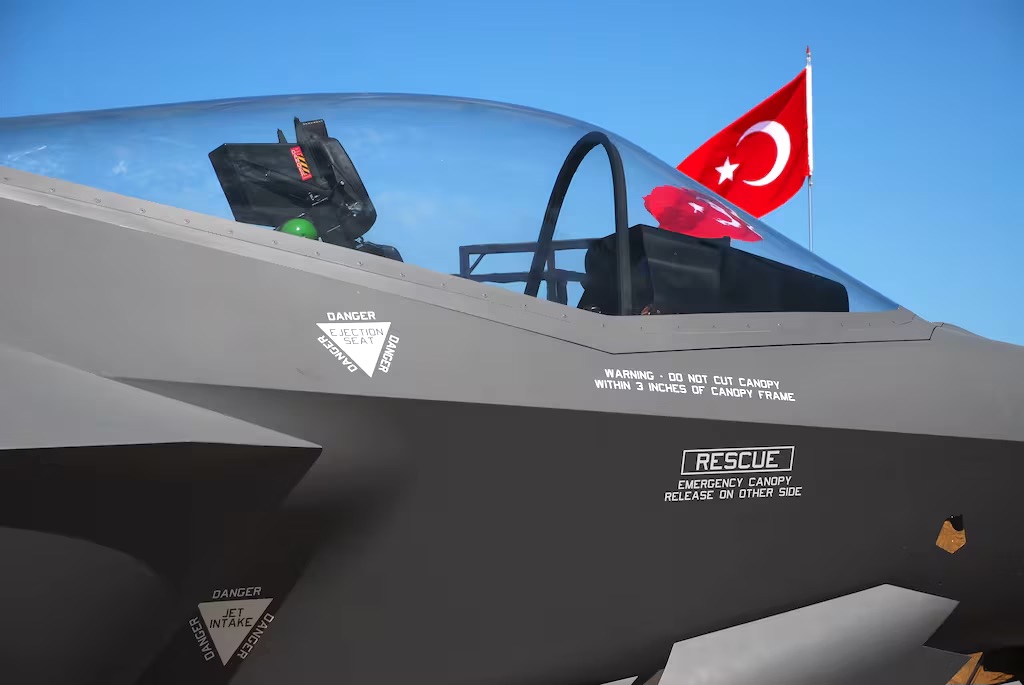

Recent statements by US Vice President JD Vance and US President Donald Trump regarding the potential delivery of F-35 fighter jets, engine procurement, and broader military-technical cooperation with Turkey should not be dismissed as routine diplomatic rhetoric. The core issue here extends far beyond the fate of a single fighter aircraft or an isolated defense contract. Instead, these developments indicate that Washington is compelled to re-evaluate its Turkey policy. This shift is driven not by a newfound affinity for Ankara, but by the relentless pressure of a shifting geopolitical reality.
In this debate, the F-35 serves as the visible tip of the iceberg. The underlying significance runs much deeper, signaling that the United States must once again recognize Turkey’s strategic weight as an independent center of power. This development does not simply imply the opening of a new chapter in bilateral relations; it represents a de facto acknowledgment that the Western security architecture cannot be sustained without Turkey.
The Failure of Containment and the Rise of Strategic Autonomy
Only a few years ago, Washington maintained an uncompromising stance. Following Turkey’s procurement of the Russian-made S-400 air defense system, Ankara was expelled from the F-35 joint strike fighter program, and various sanction mechanisms were triggered. Through these actions, the US intended to demonstrate that independent defense and foreign policy choices would carry severe consequences. By cutting off Turkey’s access to fifth-generation fighter jets and restricting critical military technologies, Washington expected to pull Ankara back into a more manageable, compliant orbit.
However, the geopolitical outcome defied Washington’s calculations. Rather than taking a step back, Turkey accelerated its pursuit of strategic autonomy. Ankara systematically enhanced its domestic defense industrial capacity and expanded its military-political footprint across a vast geography, ranging from the Black Sea to the South Caucasus, and from Syria and Libya to the Eastern Mediterranean and the Turkic world. More importantly, Turkey demonstrated that it could simultaneously remain a vital NATO member while executing an independent, multidirectional regional strategy. Consequently, the policy of exclusion failed to weaken Turkey as Washington had intended; instead, it catalyzed Ankara’s strategic independence.
The renewed signals emanating from Washington should therefore be interpreted not as gestures of goodwill, but as an admission that the previous strategy of coercion has reached its structural limits. Turkey is neither an ordinary arms customer nor a secondary member of NATO. It possesses one of the alliance’s largest standing armies, controls the Turkish Straits, and exerts simultaneous influence across the Black Sea, the South Caucasus, the Middle East, and the Eastern Mediterranean. Furthermore, the country sits at the crossroads of global energy and transport geopolitics. Attempting to exclude, discipline, or distance such a state does not merely isolate Turkey; it actively diminishes the strategic capacity of the West itself.
The New Realism in Turkish-American Relations
Washington now faces an uncomfortable reality: Turkey is no longer a country that can be coerced into alignment through exclusion from Western systems. Over the past decade, Turkey has established a comprehensive defense ecosystem encompassing everything from unmanned aerial vehicles and missile systems to advanced naval platforms and its national combat aircraft, KAAN. As a result, every bilateral crisis with the US serves as a catalyst for greater defense sovereignty rather than a deterrent. The fundamental question is no longer how much Turkey depends on the United States, but rather how much erosion in its ties with Ankara the United States can afford to tolerate.
Therefore, the current thaw between Ankara and Washington should not be viewed through a romantic lens of reconciliation. This is not a matter of the US forgiving Turkey, nor is it about Turkey returning to the Western fold. The current dynamic rests on a colder, harder, and far more realistic foundation, where both parties are beginning to communicate through the pragmatism of power, national interest, and strategic necessity.
In the contemporary international environment, the United States must recognize that Turkey has become indispensable across multiple geopolitical theaters simultaneously. The war in Ukraine has underscored the critical importance of the Black Sea and the Turkish Straits. Concurrently, ongoing crises in Syria, Iraq, the periphery of Iran, and the Eastern Mediterranean have amplified the need for actors capable of projecting military deterrence while executing diplomatic mediation. Turkey occupies this exact niche. Ankara is no longer a reactive actor; it is a power center capable of influencing the direction, velocity, and outcomes of regional crises. This elevates Turkey from a standard ally to a regional and Eurasian power hub.
Geopolitical Implications: The F-35 as a Catalyst
The F-35 issue must be analyzed within this broader context. For Turkey, the F-35 represents more than just a piece of military hardware; it signifies status, technological access, and a defined position within the evolving global security architecture. For the United States, the dilemma centers on whether to reintegrate Turkey into a critical node of the Western defense network. Washington essentially faces two options: it can either establish a more realistic compromise with Turkey to reintegrate it into core defense cooperation, or it can continue its policy of restriction, thereby accelerating Ankara’s shift toward alternative platforms and independent defense models.
If Turkey regains access to the F-35 and American aviation technology, the ramifications will extend far beyond the modernization of the Turkish Air Force. In the Eastern Mediterranean, such a development would significantly strengthen Turkey’s position regarding air superiority, maritime security, energy corridors, and the overall military equilibrium. This scenario presents a delicate challenge for Greece, as the primary issue is not merely Turkey acquiring a technically superior air force, but rather Washington being forced to construct Eastern Mediterranean security by acknowledging Turkey’s central role instead of marginalizing it.
In the South Caucasus, the impact of the F-35 would be strategic and political rather than strictly tactical. Turkey’s reintegration into high-tech defense supply chains would reinforce Ankara’s role as a regional order-settler, bolstering the security axis it has constructed alongside Azerbaijan. This would reaffirm that Turkey is not merely a supportive external actor, but a primary sovereign force shaping the regional balance of power.
In the Middle East, the implications could be even more far-reaching. A deepening of military-technical cooperation between the US and Turkey would signal that Washington once again views Ankara as a primary partner along a critical axis spanning from Syria and Iraq to the Eastern Mediterranean and Iranian containment strategies. Such a shift would enhance not only Turkey’s operational military capacity on the ground but also its diplomatic leverage and regional deterrence.
The S-400 Dilemma and the Path to Compromise
At the heart of this geopolitical equation lies the unresolved S-400 issue, which served as the primary justification for Turkey’s removal from the F-35 program and the subsequent imposition of sanctions. Today, however, the most notable aspect is not the existence of the dispute itself, but the fact that Washington now finds it strategically beneficial to untie this knot. The prolonged impasse no longer weakens Turkey as initially expected; instead, it erodes transatlantic defense ties and drives Turkey toward total self-reliance. Consequently, what was once an American leverage tool has transformed into a strategic liability.
Therefore, a compromise formula regarding the S-400 is theoretically viable, provided it satisfies two core criteria. First, Washington must devise a legal and political framework that can be successfully defended before Congress and the American public. Second, Ankara must preserve its political dignity and strategic agency, meaning the resulting resolution cannot look like a capitulation to external pressure. Any potential compromise will not be a surrender by either side, but rather the product of intense, highly technical, and calculated political bargaining.
Donald Trump’s remarks suggesting he could make decisions that would make President Erdogan “very happy” should be interpreted within this framework. This dialogue likely extends beyond the F-35 jets to include engine procurement, air force modernization, access to American military systems, defense industrial joint ventures, and a comprehensive military-technical normalization package. Should the process move forward, the F-35 will be the most visible, but certainly not the only, component of the arrangement.
Conclusion: The Realignment of the Core
Ultimately, the F-35 issue represents a critical test not just for Ankara, but for Washington as well. The core of this test lies in whether the United States can accept that Turkey is no longer a peripheral ally to be managed, but a geopolitical center in its own right. Turkey can no longer be ignored in the Black Sea, the South Caucasus, the Eastern Mediterranean, or the Middle East.
If the United States takes concrete steps to resume deep military-technical cooperation with Turkey, it will signify much more than a standard defense sale. It will mark the formal conclusion of an era. The period of attempting to force Turkey into alignment is drawing to a close, as is the policy of pushing Ankara to the margins of the Western security system. Turkey is no longer the periphery; it is a center of gravity forcing a redefinition of the core itself. This is the true meaning of the ongoing F-35 debate: Turkey is not returning to grand geopolitics, for it never left. Rather, it is Washington that is being forced to return to reality.