From Estrangement to Military Alliance
The war in Ukraine, which began in February 2022, remains ongoing, with no end in sight. It has already lasted well beyond the four years and three months of fierce fighting in World War I. The prolonged war in Ukraine has brought about major changes in the international order and has also qualitatively transformed the nature of Russia–North Korea relations.
Russia–North Korea relations, which began as a patron-client relationship after World War II, have undergone significant changes over time according to ideological and geopolitical interests. From an ideological alliance during the Cold War, the relationship passed through periods of diplomatic estrangement and pragmatic exploration in the post-Cold War era before developing into an institutionalized military alliance following the outbreak of the Ukraine war. In October 2024, North Korea began deploying large numbers of combat troops to Russia, transforming bilateral relations into what can literally be described as a blood alliance. Russia–North Korea relations are now enjoying their closest period of cooperation in history.
In this regard, experts have focused their attention on the nature and sustainability of Russia–North Korea relations, with their views divided into two contrasting perspectives. One regards the closer relationship between Russia and North Korea as a tactical choice or opportunistic partnership under specific conditions and is skeptical about its sustainability. The other sees structural factors, such as U.S.–China strategic competition, U.S.–Russia confrontation, and the emergence of a multipolar order, as bringing the strategic interests of Russia and North Korea together and strengthening their long-term ties. In other words, this perspective holds that their relationship is not a temporary rapprochement because the two countries have established a legal and institutional framework through a treaty, strengthened their mutually beneficial interdependence, and are cooperating with the postwar international order in mind.
The Changing Nature of Russia–North Korea Cooperation
To objectively identify the actual dynamics and nature of the Russia–North Korea alignment, it is first necessary to examine the form and substance of cooperation between the two countries. Three distinctive features can be observed in their recent cooperation.
First, the hierarchical relationship between the two countries has changed. Unlike the previous pattern, the relationship is no longer a vertical one dominated by the Soviet Union (Russia), in which assistance flowed primarily from Moscow to Pyongyang. Instead, it has become more horizontal as North Korea’s value to Russia has increased. During the Cold War, Moscow took the lead in providing economic and military assistance to Pyongyang. Now, North Korea supplies Russia with military equipment and manpower, and its voice in bilateral relations has become stronger.
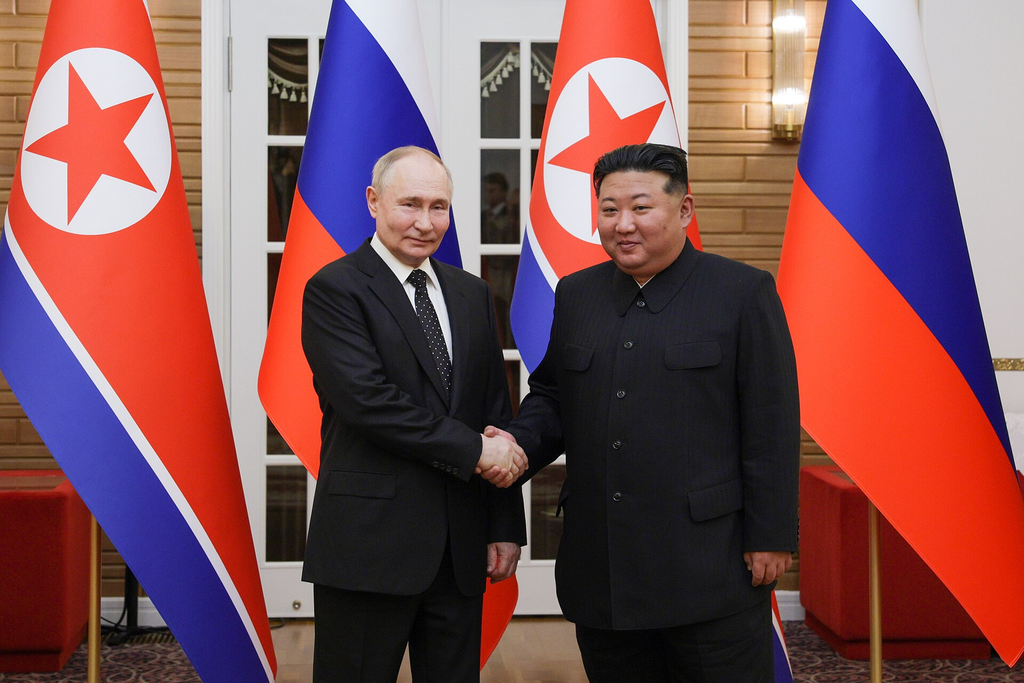
Second, cooperation is based on transactions and practical interests arising from mutual needs. Under various forms of international sanctions imposed by the West, Russia and North Korea have strengthened their cooperation by exchanging areas of comparative advantage in order to evade sanctions or increase their resilience to them. Russia, facing extensive Western sanctions, needed artillery shells and troops, while North Korea, suffering from severe economic difficulties and diplomatic isolation, urgently needed energy, food, and military technology. On the basis of these overlapping interests, Russia and North Korea have undergone an unusually rapid process of rapprochement over the past few years, including three summits in 2023, 2024, and 2025, the signing of the Treaty on Comprehensive Strategic Partnership, the deployment of North Korean troops to Russia, and frequent reciprocal visits by senior officials.
Third, cooperation between Russia and North Korea is asymmetrical and centered on military and security affairs. Although cooperation has visibly increased across political, economic, social, and cultural fields, the central pillar of bilateral relations remains security cooperation, including military technology transfers, arms supplies, and mutual defense under their comprehensive strategic partnership. Compared with the strengthening of military and security relations, economic exchanges remain very limited. This is because the existing trade base between the two countries is narrow, while Russia itself, burdened by the war and Western sanctions, lacks the capacity to provide large-scale economic assistance.
The Driving Forces Behind the Alignment
The fundamental force bringing Russia and North Korea together can be explained as solidarity based on opposition to the West, represented by the United States. The convergence of their perceptions and strategies regarding a new Cold War and a multipolar order, together with their political and economic needs to overcome international isolation and secure friendly partners, has driven their closer relationship.
The particular circumstances of the Ukraine war have further accelerated this process. As the prolonged war has caused Russia substantial losses of personnel and military equipment, Moscow has faced serious military and security difficulties. Under these circumstances, Pyongyang, with various strategic considerations in mind, has actively provided war supplies and troops to Russia, which is in a difficult position, thereby deepening the Russia–North Korea alignment. In this respect, Soviet–North Korean relations during the Cold War and Russia–North Korea relations after the outbreak of the Ukraine war in 2022 share the broad characteristic of strategic alignment against the United States and the West. However, they differ clearly in the leadership of the alliance and the structure of mutual dependence.
Taken together, the above analysis suggests that Russia–North Korea relations are more appropriately characterized not as an ideological blood alliance of the Cold War era, but as a transactional alliance based on the exchange of practical benefits and formed by the external shock of the Ukraine war. Nevertheless, it is difficult to regard the relationship as purely temporary or opportunistic, given that both countries are seeking to institutionalize their ties through treaty commitments and multi-year military cooperation plans amid structural changes in great-power politics and the international order of norms.
Future Prospects for Russia–North Korea Relations
In this respect, future Russia–North Korea relations will be shaped by the interaction between the momentum of institutionalization and the circumstances surrounding the end of the war. Three possible paths can be identified: (1) institutionalized cooperation is maintained and expanded even after the war ends; (2) the scale of cooperation declines, but the framework of the alliance treaty remains in place; and (3) the close relationship rapidly weakens as the exceptional conditions created by the war disappear.
Russia–North Korea relations are likely to remain strong for the time being, but they will probably be influenced by the course of the Ukraine war and changes in the international situation. From the Kremlin’s perspective, an end to the war or a readjustment of relations with the West, including South Korea, could provide an incentive to adjust the intensity of its relationship with North Korea. Overall, Russia–North Korea relations have a strong character as a wartime alliance formed under the particular circumstances of the Ukraine war, and their sustainability and degree of further development will depend largely on two variables: the course of the war and Russia’s relations with the West.
For South Korea, the closer relationship between Moscow and Pyongyang complicates efforts to improve inter-Korean relations. North Korea’s military support for Russia has increased its strategic value to Moscow, giving Pyongyang an additional source of external support. This may reduce North Korea’s incentives to engage with Seoul, particularly as long as its cooperation with Russia continues to bring practical benefits. South Korea’s approach to inter-Korean relations will therefore need to take account of the changing nature of North Korea’s external partnerships, rather than assuming that Pyongyang’s diplomatic choices remain largely dependent on its relations with Seoul and Washington. At the same time, Russia’s closer ties with North Korea do not necessarily mean that Moscow’s interests on the Korean Peninsula will remain unchanged. Russia has maintained diplomatic and economic interests in South Korea, and its priorities could shift if the Ukraine war ends or its relations with the West change. This does not suggest an immediate improvement in South Korea–Russia relations, but it leaves open the possibility of future diplomatic adjustments. For Seoul, maintaining channels of communication with Moscow may remain useful, even as it responds to the security concerns arising from Russia–North Korea military cooperation. The challenge will be to assess the durability of the alignment without overlooking the possibility that the interests of Moscow and Pyongyang may diverge over time.
Wansuk Hong
Professor Emeritus
Hankuk University of Foreign Studies (HUFS)