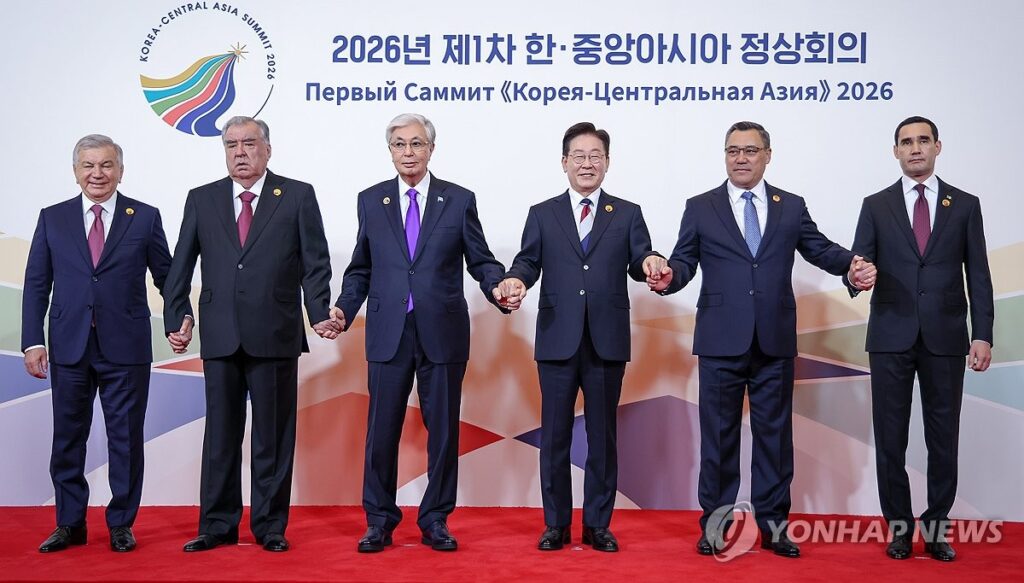

The first South Korea-Central Asia summit in Seoul on September 16 marked an important turning point. President Lee Jae Myung invited the leaders of Kazakhstan, Uzbekistan, Turkmenistan, Tajikistan and Kyrgyzstan to the first meeting of its kind at the leaders’ level. Critical minerals, energy, supply-chain diversification, infrastructure, artificial intelligence, digital industries and connectivity are on the agenda. Seoul also prepared a “Seoul Declaration” outlining a longer-term framework for cooperation.
South Korea’s interest in Central Asia is not a new development. Korean companies entered the region right after the collapse of the Soviet Union. Uzbekistan became an especially important destination since 1992. Afterwards, Seoul successfully expanded its relations with Kazakhstan, Turkmenistan, Kyrgyzstan and Tajikistan. Successive Korean governments introduced different initiatives related to the regional affairs, including the Nordpolitik, New Asia Initiative, the Eurasia Initiative and the New Northern Policy.
As the latest initiative, the K-Silk Road strategy announced in 2024 represented the most comprehensive attempt to bring all efforts together. It aimed to connect Korean technology and industrial capacity with Central Asian resources, infrastructure and markets. Critical minerals became particularly important as Seoul sought to strengthen the resilience of supply chains supporting its advanced industries. But the K-Silk Road is not only a resource strategy because Seoul is not only looking for minerals. It is trying to create a more diversified economic environment around Korean industries.
The country’s experience in Central Asia demonstrates that a middle power can expand its strategic options without turning every economic relationship into a geopolitical contest. Korean engagement can be described as practical cooperation, mutual economic benefits and political independence.
Similarly, Central Asian leaders have increasingly welcomed this type of beneficial relationship. At the same time, Kazakhstan, Uzbekistan and the other regional governments do not want to become dependent on a single external power such as China and Russia. They are actively seeking additional partners in Europe, Asia and the Middle East. South Korea fits this diversification strategy unusually well.
The result is a relationship in which both sides are pursuing diversification for different reasons.
The most important change in Seoul’s approach may be the shift from simple economic cooperation toward supply-chain security. South Korea is particularly exposed to disruptions in the global supply of minerals and industrial inputs. Its dependence on imported resources has made diversification a strategic concern. This is particularly for industries such as semiconductors, batteries, automobiles and advanced manufacturing. This issue became an even more pressing concernafter the closure of the Strait of Hormuz. An earlier and similar example can be found in the 1973 global oil crisis.
The extent of this vulnerability is impressive since semiconductors made up 41 per cent of South Korea’s exports in the first eight months of 2026, semiconductor exports amounting to $281 billion.
That is the reason why Central Asia becomes more important. Kazakhstan and Uzbekistan, specifically, have large amounts of minerals which are becoming more important for advanced industries and both countries are also looking for foreign investment and technology in order to develop their mining and processing sectors. The aim with regard to Seoul is not merely to obtain the resources from Central Asia and send them to Korea. It wants to build partnerships at all stages of the value chain. This approach involves exploration, processing, technology, infrastructure and industrial production.
That approach is consistent with South Korea’s broader economic-security strategy. It is also one reason the critical-minerals agenda has become so prominent in Korea’s Central Asian diplomacy. The United States (U.S.) has been pursuing a similar objective through its C5+1 Critical Minerals Dialogue, which seeks to increase Central Asia’s participation in global critical-mineral supply chains and promote investment and technological cooperation.
There is also a geographic reason why this strategy matters. Central Asia is no longer simply a resource-producing regionlocated between Russia and China. Its position between Europe and Asia has acquired renewed importance as governments and companies look for alternative transportation routes.
The Middle Corridor has therefore become increasingly relevant to Korea’s economic calculations. Better connectivity across Central Asia could give Korean companies additional options for reaching European and regional markets while strengthening commercial links between East Asia, Central Asia and Europe.
South Korea can provide technology, industrial expertise, financing, infrastructure and private-sector investment without demanding that Central Asian governments choose between competing geopolitical camps. That may ultimately prove more valuable than trying to compete with China project by project.
Why Washington Should Pay Attention
There is a broader implication for Washington. The U.S. has spent considerable effort encouraging supply-chain diversification and strengthening its economic engagement with Central Asia. The C5+1 framework has become an important instrument of the U.S. policy toward the region, with Washington explicitly supporting cooperation on trade, investment, critical minerals, transportation and economic resilience.
South Korea’s approach can complement these efforts. Washington does not need and does not want another country attempting to impose a geopolitical bloc on Central Asia. The U.S. seeks reliable partners capable of investing, building infrastructure and developing alternative supply chains. South Korea is well positioned to do exactly this strategy. That makes Korean engagement politically easier for regional governments while also serving broader U.S. interests in the region.
This summit should not be interpreted as merely an elevation of an already existing stage of dialogue but rather an acknowledgment of the inclusion of Central Asia into Seoul’s strategic environment for the long run, due to the simple fact that it requires a network. Such a network could include safe supply chains, energy partnership, infrastructure development projects, technology and political contacts, everything which has been missing in Seoul’s strategic room for maneuvering throughout Eurasia.