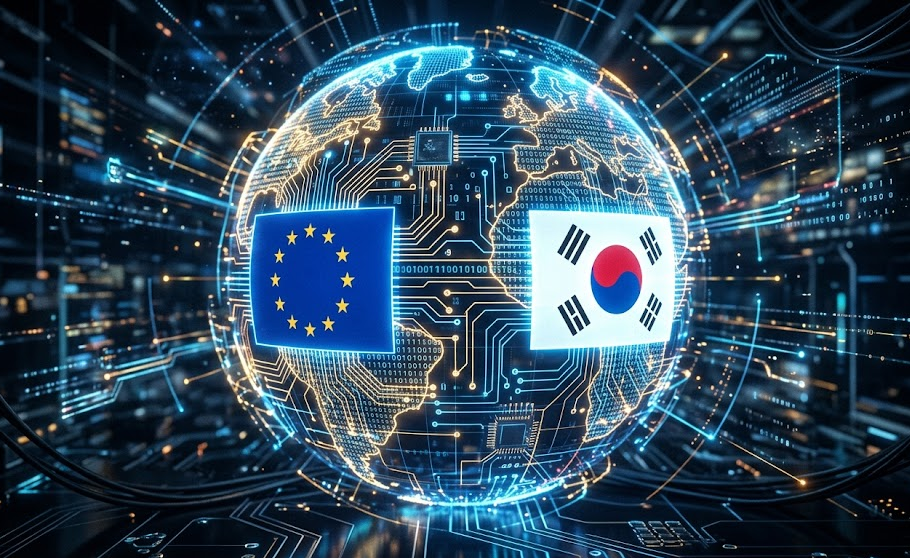

Introduction: The Geopolitics of Digital Regulation
The politics of digital regulation has become one of the clearest examples of how economics, technology, and geopolitics now overlap. What might once have looked like a technical debate over competition law, online safety, or artificial intelligence (AI) has increasingly turned into a question of power: who sets the rules for the digital economy, whose firms bear the greatest regulatory burdens, and how allies manage disagreement when regulation collides with market dominance. This is especially visible in the triangular relationship between the European Union, South Korea, and the United States. The EU has moved furthest in constructing an ambitious regulatory architecture for the digital sphere, while Korea has begun to develop a more systematic framework of its own. In both cases, however, many of the firms most affected are American. As a result, digital regulation is no longer only a domestic governance issue. It has become a matter of trade diplomacy, strategic trust, and alliance management.
The EU and South Korea are gradually converging on the idea that stronger public oversight of digital markets and AI is necessary, even if such oversight often falls most heavily on U.S.-based technology firms. At the same time, this convergence should not be overstated. The EU’s approach is more comprehensive, more legalistic, and more openly linked to ideas such as fundamental rights, fairness, and digital sovereignty. Korea’s approach is more cautious and more hybrid. It combines concerns about trust and safety with industrial policy, innovation promotion, and sensitivity to trade repercussions. Precisely because the two sides are similar but not identical, there is a strong need for EU- Korea cooperation. Without closer coordination, both may find themselves regulating the same global firms for related reasons while producing fragmented standards, duplicated compliance costs, and unnecessary friction with Washington.
The European Union: From Self-Regulation to Digital Sovereignty
The EU position is now relatively clear. Over the last several years, Brussels has tried to move beyond the older assumption that digital markets are best left to self-regulation or ex post antitrust enforcement. The Digital Services Act (DSA) introduced a new framework for online intermediaries and platforms, especially very large platforms and search engines, with the stated aim of making the online environment safer and more trustworthy. The Digital Markets Act (DMA), in turn, targets socalled gatekeepers, that is, major digital firms able to act as bottlenecks between business users and consumers. In parallel, the EU’s AI Act established a risk-based approach to AI governance and is described by the European Commission as the first comprehensive legal framework for AI. Taken together, these measures show that the EU no longer sees digital regulation as a marginal supplement to the market. It sees it as part of the constitutional order of the digital single market.
It would be too simple, however, to say that the EU is merely “anti-Big Tech.” A more accurate interpretation is that the EU has concluded that concentrated digital markets create structural asymmetries that ordinary competition law is too slow to correct. The DSA and DMA are therefore not only instruments of consumer protection; they are tools of public authority. The EU explicitly presents the DSA and DMA as measures to protect fundamental rights online and to create a fairer environment for businesses. Likewise, the AI Act is framed not as a rejection of AI innovation, but as an attempt to shape trustworthy adoption. In other words, the EU position is not simply punitive. It is regulatory in a much broader and more self-confident sense.
U.S. Critiques of EU Policy
This is exactly where the United States enters the picture. Because many of the firms designated or scrutinized under these frameworks are American, U.S. officials and business actors have often interpreted EU digital regulation as disproportionately targeting U.S. companies. The 2026 USTR National Trade Estimate treats the DSA and DMA as significant measures affecting large digital service suppliers and highlights enforcement activity involving U.S. firms.
Although the U.S. critique does not necessarily mean the EU rules are illegitimate, it does show that Washington increasingly reads digital regulation through the language of trade barriers and discriminatory effects. This is politically important because it transforms what the EU often presents as neutral rule-making into an issue of transatlantic commercial contestation.
South Korea’s Hybrid Approach: Balancing Innovation and Alliance Management
South Korea occupies a more complicated position. On one hand, it shares with the EU a growing awareness that digital markets cannot simply be left to dominant private actors. Korea has also tried to strengthen platform oversight, data governance, and AI policy, and it has explicitly moved toward a legal framework that combines promotion of AI development with a foundation for safety and trust. The Ministry of Science and ICT stated in its 2025 work plan that, following enactment of the AI Framework Act in December 2024, the government would prepare subordinate regulations to balance innovation and safety, including standards for high-impact AI and deepfake-related measures. Official Korean materials also describe the AI Basic Act as promoting the AI industry while establishing a foundation for safety and trust before its January 2026 enforcement. OECD reporting similarly notes that Korea’s AI Basic Act was approved in January 2025 and would be enforced from January 2026, while emphasizing principles such as transparency, explainability, safety, and reliability.
On the other hand, Korea’s regulatory logic is not identical to the EU’s. Seoul has been much more careful not to appear hostile to innovation, and it remains more exposed than Brussels to security and trade pressure from the United States. In fact, U.S. concerns about Korea’s digital policy environment have become increasingly explicit. The 2026 USTR report notes that, under a November 2025 U.S.–Korea joint fact sheet, Korea committed to ensuring that U.S. companies are not discriminated against and do not face unnecessary barriers in laws and policies concerning digital services. The same report also raises concerns about barriers affecting foreign cloud service providers in Korea’s public sector. On 23 April 2026, Reuters reported that Seoul again assured U.S. lawmakers that American technology firms would not face discriminatory treatment. These developments suggest that, unlike the EU, Korea must regulate in a narrower political space. It is trying to show that stronger oversight of digital markets is compatible with alliance management and open trade.
For that reason, it would be misleading to portray Korea as simply following the European model. Korea has its own reasons for digital regulation: concern about platform fairness, national technological competitiveness, data governance, public safety, and long-term industrial positioning in AI. Yet it must pursue these objectives while reassuring Washington that regulatory activism is not disguised discrimination. This creates a tension that the EU also knows, but in a less acute form. Brussels is more willing to absorb U.S. criticism because digital sovereignty has become central to its policy vocabulary. Seoul appears more cautious, and at times more defensive, because its strategic dependence on the United States remains deeper and more immediate.
Strategic Alignment: Core Areas for EU-Korea Digital Cooperation
This is precisely why EU – Korea cooperation matters. If one looks only at national legal measures, the differences between Brussels and Seoul are obvious. But if one looks at the broader strategic environment, their common interests become clearer. Both want the digital economy to remain open without being ungoverned. Both are uneasy with excessive dependence on a handful of dominant foreign platforms. Both need AI governance that encourages innovation while maintaining public trust. And both increasingly understand that digital governance is tied not only to economic competitiveness, but also to resilience and economic security. The joint statement of the third EU – Korea Digital Partnership Council in November 2025 explicitly described the Digital Partnership as central to cooperation in emerging digital technologies, competitiveness, innovation, resilience, research, and economic security. That language is important because it shows that the bilateral relationship has already moved beyond symbolic dialogue.
The most obvious area for cooperation is regulatory interoperability. The EU and Korea do not need identical laws, but they do need compatible principles. If they regulate platforms, AI systems, data transfers, or cloud services using completely different concepts and compliance methods, they may weaken their own leverage and increase business uncertainty. Interoperability does not mean uniformity. It means building enough institutional dialogue so that rules developed in one jurisdiction do not become opaque or contradictory in the other. This is especially important in sectors where firms operate across both markets and where overregulation by accumulation can become a real problem. A fragmented regulatory landscape would not necessarily strengthen autonomy; it could simply increase confusion.
A second area is digital trade and data governance. Here, the March 2025 conclusion of negotiations on the EU – Korea Digital Trade Agreement is especially significant. According to the European Commission, the agreement covers cross-border data flows, privacy and personal data protection, electronic contracts, trust services, source code protection, online consumer trust, open government data, and regulatory cooperation on digital trade. This matters because it provides a concrete institutional basis for balancing openness with regulation. In other words, the EU and Korea are not forced to choose between digital trade and digital governance. They are attempting to design a framework in which both can coexist. That may become increasingly valuable if U.S. concerns about discriminatory regulation continue to grow.
A third area is AI governance. The EU has moved first and more forcefully, but Korea’s recent legislation shows that it also wants a governance framework that combines trust with industrial development. That creates an opportunity for policy learning in both directions. Korea can learn from the EU’s experience in building legal clarity and institutional oversight, while the EU can learn from Korea’s stronger sensitivity to deployment, industrial scaling, and implementation realities. In that sense, cooperation should not be reduced to rule export from Brussels to Seoul. It should be a twoway process. The risk, otherwise, is that the EU offers a highly formal model while Korea offers a more pragmatic one, and neither side fully translates its strengths into a shared approach.
Finally, EU – Korea cooperation is necessary because both sides need a way to manage the U.S. dimension more intelligently. Neither Brussels nor Seoul benefits from framing digital regulation as an anti-American front. That would be strategically clumsy and politically counterproductive. But neither can afford to let U.S. sensitivity determine the outer limits of domestic regulatory ambition. The challenge, then, is to cooperate in a way that makes their regulatory choices more transparent, less arbitrary, and easier to defend in international economic terms. If the EU and Korea can coordinate their language around fairness, trust, safety, interoperability, and due process, they may reduce the likelihood that every regulatory action is immediately interpreted as protectionism.
Conclusion: Building a Coherent Model for Digital Governance
The EU and Korea are not identical digital regulators, but they are moving in the same general direction. Both now accept a stronger role for the state in shaping digital markets and AI governance. Both face the structural reality that many of the firms most affected are American. And both must therefore navigate the difficult boundary between legitimate regulation and the perception of discrimination. The EU has approached this challenge through an expansive rights-based and sovereignty-conscious framework. Korea has pursued a narrower and more cautious path shaped by innovation concerns and alliance sensitivity.
Yet these differences do not weaken the case for cooperation. They strengthen it. If Brussels and Seoul fail to coordinate, they risk becoming parallel regulators with overlapping objectives but fragmented outcomes. If they do cooperate, they may help build a more coherent model of digital governance that is neither deregulatory nor protectionist, but strategically balanced and institutionally credible.