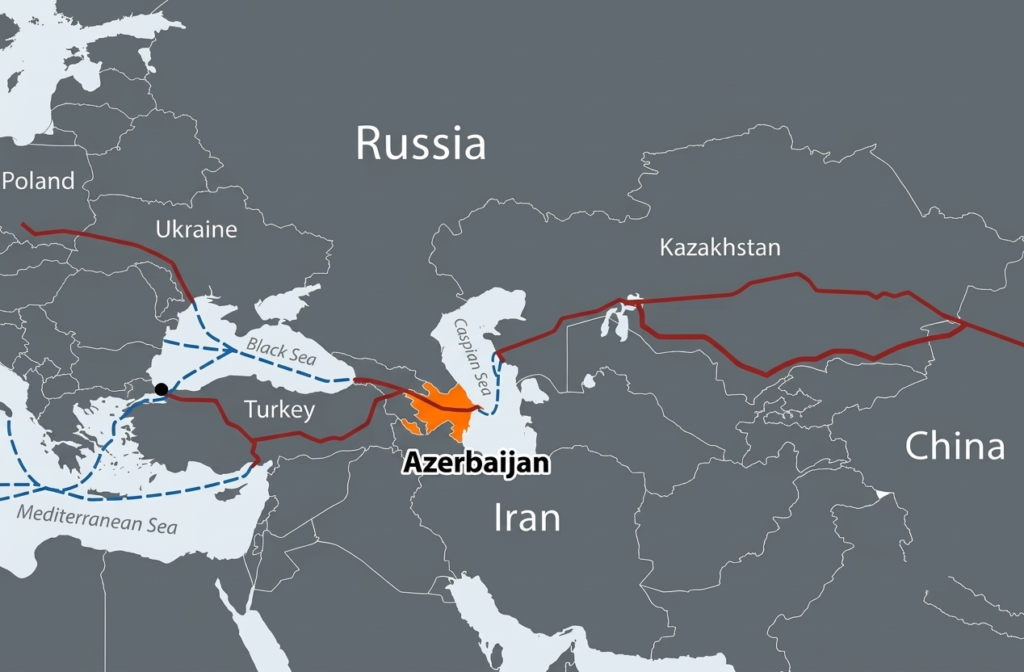
In late September 2026, the World Bank revealed its flagship Integration: High-Grade Trade Logistics along the Trans-Caspian Transport Route report, providing a strategic roadmap to transform the Middle Corridor (TITR) from a simple transit route into a fully integrated economic corridor.
The report provides an in-depth analysis of the route’s cargo capacity, required investments, and the macroeconomic benefits, focusing mostly on the countries alongside the corridor. The initial assessment of the report suggests that strategic investments in the emerging Middle Corridor, could more than triple trade volumes along the route, halve travel times, boost GDP by 3.3%, and create 2 million more jobs by 2040. Moreover, the sustainable development of the corridor will ease the solution of bottleneck problem, improve supply chain reliability, and widen market access in countries like Armenia, Azerbaijan, Georgia, Kazakhstan, Turkmenistan, and Uzbekistan.
In this regard, the report positively evaluates the current infrastructure work in Azerbaijan, including efforts to increase annual freight volumes and expand the railway network across the country. Hence, the country’s railway network reaches a total length of 2.1 thousand kilometers, while the annual volume of freight transportation amounts to approximately 18.5 million tons. Nevertheless, the new report recommends transitioning to a tariff formation model based on actual cost-to-serve, which will ensure greater transparency for international freight forwarders.
As such, Azerbaijan apprehends that the continuous flow of investments for the construction of additional infrastructure is of particular importance to boost the importance of the Middle Corridor route. It is noteworthy that in the near term, the main obstacle to the development of the Middle Corridor will not be the lack of infrastructure capacity, but rather the low service quality typical of state-owned transport enterprises (SOEs) and institutional barriers. Therefore, the World Bank proposes establishing a joint non‑asset company among the largest state transport enterprises of Azerbaijan, Georgia, Kazakhstan, and Türkiye to take on the coordination of container shipments along the Middle Corridor in order to streamline operations, enhance efficiency, and strengthen regional cooperation in multimodal freight transport.
In the context of attracting additional investments, Azerbaijan hosted International Investment Forum in Baku on September 26. The groundbreaking event brought together government officials from multiple countries, global investors, and representatives of international financial institutions. Beyond showcasing Azerbaijan’s determination to attract greater foreign investment into strategically vital sectors, particularly transport and energy, the high‑level business forum underscored the importance of financial sustainability and regulatory reforms to enable state‑owned rail, port, and shipping enterprises to operate on a more commercial basis.
As a result, Azerbaijan signed agreements representing more than $10 billion in potential investment during the event, particularly in energy field. Since energy has long been Azerbaijan’s most effective tool for boosting its soft power influence in the region and beyond, State Oil Company (SOCAR), France’s TotalEnergies and Abu Dhabi’s XRG reached a final investment decision on the full-field development of the Absheron gas and condensate field. Amid the ongoing energy crisis in light of the Hormuz crisis and disruption of supply chain, Azerbaijan eyes strengthening position as a “middle power” by increasing volumes of additional natural gas to Europe. In this vein, Absheron gas field will increase Azerbaijan’s gas production by around 5 billion cubic metres within three to four years.
On the same day, SOCAR inked a Production Sharing Agreement with ExxonMobil for the exploration, development and production of unconventional hydrocarbon resources in Middle Kura Basin, marking a significant step in attracting international expertise and investment into Azerbaijan’s unconventional energy resources. In addition, a separate agreement was signed with Apollo to evaluate and structure potential investments in SOCAR’s upstream development and production projects with the aim of attracting international capital into its upstream portfolio.
Azerbaijan’s commitment to strengthening regional connectivity, expanding interregional trade along the Middle Corridor, diversifying economy, advancing the green energy transition, and increasing natural gas exports reflects the country’s pragmatic foreign policy approach. This pragmatism has enabled Azerbaijan to safeguard its core national interests while diversifying its economy and fostering the development of the non-oil sector amid an increasingly volatile global security environment. Reflecting this progress, President Ilham Aliyev noted that the non-oil sector accounted for 72% of GDP in 2025, while real non-oil GDP growth has averaged 5% annually since 2020.
The growing interest among European countries in alternative trade routes and access to critical infrastructure, particularly rail and maritime networks, is likely to persist as traditional transport corridors are unlikely to return to their pre-war trade volumes in the foreseeable future. Hence, the Middle Corridor appears to be the most viable route for the transit of containers and energy resources, particularly in the case of Kazakhstan. Since 2022, the corridor traversing the Caspian Basin has served as a reliable alternative for transporting Kazakh oil to European markets, helping to mitigate the security risks associated with the Russia-Ukraine war.
However, sustaining long-term gains in competitiveness, freight volumes, and economic impact will require not only continued infrastructure development but also enhanced corridor performance, more efficient transport services, and comprehensive institutional reforms across participating countries. Therefore, Azerbaijan’s ambitions in hosting high-level investment forums to attract additional money to the development of trade route and network of infrastructure, particularly energy, seems very rational.
Aybaniz Ismayilova
She is a strategic advisor working at the intersection of international cooperation, regional connectivity, sustainable infrastructure and corporate affairs. Her policy and analytical work focuses on the Middle Corridor, Caspian–Black Sea connectivity, sustainable infrastructure, ESG and regional economic cooperation. She is particularly interested in how transport corridors, ports, investment and cross-border partnerships are reshaping connectivity between Central Asia, the South Caucasus, the Black Sea and Europe. She is a graduate of the Strategic Chief Sustainability Officer Program at Stanford Graduate School of Business and holds a postgraduate degree from the University of Manchester.