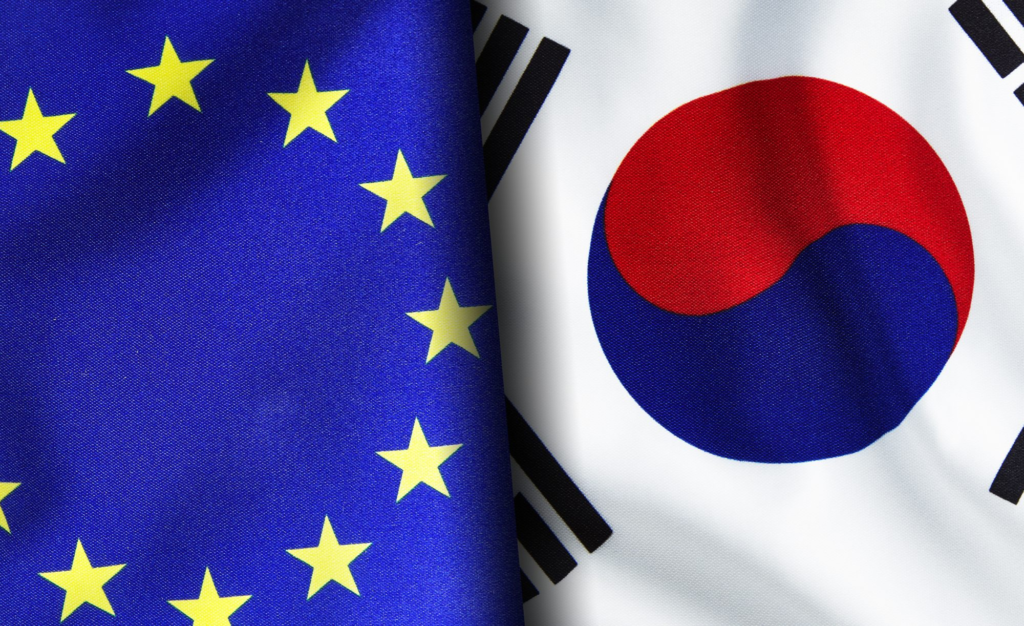

In a globalized world with ever-increasing economic interdependence, economic ties have rapidly become yet another tool for states to further their agendas. They have become a source of geopolitical leverage, with states increasingly using trade, investment and access to critical goods and technologies as tools for coercion, forcing governments to not only consider economic efficiency but also economic security. As such, economic security has become a major concern of international politics, creating new challenges that states must relate to. Critical minerals, semiconductors, batteries and digital infrastructure are evolving to become strategic assets, no longer being simple commercial goods. Disruptions to these assets can possibly have significant consequences for national economies and consequently political autonomy.
In the case of South Korea and the European Union, both of which are highly reliant on trade, advanced technology and stable global supply chains, a shift like this presents a challenge that must be overcome. By what methods can a state reduce its dangerous dependencies without fully undermining the openness that leveraged their economies to great success in the first place?
This changing security environment, shaped by growing economic interdependence, has pushed South Korea-EU cooperation to new heights, including areas like digital technology, semiconductors, supply-chain resilience and more. By diversifying the suppliers and promoting coordination around standards while simultaneously combining each actor’s strengths Korea and the EU can reduce their vulnerability to coercion or external shocks, something which both actors recognize. Yet growing cooperation is not without challenges, as important questions about geopolitical retaliation, policy coordination and the future of the open international economy are raised.
However, challenges such as these, should not become an excuse for protectionism. On the contrary, they demonstrate why even further cooperation is necessary among likeminded partners. Responding to geopolitical uncertainty through unilateral protectionist measures might offer short-term domestic political reassurance, it comes at the expense of benefits such as competitiveness and resilience gained from having diversified markets and supply chains. Korea-EU cooperation lets both sides share technological expertise, improve and coordinate on common agreed standards, strengthen supply-chain resilience and reduce strategic dependencies. Although closer cooperation in economic security creates challenges, these are best managed through partnership rather than through isolation.
Delving deeper into the opportunities presented by growing Korea-EU cooperation in economic security, one of the strongest opportunities lies in the strengthening of supply-chain resilience. Growing geopolitical tensions in the last decade have exposed vulnerabilities of highly concentrated supply chains, particularly in strategically important industries. This shows how a dependence on a very limited number of suppliers can become a liability both economically and security-wise. With both South Korea and the EU heavily relying on advanced manufacturing and trade, reducing these vulnerabilities have become central for their economic security. By diversifying production networks across trusted partnerships, thus spreading out the risk, resilience will become stronger, as it is dependent on reliable networks that can absorb disruptions without collapsing.
Another opportunity comes in the strengthening of technological competitiveness. Not only is the access to critical goods important, but the capacity to develop and apply advanced technologies is crucial for economic security. Without it a state is bound to become more reliant on other states which as mentioned earlier can have negative consequences. By expanding joint research programmes and having greater collaboration between universities and the private sector as well as coordinated investments into emerging technologies, South Korea and the EU can pool expertise and resources to maintain a competitive edge in the technologies of the future.
This cooperation is already producing results. In 2024, the EU and South Korea announced the “Joint EU/Republic of Korea Chips Projects” which are four jointly funded semiconductor research projects under the EU-Republic of Korea Digital Partnership, which shows how this cooperation is not merely some political commitment but rather a working technological collaboration. A further positive opportunity that comes from growing cooperation and stands side by side with technological competitiveness is that it also makes innovation more resilient, as access to a wider pool of talent, capital and specialists increases. This is important because the dream of true technological self-sufficiency is both costly and unrealistic in today’s world. Even the most advanced economies are highly reliant on international cooperative networks among researchers, suppliers and manufacturers.
The final opportunity that I would like to highlight, is that the growing cooperation between South Korea and the EU concerning economic security serves to bolster and defend the rules-based international economy during a time where economic ties are used as tools for political pressure. As both the EU and South Korea rely on international trade it is in their shared interest to maintain a stable system that can withstand economic coercion. Acting together gives South Korea and the EU greater influence than either would have alone.
Despite the opportunities that closer Korea-EU cooperation brings, it is not without risks. One of the most direct challenges is the risk of geopolitical retaliation from third countries, such as China. As cooperation among like-minded partners can be seen as an attempt to exclude or contain strategic competitors, this leads the risk of economic coercion through trade restrictions, tariffs or certain markets becoming off-limits. One example of when this risk became reality was during the THAAD controversy in 2017, when China introduced restrictions on tourism, consumer related goods and Korean firms, which shows how interdependence can be weaponized for political purposes. Thus, a closer cooperation between Korea and the EU could provoke similar forms of retaliation. Nevertheless, it is precisely due to this risk that the case for closer cooperation is so strong. As diversifying markets reduces excessive dependence on any single partner, Korea and the EU become better equipped to stand against external pressure than they would have alone.
Another risk concerns cooperation in general, but that can introduce challenging consequences would be diverging strategic priorities. Previously throughout the text, the word “like-minded” has been used, however this does not mean identical. Like-minded countries might agree on some things and disagree on others, might prioritize similarly in some cases but differently in others. While South Korea and the EU share democratic values and are supportive of an open international economy, their security environments are very different. As a result, moving from these shared principles into coordinated policy is difficult. For instance, the EU’s immediate security environment has in recent years been strongly affected by Russia’s invasion of Ukraine, whereas South Korea faces the more direct threat of North Korea and an economy that is more exposed to China than that of many EU member states, which certainly means that priorities will be diverging. This means that closer cooperation will be challenging, but the important thing to remember is that this does not mean that it is impossible. There are simply hurdles along the way to clear.
As we see economic interdependence becoming more and more inseparable from national security, the growing cooperation between South Korea and the EU is a prime example of how the international economy is transforming. As this cooperation grows, opportunities to strengthen supply-chain resilience, technological competitiveness and continued support for the rules-based international order flourish. However, at the same time it exposes both partners to risks of geopolitical retaliation, as well as more practical difficulties of coordinating policies across different strategic priorities. While it is important to acknowledge these risks, they are not insurmountable. Rather, than turning their backs on cooperation, South Korea and the EU should focus on how they can manage these challenges. Through continued dialogue, coordination and diversification. In so doing, they will be better prepared to improve their economic security, one that is more resilient, cooperative and that will withstand an increasingly uncertain geopolitical environment.