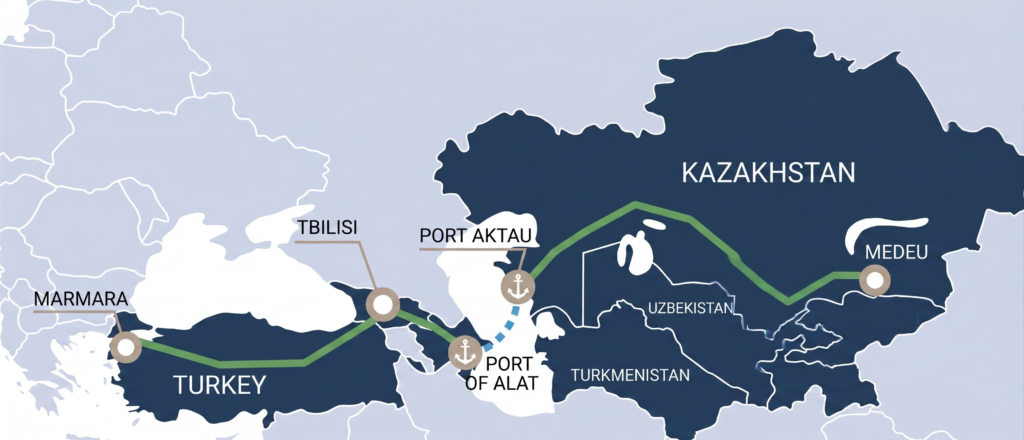

Global supply chains have been undergoing significant restructuring for several years. In 2020–2021, the COVID-19 pandemic demonstrated the fragility of the existing system, exposing dependence on narrow production and logistics corridors. The Russian invasion of Ukraine added political constraints and the risk of sanctions, forcing companies and governments to rethink routes and partners. In 2024–2025, heightened tensions in the Persian Gulf have underscored that even traditional maritime routes do not guarantee stability.
Today, this process has become structural and, to a large extent, irreversible. Energy security, political risk, and technological competition increasingly determine where goods are produced and how they move. Within this evolving geography, Central Asia has gained renewed strategic relevance. Landlocked but connected in every direction, the region has turned from a remote buffer zone into a place where major trade corridors intersect. New rail links, ports on the Caspian, and foreign partnerships are building a platform for growth. Yet the deeper question is whether the region can match these physical upgrades with the governance capacity and policy coherence that modern supply networks demand. Progress here will define whether Central Asia becomes an active stakeholder or remains simply another route between other powers.
Global Context: Fragmentation and Realignment
The global trading system no longer functions as a single network. The United States and its allies are pursuing “friend‑shoring” strategies, choosing political reliability over minimum cost. Meanwhile, China continues to diversify the Belt and Road routes to reduce exposure to conflict zones and sanctions. The European Union, through its Global Gateway program, is channeling large‑scale investment into safer Eurasian connections that bypass Russia.
Amid this shift, analysis by the Asian Development Bank indicates Central Asia’s gradual integration into global value chains and its potential to move toward higher value-added activities. Economic transformation in Central Asia is increasingly visible in both sectoral data and regional connectivity patterns.
According to the Asian Development Bank, growth in the region has been supported by expanding industrial activity, infrastructure investment, and stronger integration into regional trade networks. Kazakhstan and Uzbekistan are attracting assembly and processing projects, although their export structures remain largely resource-based. However, despite these shifts, economies remain significantly dependent on resource sectors, and structural transformation is still ongoing.
At a technological level, digital logistics platforms and satellite tracking have improved efficiency at border crossings and reduced processing times. These are tangible improvements. However, as highlighted in a study by the Institute for Advanced International Studies, geopolitical disruptions have exposed the vulnerability of traditional transit routes in Eurasia, forcing Central Asian countries to rethink their trade and logistics strategies.
What remains fragile is policy consistency. Differing tax rules, tariff systems, and border procedures continue to create significant trade frictions. Infrastructure alone will not overcome such challenges; institutional coordination is the indispensable next step if the region hopes to capture more value from global trade. This tension between expanding connectivity and limited policy coordination is clearly illustrated by the development of the Trans-Caspian corridor.
The Trans Caspian International Transport Route (TITR) is a good test of the region’s maturity. Stretching from China through Kazakhstan and the South Caucasus to Turkey, it provides an alternative to sanctioned or unstable corridors to the north and south. The European Commission has committed roughly €10 billion under the Global Gateway initiative to modernize railways, ports, and digital systems. If implemented effectively, TITR could significantly boost economic growth across participating countries. However, implementation remains uneven. According to various estimates and industry analyses, freight costs along this route are still considerably higher than through established northern corridors, largely because each country maintains separate tariffs and customs procedures.
This creates what is often described as a coordination problem: the corridor is physically continuous but institutionally fragmented. In short, TITR’s future lies less in building rails and ports than in aligning data standards, customs automation, and pricing policies. A corridor that functions as a regulatory alliance could reshape Eurasian trade. Without that, TITR risks becoming a costly symbol of missed potential. Beyond transit, however, the region’s growing strategic importance is also tied to its resource base and its role in emerging industrial supply chains. In this context, Kazakhstan has become a key partner for Western economies.
Kazakhstan and Western Critical Raw Material Partnerships
Kazakhstan now plays a central role in the West’s long-term energy transition. The country holds around 18 percent of global uranium reserves, along with significant titanium and rare earth deposits and emerging lithium potential. Through initiatives such as the EU–Kazakhstan Critical Raw Materials Roadmap (2025–2035) and the Minerals Security Partnership, supported by the U.S. Department of State, foreign investment and technology transfer are expanding.
This integration is both an advantage and a constraint. Western partners bring capital and ESG standards that improve environmental and safety performance, yet these same frameworks can limit Kazakhstan’s autonomy over production rules. As noted in recent analysis by the Pulaski Foundation, control over traceability standards increasingly determines control over value chains.
As discussed in analysis published by the Yorktown Institute (author’s analysis), Kazakhstan’s key challenge is to move beyond extraction by developing refining capacity and local research partnerships. If successful, the country could significantly expand its role in supplying processed materials to European markets. If not, it risks remaining a well-regulated supplier rather than a co-author of global standards. Kazakhstan’s trajectory reflects broader structural dynamics across Central Asia, where the ability to move up the value chain increasingly depends on institutional coordination and external alignment. These regional dynamics can be illustrated through several forward-looking scenarios to 2035.
Regional Scenarios: Outlook to 2035
Economic prospects for Central Asia depend on how far institutional integration can advance relative to global political competition. To better illustrate how varying degrees of institutional integration and strategic alignment may shape future outcomes, three forward-looking scenarios for the period up to 2035 are outlined below.
Table 1. Development scenarios for Central Asia (2026–2035)
| Scenario | Core Dynamics | Probability | Expected Economic Impact |
| Strategic Integration | Coordinated TITR governance, unified tariffs, shared data systems, Western and Chinese investment both anchored under transparent rules. | ~40 % | 5-6 percent annual growth; region becomes a mid‑tier industrial and logistics hub. |
| Controlled Duality | Multi‑vector diplomacy managed pragmatically; partial harmonization without political union. | ~45 % | 3-4 percent growth; steady modernization and risk diversification. |
| Fragmented Rivalry | Corridor competition, re‑emerging external dependence, and inconsistent domestic regulation. | ~15 % | Below 2 percent growth; efficiency losses and declining investor confidence. |
As shown in Table 1, the region’s economic trajectory is primarily determined by the level of institutional coordination rather than the volume of external investment alone. While all scenarios assume continued engagement from major external actors, their economic outcomes diverge significantly depending on the degree of policy harmonization, regulatory alignment, and corridor governance.
The “Controlled Duality” scenario appears the most probable, reflecting the region’s current preference for multi-vector diplomacy combined with limited institutional integration. However, this path delivers only moderate economic gains and does not fully resolve structural inefficiencies.
By contrast, the “Strategic Integration” scenario, although less certain, offers substantially higher growth potential by transforming Central Asia into a coordinated industrial and logistics hub. This comparison highlights a fundamental trade-off between political flexibility and economic efficiency. Without deeper regional coordination, infrastructure investments and external partnerships alone are unlikely to generate sustained, high-level growth.
Conclusion
The current transformation of world trade has given Central Asia a rare opening. It can either remain a route passively linking others or evolve into a platform actively shaping how Eurasia connects. Achieving the latter will require the region’s governments to treat policy harmonization as a shared strategic asset rather than a theoretical goal.
Physical infrastructure has never been more advanced; what is missing is a stronger layer of governance. Digitalizing customs, aligning tariffs, and committing to clear environmental and investment rules would lock Central Asia into global growth for decades. If neglected, these same gaps will keep it exposed to external volatility. In today’s segmented global economy, governance is the new geography. Whoever manages interoperability, manages influence. For Central Asia, the lesson is clear: the region’s future depends on how well it governs the corridors that the world now needs.