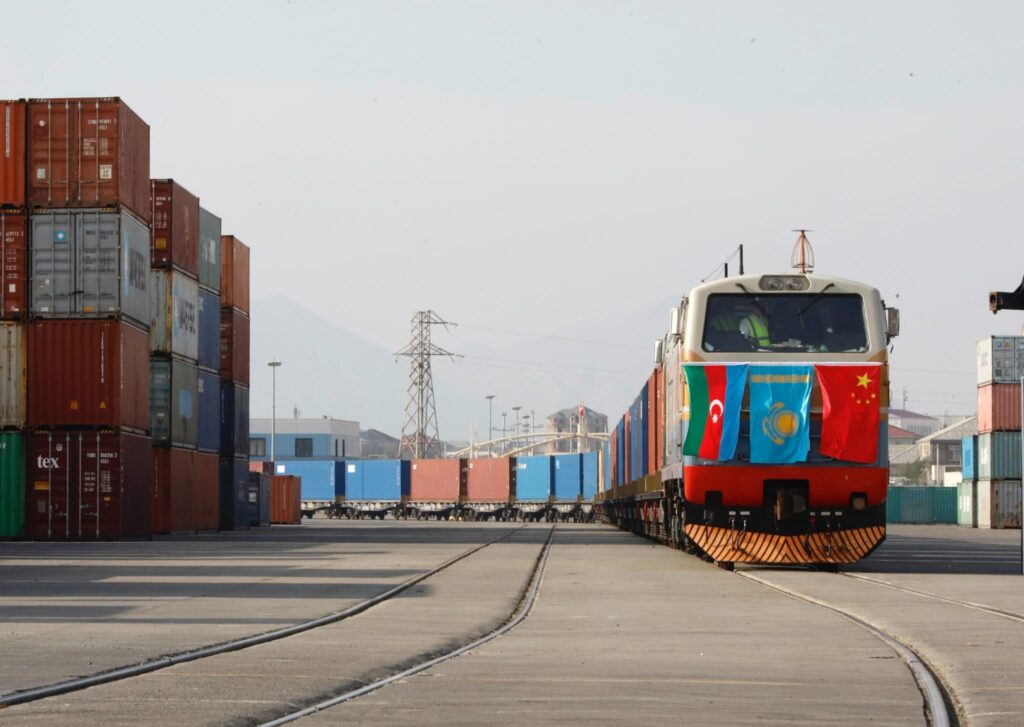
Global competition for resilient supply chains and reliable transit routes is intensifying, increasing the strategic importance of alternative trade corridors. In this context, the Middle Corridor has re‑emerged as a key overland route linking China to Europe through Central Asia, the Caspian Sea, the South Caucasus, and onward via Türkiye.
Azerbaijan occupies a central position along this route, supported by major infrastructure including the Baku–Tbilisi–Kars (BTK) railway and the Port of Baku. This well‑integrated network strengthens the country’s role in East–West connectivity while also supporting growing transit flows across the North–South axis, reinforcing Azerbaijan’s position in Eurasian trade and logistics.
Azerbaijan strategic geographical position and well-developed transport infrastructure have contributed to record freight volumes across its major transport corridors. For example, in the first eight months of 2026, Azerbaijan Railways (ADY) recorded a 12 percent increase in transit cargo, while cargo volume along the East-West corridor rose by 17 percent to reach 2.8 million tons. Meanwhile, traffic along the North–South corridor totaled 2.378 million tons in the first seven months of the year, marking a 16 percent year-on-year increase.
The expansion of Azerbaijan’s transit role is not limited to the East–West corridor. On the North–South axis, the Astara Terminal, located on Iranian territory, has become an important transshipment point linking the Azerbaijani and Iranian rail networks. The terminal handled more than 477,000 tons of cargo in the first seven months of 2026, up 24 percent year-on-year. Once completed, the terminal is expected to further strengthen capacity along the North–South corridor. Port of Baku also recorded growth in 2026: cargo throughput for January-July reached 4.819 million tons, up 3 percent year-on-year.
The development of multimodal transport infrastructure holds particular strategic importance, as the effectiveness of the Middle Corridor increasingly depends not only on physical capacity but also on digital integration, faster customs clearance, efficient permitting, transparent cargo tracking, and seamless data exchange among participating countries. International experience from Europe and the Asia Pacific demonstrates that competitive cross-border transport increasingly depends on multimodal integration and interoperable digital systems. Azerbaijan and Kazakhstan, two key states along the Trans-Caspian section of the route, have therefore placed digitalization at the center of corridor development, including the gradual deployment of artificial intelligence (AI) tools.
The digital transformation of the route is also supporting the institutional development of the Middle Corridor by encouraging more structured transport governance, regulatory harmonization, and integrated logistics management. Political coordination, synchronized infrastructure investment, and digital integration across Central Asia and the South Caucasus are gradually turning the corridor into a broader geoeconomic network linking railways, highways, seaports, and logistics hubs.
Azerbaijan’s digital strategy for the logistics sector is driving modernization across ADY, the country’s seaports, and air cargo infrastructure. This digital push is being matched by large-scale investment in physical capacity. The Horadiz–Agbend railway line, a 110.4-kilometer single-track route launched in 2021 to reconnect liberated territories and form part of the wider east–west transport network (via Zangezur Corridor, aka TRIPP), illustrates how ADY is pursuing infrastructure development and digitalization in parallel rather than as separate stages.
The same approach underpins the reconstruction of the Alat-Osmanlı-Astara railway line, a roughly 245-kilometer artery of the North-South International Transport Corridor targeted for completion by 2027-2028. At the same time, growing competition and security risks in global freight transport are increasing pressure on corridor countries to expand operational capacity. For ADY, this means more than simply leveraging the country’s favorable geography. The acquisition of new locomotives from China in September 2026, expansion of the wagon fleet, and plans for additional rolling stock are intended to convert geographic advantage into greater freight-carrying capacity. Azerbaijan is therefore investing not simply to remain a transit country, but to meet rising demand and strengthen its position as a reliable logistics hub.
This rolling-stock renewal is directly linked to rising freight volumes on the North–South and East–West corridors. Infrastructure alone does not determine corridor capacity: locomotives, wagons, terminal handling, and operational coordination ultimately determine how much cargo the network can move. At the same time, the Baku-Tbilisi-Kars railway has entered a new operational phase following large-scale modernization completed in May 2026. The works included renewal of more than 200 kilometers of contact-line infrastructure, repairs to 340 kilometers of track, and construction of 61 kilometers of new track. The creation of the BTKI Railways joint venture between ADY and Marabda-Kartsakhi Railway adds an institutional mechanism for coordinating operations and improving the efficiency of this key China–Central Asia–Europe link.
For Azerbaijan in particular, its location at the crossroads of East and West enabled the country over the past two decades to deepen economic ties with the European Union and Central Asian states, while strengthening its role as a transport link between the Caspian region and European markets. This growing connectivity role was also reflected in Azerbaijan’s inclusion in the C5 (Central Asian leaders’ consultative mechanism) in 2025, further linking the South Caucasus with Central Asia’s emerging regional cooperation architecture.
Taken together, these developments show that the Middle Corridor is evolving beyond a physical trade route into an increasingly integrated geoeconomic network. Digital platforms, electronic documentation, AI-supported tools, modernized rail infrastructure, expanded rolling stock, and closer institutional coordination are increasingly shaping how the corridor operates.
Azerbaijan, with ADY at the core of its rail connectivity strategy, has been making a tangible contribution to the corridor by expanding infrastructure, renewing rolling stock, advancing digital integration, and improving operational coordination. Jointly with similar efforts by Kazakhstan and other regional partners, these investments are strengthening the Middle Corridor’s role in Eurasian connectivity while creating greater scope for trade diversification, more resilient supply chains, and deeper regional integration.
Fuad Shahbazov
Political Analyst