
Russian Deputy Foreign Minister Mikhail Galuzin’s warning on May 20, 2026 was unusually direct. Speaking to Izvestia, Galuzin said Moscow was concerned by growing United States (US) and European Union (EU) efforts to gain access to rare earth elements and critical minerals in Central Asia, and framed these moves as an attempt to weaken Russia’s position while building Western-controlled infrastructure close to Russian borders.
The statement was not only about mining. It was a political signal that Moscow increasingly views mineral diplomacy in Central Asia as part of a wider struggle over influence, logistics, industrial capacity, and the post-Soviet regional order.
This reaction needs to be understood against the background of Russia’s war in Ukraine. Since the full-scale invasion in February 2022, Moscow’s regional influence has not disappeared, but it has become more constrained, more defensive, and more expensive to maintain. The war and sanctions have weakened Russia’s position as a predictable trade and transit hub, pushing Central Asian states to search for alternative corridors to Europe and global markets.
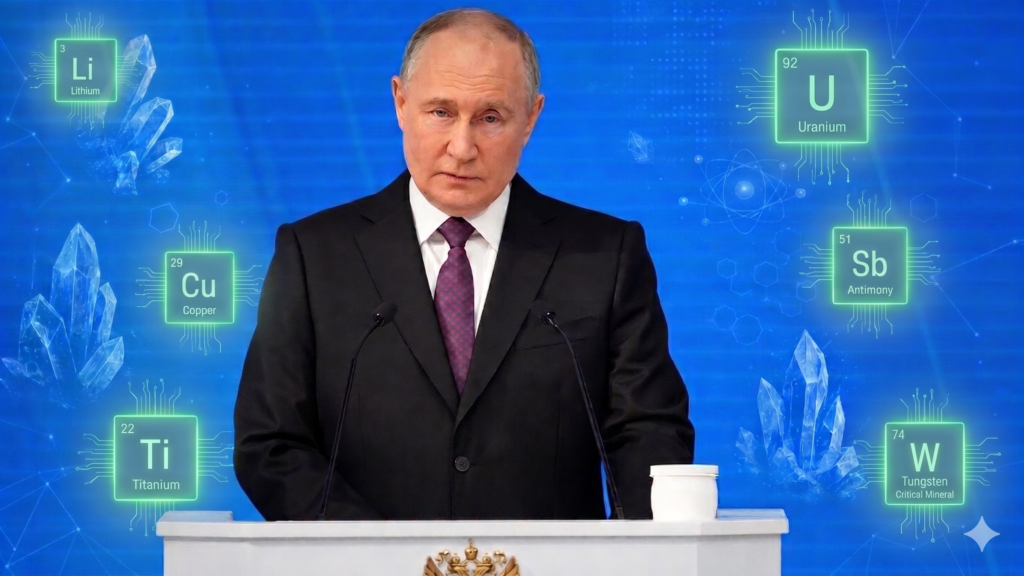
The timing matters. Critical minerals have become central to the new global economy because they connect energy transition, digital industrialization, and defense modernization. Lithium, graphite, nickel, cobalt, copper, manganese, titanium, tungsten, antimony, uranium, and rare earth elements are needed for electric vehicle batteries, permanent magnets, wind turbines, grid infrastructure, semiconductors, aerospace systems, military optics, and precision-guided weapons.
The International Energy Agency (IEA) reported that lithium demand rose by nearly 30 percent in 2024, while demand for nickel, cobalt, graphite, and rare earths increased by 6 to 8 percent in the same year. Under the IEA’s stated policies scenario, lithium demand is projected to grow fivefold by 2040, while graphite and nickel demand are expected to double. These figures explain why minerals that once appeared as technical commodities are now treated as strategic assets.
The US and Europe are especially focused on Central Asia because mineral security has become inseparable from reducing dependence on China. USGS data show that China supplied 70 percent of US imports of rare earth compounds and metals during 2020-2023.
China has also used export controls on minerals such as gallium, germanium, antimony, graphite-related items, and rare earth elements, reinforcing Western concerns about supply-chain vulnerability. China banned exports of gallium, germanium, and antimony to the US in December 2024, before later adjusting parts of the restriction through licensing arrangements.
For Washington and Brussels, the issue is no longer only price volatility. It is whether the industrial inputs needed for clean energy, advanced manufacturing, artificial intelligence infrastructure, and defense production can be secured outside a China-centered processing system.
Central Asia’s Emerging Resource Value
Central Asia has become attractive because it combines geological depth, Soviet-era mining legacies, underdeveloped deposits, and a strategic location between China, Russia, the Caspian basin, and Europe. Kazakhstan remains the region’s most important mineral power. It produced around 39 percent of global uranium mine supply in 2024 and about 40 percent in 2025, making it the world’s leading uranium producer. Kazakhstan also holds major deposits of chromium, manganese, titanium, copper, zinc, and rare metals, which makes it central not only to nuclear energy supply but also to broader industrial diversification.
Uzbekistan is emerging as another major target of Western mineral diplomacy. Its uranium production reached 7,000 metric tons in 2025, and its uranium reserves were estimated at around 139,000 tons. The country also has significant gold, copper, tungsten, lithium, and molybdenum potential. This explains why Washington and Tashkent have moved beyond general economic dialogue toward a more structured critical minerals agenda. In February 2026, the US and Uzbekistan signed a Joint Investment Framework involving the US International Development Finance Corporation, with the aim of supporting investment across exploration, extraction, processing, and related infrastructure.
What makes these Western initiatives politically important is that they are not presented only as extraction deals. The EU, in particular, has linked its partnerships to refined materials, batteries, renewable hydrogen, sustainability, and industrial value chains. This gives Central Asian governments room to argue that cooperation with Europe is not a new form of dependency but a route toward processing capacity, technology transfer, and economic diversification. Whether this promise will be fully realized is another question, but the political framing matters.
The EU has also moved to support the corridor politically and financially. At the first EU-Central Asia summit in Samarkand in April 2025, European Commission President Ursula von der Leyen announced a 12 billion euro Global Gateway package covering transport, critical raw materials, energy, digital connectivity, and water management. Earlier EU and Western financial institution commitments also focused on Trans-Caspian connectivity, showing that Brussels sees the region as part of a broader supply-chain and infrastructure diversification strategy.
Corridors, War, and Russia’s Shrinking Leverage
The mineral question cannot be separated from transport. A mine in Central Asia has limited strategic value for Europe if the export route remains dependent on Russian territory. Before the Ukraine war, Russia’s Northern Corridor and related rail infrastructure gave Moscow significant leverage over Eurasian connectivity. After 2022, sanctions, political risk, and the disruption of Russia-centered trade routes increased interest in the Trans-Caspian International Transport Route, usually known as the Middle Corridor. The World Bank describes the Middle Corridor as a multimodal route connecting China and Europe through Central Asia, the Caspian Sea, Azerbaijan, Georgia, and Turkey.
The World Bank has argued that investments and efficiency measures could halve travel times and triple trade flows along the Middle Corridor by 2030. This matters directly for critical minerals. If Central Asian resources can move westward through the Caspian and South Caucasus without passing through Russia, Moscow’s ability to use geography as a political instrument declines. This is why Russian anxiety about Western mineral access is also anxiety about infrastructure. Mining agreements, port upgrades, customs harmonization, railway modernization, and Caspian shipping capacity are all parts of the same strategic picture.
This is where Russia’s problem becomes clearer. Moscow still has serious influence in Central Asia, but the character of that influence is changing. It remains a security actor through the Collective Security Treaty Organization (CSTO), bilateral defense ties, intelligence networks, Russian-language media, education links, and labor migration. It also retains leverage over Kyrgyzstan and Tajikistan through remittance dependence and migration policy. At the same time, the war in Ukraine has placed heavy pressure on Russia’s economic resources and reduced its capacity to finance large-scale regional infrastructure on competitive terms. Analysts have noted that sanctions and war spending limit Russia’s ability to meet Central Asian investment and infrastructure needs.
This explains the sharper tone of Russian diplomacy. When Russia had more confidence in its regional position, Western activity in Central Asia could be treated as manageable or secondary. Now, the combination of Western mineral diplomacy, Chinese economic dominance, Middle Corridor development, and Central Asian multi-vectorism makes Moscow more sensitive to any project that reduces dependence on Russian networks. Galuzin’s warning therefore reflects a defensive posture. Russia is not only objecting to the US and EU access to minerals. It is objecting to the possibility that Central Asia can increasingly connect its resources, capital flows, and export routes without Russian mediation.
Still, Russia should not be written out of the region. Its relations with Kazakhstan show that Moscow can still secure major strategic projects. In May 2026, Russia and Kazakhstan signed a 16.5 billion dollar agreement for Rosatom to build Kazakhstan’s first nuclear power plant. Similarly, Russia expects to boost its military cooperation with Kyrgyzstan by extending the air defense treaty. These examples demonstrate that Russian influence remains strong in sectors where legacy expertise, political familiarity, defense and nuclear technology matter. The issue is not whether Russia remains present. The issue is whether it can still block alternative partnerships. That is becoming much harder.
Central Asian governments are using this opening carefully. Kazakhstan and Uzbekistan do not present Western mineral agreements as anti-Russian moves. They frame them as commercial, technological, and developmental partnerships. This allows them to attract Western financing and technology without openly challenging Moscow’s security role. At the same time, they continue to work with China because Chinese firms bring capital, infrastructure, processing capacity, and long-term demand. The result is not a clean geopolitical realignment. It is a more complex bargaining environment in which Central Asian states use mineral scarcity to increase their diplomatic room for manoeuvre.
Consequently, Galuzin’s statement reveals more than Russian concern about rare earths. It reveals Moscow’s recognition that Central Asia is no longer simply a post-Soviet periphery to be managed. The region is becoming an active player in the geopolitics of minerals, corridors, and industrial transition. For Russia, that is the real source of anxiety.