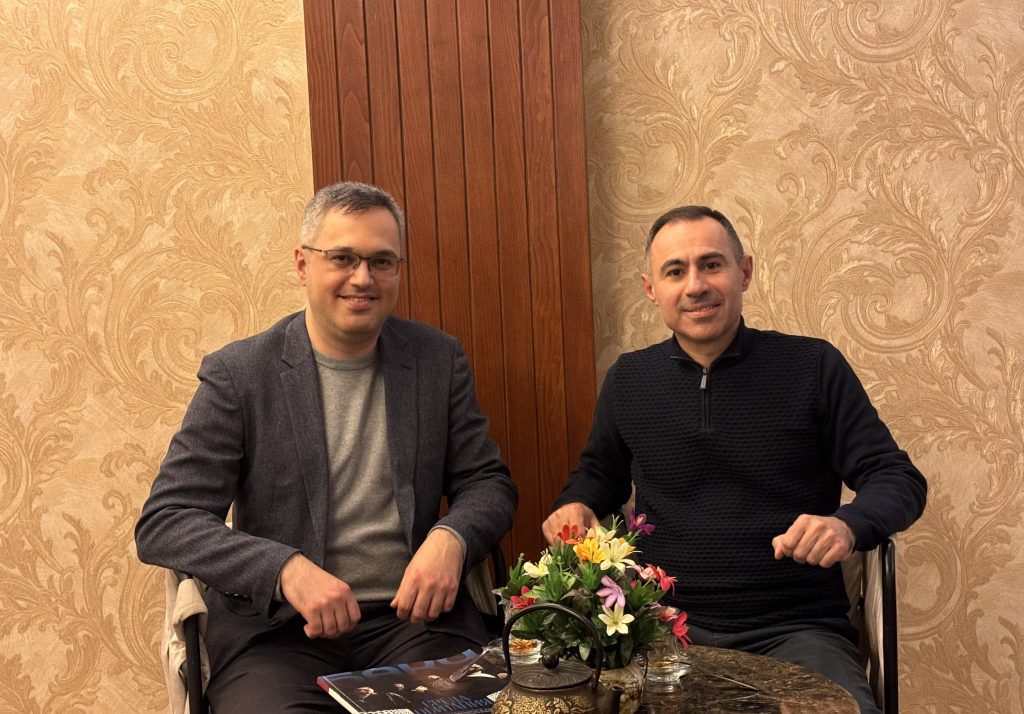
A meeting between the Seoul Institute of Global Affairs (SIGA) and QAFSAM – Caucasian Center for International Relations and Strategic Studies was held in Baku on 12 February 2026. The discussion brought together Dr. Mehmet Fatih Oztarsu, Deputy Director of SIGA, and Prof. Dr. Araz Aslanli, President of QAFSAM, and the Vice-Rector at Azerbaijan Tourism and Management University.
During the meeting, the participants exchanged views on the role of think tanks in fostering international academic dialogue and policy-oriented research. Particular attention was given to potential collaborative initiatives that could contribute to strengthening relations between Korea and Azerbaijan through research, dialogue platforms, and joint institutional activities.
The discussion also highlighted the importance of expanding regional studies in both countries. In this context, the sides explored ways to promote Korean studies in Azerbaijan while encouraging greater scholarly attention to the Caucasus region in Korea. Both institutions noted that closer academic interaction could help generate a deeper understanding of the geopolitical, economic, and social dynamics shaping Eurasia.
Prof. Aslanlı emphasized that QAFSAM intends to broaden its engagement with East Asian studies in the coming period, noting that cooperation with SIGA could serve as an important bridge for developing research networks and intellectual exchange with institutions in Korea. In this regard, the idea of establishing non-resident fellow positions between the two institutions was also discussed as a mechanism to strengthen long-term collaboration.
In addition, the two sides agreed to explore the possibility of organizing a joint program on conflict resolution to be held in Baku and Seoul. The initiative is expected to bring together scholars, policy experts, and young researchers to exchange perspectives on conflict management and regional stability.
The meeting concluded with a shared commitment to developing practical avenues for cooperation, including joint publications, research projects, and academic events that could further connect the Korean and Caucasian policy and research communities.