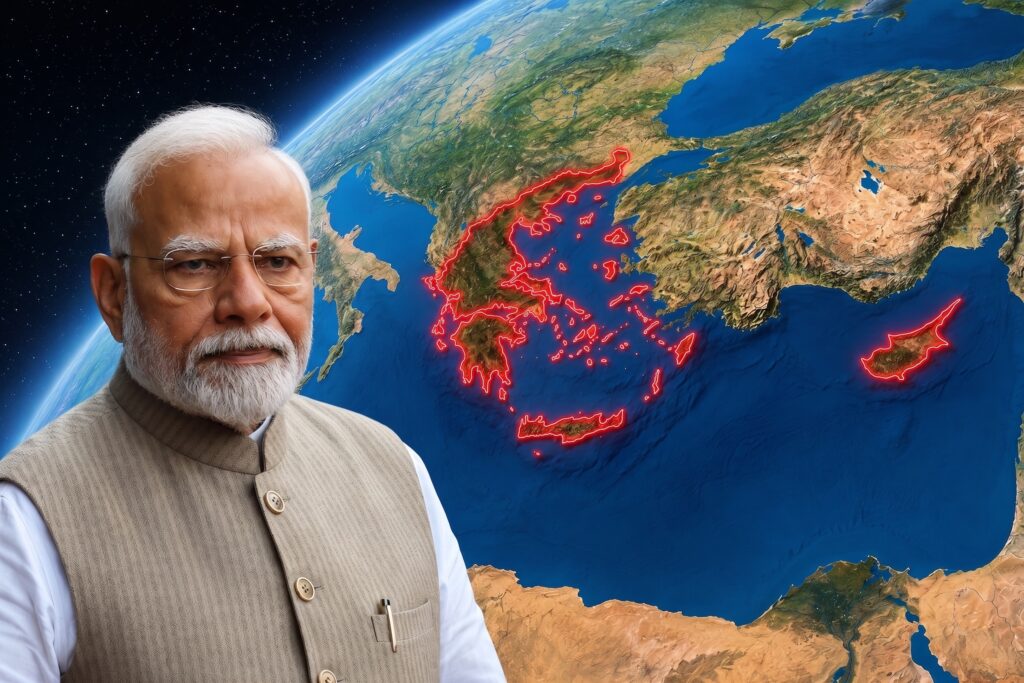

India’s growing engagement with the Mediterranean reflects a broader adjustment in New Delhi’s external strategy. As India seeks more resilient trade routes, a stronger role in Eurasian connectivity and wider markets for its defence industry, the Eastern Mediterranean has become more relevant to its foreign policy calculus.
Specifically, Cyprus and Greece offer India specific strategic utilities: access to the European Union (EU), proximity to the Suez and Levantine maritime routes, port and logistics infrastructure, and political partnerships with states that are already embedded in regional disputes involving the Middle East and European security.
Cypriot President Nikos Christodoulides’s state visit to India from 20 to 23 May 2026 was therefore significant. It took place during the final phase of Cyprus’s rotating presidency of the Council of the EU. The visit resulted in the elevation of India-Cyprus relations to a strategic partnership and produced agreements or mechanisms on defence cooperation, cyber security, counterterrorism, connectivity, education and culture. This was not simply a symbolic diplomatic upgrade. It indicated that Cyprus is being positioned as a small but useful node in India’s wider Mediterranean and European outreach.
The defence component was particularly notable. The two countries announced a Roadmap for Defence Cooperation for 2026 to 2031, alongside new institutional mechanisms such as a cyber security dialogue and a counterterrorism working group. Cyprus also joined India’s Indo-Pacific Oceans Initiative, a step that make India closer to the Mediterranean space. This matters because India is increasingly treating maritime security, trade corridors and defence diplomacy as interconnected rather than separate policy areas.
Connectivity, Trade and the Mediterranean Route to Europe
India’s interest in Cyprus and Greece is strongly connected to the future of India-Europe trade. The EU and India already trade more than €180 billion in goods and services annually, and EU-India goods trade alone reached more than €120 billion in 2024. This scale gives India a strong incentive to diversify routes, political partners and logistics gateways into Europe. The India-Middle East-Europe Economic Corridor (IMEC), announced at the G20 Summit in New Delhi in 2023, provides the strategic framework for this approach, even if implementation remains uncertain because of instability in Palestine, the Red Sea and the wider Middle East.
Cyprus’s value lies less in the size of bilateral merchandise trade and more in its institutional and geographic position. India-Cyprus bilateral trade was $140.47 million in April 2024 to March 2025, compared with $136.96 million in 2023 to 2024 and $198.05 million in 2022 to 2023. These are modest figures, but Cyprus’s investment profile is more consequential. Cyprus became among the top nine investors in India, with cumulative FDI equity inflows of $15 billion from April 2000 to June 2025. This makes Cyprus relevant as a financial and investment channel, not merely as a trade partner.
Greece adds greater economic and logistical depth. India-Greece bilateral trade reached $1.94 billion until 2023, with Indian exports of $785.72 million and imports from Greece of $1.15 billion. During Prime Minister Narendra Modi’s 2023 visit to Athens, the first by an Indian prime minister to Greece in 40 years, India and Greece upgraded relations to a strategic partnership and agreed to work toward doubling bilateral trade by 2030. Greece’s role is shaped by ports, shipping, energy infrastructure and access to the Balkans and Central Europe. Athens sees India as an economic and strategic partner beyond Asia, while New Delhi sees Greece as a potential European entry point for trade, logistics and infrastructure.
The economic logic also includes investment and mobility. Indian-linked infrastructure activity in Greece, including the GMR Airports joint venture with GEK-Terna for the new Kasteli airport in Crete, shows that the relationship is not limited to diplomatic declarations. Greece has also promoted itself as a destination for Indian capital, tourism and real estate investment. This does not yet amount to a major economic transformation, but it supports the gradual formation of an India-Greece-Cyprus triangle built around connectivity, investment facilitation, technology, ports and services.
At the European level, Cyprus and Greece may also help India politically. The EU-India trade agenda has gained momentum, and Cyprus fulfilled its 2026 EU presidency to present itself as a bridge between India and Europe. The European Commission states that EU-India trade already supports close to 800,000 jobs in the EU, which underlines the political importance of the relationship for both sides. For India, Mediterranean countries can provide additional support within EU institutions, especially on trade, maritime security, digital cooperation and supply-chain resilience.
Defence Cooperation, Strategic Signalling and the Turkish Dimension
The defence layer is central to India’s Mediterranean opening. With Greece, cooperation has become more structured in recent years. The two sides established a Joint Working Group on defence cooperation in July 2024, Greece participatedin India’s Tarang Shakti 2024 air exercise with four fighter aircraft, and India joined Greece’s INIOCHOS 2025 exercise with four Su-30 MKI aircraft.
Moreover, the two countries convened the first Greece–India Maritime Dialogue in December 2015. This cooperation subsequently culminated in the signing of a Joint Declaration of Intent in February 2026, aimed at strengthening defence industrial cooperation and fostering synergies between India’s defence manufacturing ambitions and Greece’s defence modernization agenda. This gives the relationship a practical military-industrial dimension rather than leaving it at the level of political symbolism.
With Cyprus, defence cooperation is newer but increasingly visible. India and Cyprus signed bilateral defence cooperation programmes for 2025 and 2026, while the Indian Navy frigate INS Trikand made a port call at Limassol in September 2025. India also used defence promotion activities in Nicosia to showcase its defence production capabilities. These developments suggest that New Delhi is testing the Eastern Mediterranean as a market and diplomatic space for its emerging defence-export profile.
The Turkey factor should be assessed with caution. India carefully adopts policy measures in the region. The Indian and Turkish sides still maintain meaningful commercial ties. The Turkish Ministry of Foreign Affairs states that bilateral trade between Turkey and India reached $8.54 billion in 2024, with Turkey exporting $1.51 billion to India and importing $7.02 billion from India.
However, India’s closer alignment with Cyprus and Greece does have implications for Ankara. The Turkish defence and political relationship with Pakistan, its support for Pakistan on Kashmir, and its assertive role in the Eastern Mediterranean all shape Indian perceptions. From New Delhi’s perspective, Cyprus and Greece provide diplomatic and strategic depth in a region where Turkey has often supported positions contrary to India’s interests. From Ankara’s perspective, India’s presence in the Greek-Cypriot strategic environment may look like an indirect response to Turkey-Pakistan cooperation.
The most sensitive issue is potential defence procurement. Reports about Cypriot interest in Indian systems such as BrahMos missiles, drones and loitering munitions should not be treated as confirmed sales unless official contracts are announced. Still, the debate is relevant because threat perceptions can shift even before procurement occurs. BrahMos is a supersonic cruise missile system associated with high-speed precision strike capabilities, and its possible entry into the Eastern Mediterranean would be interpreted through the lens of naval balance, coastal defence and deterrence. Media narratives in India, Greece, Cyprus and Turkey may exaggerate this issue, but the underlying strategic signal is real: Indian defence technology is now being discussed in a theatre where Turkey has direct security interests.
The wider geopolitical implication is that India is connecting several regions that were often treated separately: South Asia, the Gulf, the Eastern Mediterranean and Europe. IMEC links India to the Gulf and Europe. Cyprus links India to the EU and the Levant. Greece links India to ports, shipping, the Balkans and European infrastructure. Israel, although not the focus here, remains another relevant node in this emerging architecture. This is not a formal alliance system, but it is a network of overlapping interests in connectivity, maritime security, defence technology, cyber security and supply-chain diversification.
India’s Mediterranean policy still faces limits. IMEC is vulnerable to geopolitical disruption. Cyprus and Greece can support India’s European outreach, but they cannot guarantee corridor security or EU market access by themselves. Defence cooperation may strengthen India’s position, but it could also expose New Delhi to regional disputes where its direct interests are limited. India must also balance its ties with Turkey, because commercial interests and strategic differences coexist.
Still, the direction is clear. India is no longer approaching the Mediterranean only as a distant maritime space. It is building a selective presence through Cyprus and Greece, combining trade, connectivity, defence diplomacy and political signalling. Christodoulides’s visit to New Delhi confirmed that Cyprus is becoming a more institutionalized part of this approach. Greece provides greater scale, infrastructure and military cooperation. Together, they give India a Mediterranean platform that serves both its European ambitions and its wider strategic response to shifting alignments involving Turkey and Pakistan.