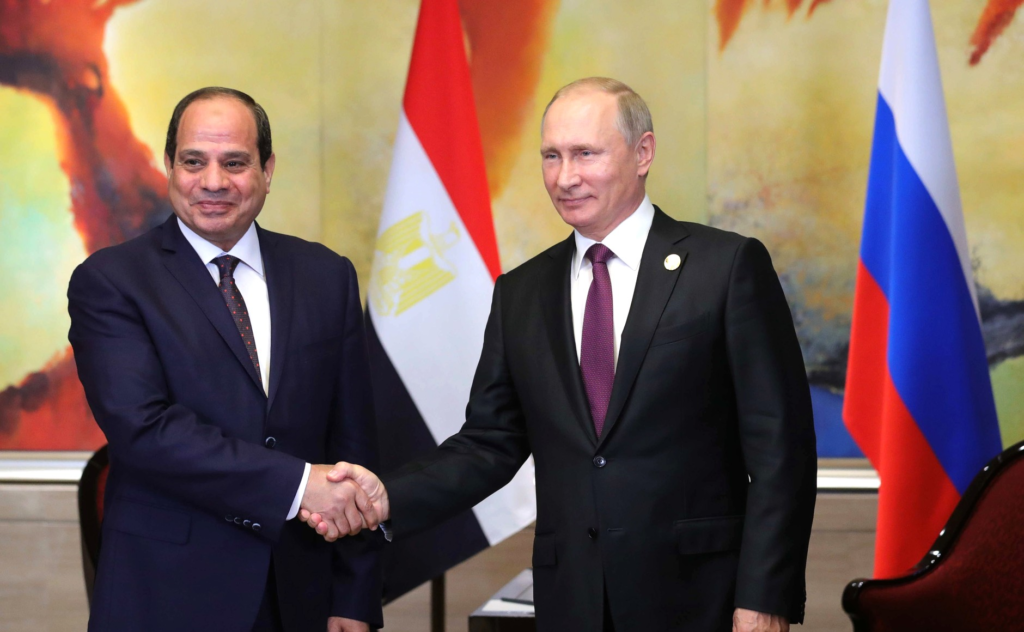

In April 2026, President Vladimir Putin said that Russia and Egypt could discuss plans to create a “grain and energy hub” in the North African country. At first glance, this may seem like a routine extension of bilateral economic cooperation. Yet the proposal is more significant than a mere trade arrangement. It comes at a time when sanctions, disrupted supply routes, and geopolitical competition are reshaping the organization of food, energy, and infrastructure. In this context, Egypt is not only a massive consumer market and the world’s largest wheat importer, but also a strategic node connecting the Mediterranean, the Red Sea, Africa, the Middle East, and Europe.
The proposal also builds on an existing pattern of cooperation rather than a speculative starting point. Egypt is already among Russia’s most important wheat importers, with Reuters reporting that it had bought around 7.6 million tonnes of Russian grain in the current year. Discussions around the hub also sit alongside other major Russia-Egypt projects, including the El Dabaa nuclear power plant and the Russian industrial zone in the Suez Canal Economic Zone. This combination of food, energy, logistics, and infrastructure is what defines the proposal as politically revealing.
The core question, therefore, is not whether Egypt should cooperate with Russia. Nations often diversify partnerships to widen their autonomy and manoeuvring capacity. The more important question is whether Egypt can shape such cooperation in a way that increases its room for manoeuvre, or whether the same infrastructure that raises Egypt’s strategic value could gradually create new forms of dependence.
Egypt in Russia’s map to reroute trade networks
The proposed hub should be read against the wider background of Russia’s desire for new routes, markets, and intermediary platforms to counter Western sanctions. Sanctions rarely stop trade completely, but more often, they redirect it through new corridors, partners, and logistical arrangements. For Russia, Egypt’s value lies not only in demand for wheat or fuel products, but also in its ability to serve as a redistribution platform toward Africa, the Middle East, and potentially the Mediterranean.
This is why the idea of a hub matters. It would not simply mean storing grain or handling energy products but would place Egypt inside a broader strategy of preserving commodity flows and political influence through infrastructure. Reuters also reported that Egypt is relevant to Russian trade in commodities such as wheat and gasoline, while separate data on Russian seaborne fuel oil and vacuum gasoil showed deliveries to Egypt’s Ain Sukhna terminal for storage and re-export. These details suggest that Egypt is not only the destination, but it can also operate as an intermediary point in regional commodity flow.
That intermediary role can be valuable. Logistics hubs, ports, industrial zones, and storage facilities are increasingly part of how states manage geopolitical pressure. They allow countries to reorganise flows when normal routes are disrupted. But they also create relationships that can become “difficult” to reverse, especially when infrastructure, financing, technology, and commercial contracts begin to reinforce one another over time.
Opportunity and dependence: the central trade-off
For Egypt, the opportunity is clear. A grain and energy hub could strengthen Cairo’s regional role, increase its position, and reinforce its image as a connector between several markets. Geography is one of Egypt’s most important strategic assets, and the Suez Canal Economic Zone gives that geography an institutional and investment framework. If managed carefully, a hub could help Egypt convert location into leverage.
The risk, however, is also clear. Dependence would not necessarily appear immediately. It could develop gradually across four linked areas. First, food-supply dependence could deepen if Egypt’s wheat imports become even more concentrated around Russian supply. Second, energy dependence could increase if Russian fuel products, nuclear cooperation, or energy infrastructure become more embedded in Egypt’s long-term planning. Third, infrastructure dependence could emerge if storage, transport, industrial zones, or logistics platforms are structured around Russian commercial and technical networks. Fourth, political leverage could arise if these dependencies give Moscow indirect influence over supply timing, pricing, or strategic choices.
In that sense, the proposal reflects a broader pattern of weaponised interdependence, where control over routes, infrastructure, and access can become a source of political leverage. The strategic value of the hub would therefore lie not only in grain or energy flows, but in Egypt’s position within the networks through which those flows are stored, redirected, and negotiated.
The “El Dabaa project” demonstrates why this is important. Egypt’s first nuclear power plant, built with Russian cooperation, is designed around four reactors with a total capacity of 4,800 MW. It is an important part of Egypt’s energy diversification, but it also shows how energy partnerships can involve long-term horizons, financing arrangements, technical systems, and operational relationships. The proposed grain and energy hub may be much smaller or less clearly defined at this stage, but it belongs to the same broader debate: how can Egypt benefit from strategic partnerships without allowing them to limit future choices?
The European dimension and Egypt’s balancing strategy
The European dimension also falls into the debate. In March 2024, Egypt and the European Union elevated their relationship to a Strategic and Comprehensive Partnership, supported by a financial and investment package of up to EUR7.4 billion for 2024-2027. The partnership covers areas such as investment, trade, energy, migration, and regional stability. This makes Egypt’s external economic positioning especially sensitive. Cairo is not choosing between Russia, which is under Western sanctions, and Europe, but it is operating inside overlapping networks of interdependence.
From a European perspective, deeper Egypt-Russia logistical integration may raise questions because the proposed hub touches sectors closely linked to strategic resilience: food, energy, ports, industrial zones, and regional connectivity. That does not mean cooperation with Russia would automatically undermine Egypt’s relationship with the EU. Egypt has long practised a diversified foreign policy, maintaining relations with multiple powers at the same time. But the more infrastructure becomes linked to Russian commodity flows, the more Cairo will need to manage the perception and substance of balance.
The real test is whether Egypt can use its geography and partnerships to expand its strategic flexibility rather than become a passive point inside other actors’ routes. If the hub is designed with transparency, diversified supply options, and clear Egyptian control over infrastructure and regulation, it could strengthen Egypt’s role. If it becomes overly concentrated around one external partner, it could reproduce the very vulnerabilities it is meant to manage.
Conclusion
The proposed Russia-Egypt grain and energy hub remains an idea under discussion rather than a fully defined project. Its operational details, financing, governance model, and legal structure remain unclear. Yet, even as a proposal, it is politically revealing. It shows how food, energy, logistics, and infrastructure are becoming part of a wider struggle over influence in a fragmented international order.
For Egypt, the central challenge is not cooperation itself, but the terms and the mechanism of this cooperation. The hub could create opportunities to strengthen Egypt’s regional role and increase its strategic value. But it could also create new vulnerabilities if food supply, energy flows, and logistics infrastructure become too closely tied to one external actor. The task for Cairo is therefore to turn geography into leverage without allowing that same geography to become a channel of new dependence.
Author: Mohamed Aboghadeer is a policy and research analyst with an MA in International Relations and Diplomatic Affairs. His work focuses on EU–MENA affairs, energy security, strategic interdependence, and the geopolitics of infrastructure.