
On a map, Kazakhstan’s transit advantage appears self-evident. The country lies between China and Europe, borders Russia, and reaches westward through the Caspian Sea. In logistics, however, location is only the starting point. Cargo owners choose routes that are predictable, competitively priced and easy to track. Political resilience matters, but so do timetables, border procedures and the quality of service.
Kazakhstan is therefore moving beyond the idea of being a passive land bridge. Its emerging model combines railways, highways, Caspian ports, border terminals, aviation hubs and digital customs procedures. The objective is not one corridor, but a network of options. In a period marked by sanctions, maritime disruptions and geopolitical uncertainty, such optionality has become an economic asset and a form of strategic autonomy.
From Infrastructure Expansion to a Logistics System
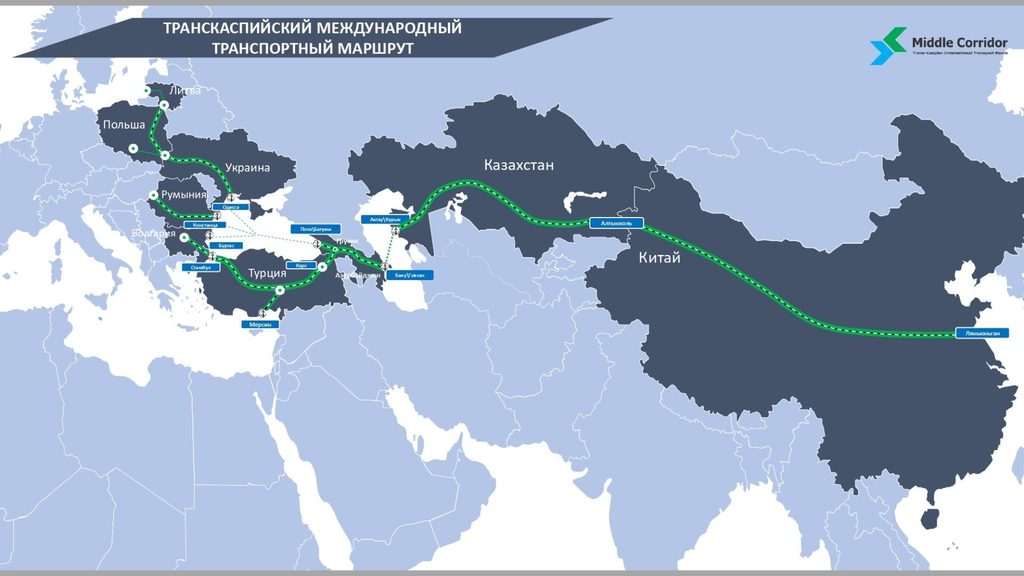
Kazakhstan is investing heavily in the physical network. In 2026, the government expects the Darbaza-Maktaaral (near South Kazakhstan near the border with Uzbekistan) and Moiynty-Kyzylzhar (railway in Central Kazakhstan links Dostyk station at the Chinese border with Caspian Sea in western Kazakhstan) railway lines to enter operation. Darbaza-Maktaaral should reduce improve rail links with Uzbekistan. Moiynty-Kyzylzhar will strengthen the east-west network and remove a costly detour from the Kazakh section of the Trans-Caspian International Transport Route, better known as the Middle Corridor.
The World Bank’s decision in February 2026 to provide an $846 million guarantee, helping mobilize $1.41 billion in long-term financing for the 322.3-kilometer Moiynty-Kyzylzhar line, gives the project additional weight. The new railway is expected to shorten the route by 149 kilometers, relieve congestion and allow more efficient container operations. Kazakhstan is also upgrading the Altynkol-Zhetygen (from Khorgos city to Almaty region as a part of Trans-Caspian TMTM route) and Zhezkazgan-Saksaul (center-western Kazakhstan links) sections, reconstructing stations, renewing rolling stock and extending its terminal network beyond the country. Facilities in Alat, Selyatino and Svisloch are to be followed by work in Budapest, Chengdu and Constanța.
The Caspian is becoming more important within this network. A proposed multimodal hub at Kuryk Port is expected to raise the port’s processing capacity to 15 million tons in its first stage. Aktau, meanwhile, is being developed as a point where maritime, rail and air routes can meet. Cargo aviation is part of the same picture. Infrastructure in Almaty, Astana, Aktobe, Karaganda and Aktau is intended to serve high-value goods, e-commerce and time-sensitive supply chains. In the first seven months of 2026, Kazakhstan’s airports handled 102,500 tons of cargo, 10 percent more than in the same period a year earlier.
The figures are important, but they do not by themselves create a logistics hub. Kazakhstan’s real test is whether railways, ports, terminals and border crossings can function as one commercial system rather than as separate infrastructure projects.
The Middle Corridor Is a Test of Coordination
The Middle Corridor has attracted attention because it links China and Europe while reducing dependence on routes exposed to disruption elsewhere. Its commercial future, however, will depend less on geopolitical visibility than on day-to-day performance. A container travelling through Kazakhstan, across the Caspian Sea and onward through Azerbaijan and Georgia passes between several railway administrations, ports and customs systems. Each transfer can add cost, delay and uncertainty.
The World Bank estimates that freight volumes along the corridor could triple and end-to-end travel times could be halved by 2030. Reaching that target will require more than new track. Harmonized tariffs, coordinated timetables, interoperable documents, real-time tracking and reliable port calls are equally important. Kazakhstan’s plan to establish a unified digital database for managing transport chains in real time by the end of 2026 is therefore a useful step. The digitization of road permits and the expansion of permit-free arrangements with regional partners follow the same practical logic.
A corridor is judged by its least predictable segment. Kazakhstan may provide the longest land section of the Middle Corridor, but it cannot guarantee the route’s performance on its own. Reliability must be built jointly with China, Azerbaijan, Georgia, Türkiye and European partners.
Central Asian Corridors Can Compete and Connect
Kazakhstan’s plans are advancing alongside major transport initiatives elsewhere in Central Asia. Uzbekistan is developing dry ports and logistics centers while promoting the China-Kyrgyzstan-Uzbekistan railway and the Trans-Afghan route. Kyrgyzstan has begun tunnelling work on the new railway, whose total length will exceed 530 kilometers. Turkmenistan provides access toward Iran and the Persian Gulf. Across the region, governments are testing new combinations of east-west and north-south connectivity.
These projects are sometimes presented as a race in which one country’s gain must be another’s loss. The reality is more complicated. Cargo will certainly move towards the routes offering the best combination of price, speed and reliability. That competition can encourage better service. At the same time, new lines can strengthen the regional network. The China-Kyrgyzstan-Uzbekistan railway may open additional southern connections, while Kazakhstan offers higher-capacity access toward the Caspian, Russia and northern Europe. Darbaza-Maktaaral can link Kazakhstan more efficiently to Uzbekistan’s growing logistics system, and routes through Turkmenistan and Iran can widen access to the Gulf and South Asia.
For Central Asia, the most useful competition is competition over service: quicker border clearance, transparent tariffs, modern terminals, dependable schedules and digital traceability. The greater risk is not the existence of parallel routes, but parallel planning without compatible standards, shared data or realistic assessments of cargo demand.
Kazakhstan and Uzbekistan carry weight in this process. Their economies and central location make them the region’s principal organizers of connectivity. Their ambitions overlap, but overlap does not have to become rivalry. Regular coordination of border infrastructure, railway schedules, investment plans and digital systems would allow both countries to develop their own strengths while improving the region’s position.
Transit Must Support the Domestic Economy
Kazakhstan should also avoid defining transport strategy too narrowly around transit revenue. International cargo is valuable, but corridors become politically sustainable when they generate domestic value. New lines and terminals should support Kazakhstan’s exporters, industrial zones, agricultural producers and regional cities. Ports should stimulate shipbuilding, warehousing and processing. Digital logistics should create demand for local technology firms. Training programs should prepare specialists in multimodal operations, customs analytics, artificial intelligence and supply-chain management.
This domestic dimension matters because transit flows are volatile. They can shift when freight rates, sanctions, border rules or security conditions change. A logistics ecosystem anchored in national production and intra-regional trade is more resilient than one dependent on passing containers alone. Central Asia’s own market should therefore be treated not as a secondary benefit of Eurasian connectivity, but as one of its foundations.
From a Crossroads to a Coordinator
Kazakhstan’s transport strategy is entering a decisive phase. Kazakhstan already has 13 major rail and road corridors and is adding new lines, terminals, port capacity, aircraft infrastructure and rolling stock. The next phase is less visible but no less important: integrating these assets, reducing administrative friction and building trust among operators and neighboring states.
Over the coming decade, routes will compete on reliability, technology and coordination rather than on maps alone. Kazakhstan will be well placed if it uses its central location to expand choices for shippers and partners instead of relying on the assumption that cargo has nowhere else to go.
The country’s ambition, then, should extend beyond becoming a Eurasian crossroads. Kazakhstan can become a capable coordinator of routes, services and commercial interests. If infrastructure investment is matched by sound regulation, digital management and steady regional cooperation, the transport strategy will strengthen both Kazakhstan’s competitiveness and Central Asia’s ability to act on its own interests in a more fragmented international environment.
Note
The essay draws on the author’s lectures on Central Asia and specialist presentation materials on Kazakhstan’s transport and logistics strategy. The author also participated in a specialized training program organized by the Senate of the Parliament of the Republic of Kazakhstan, and data and analytical materials presented during that program informed this analysis. The views expressed are solely those of the author.