
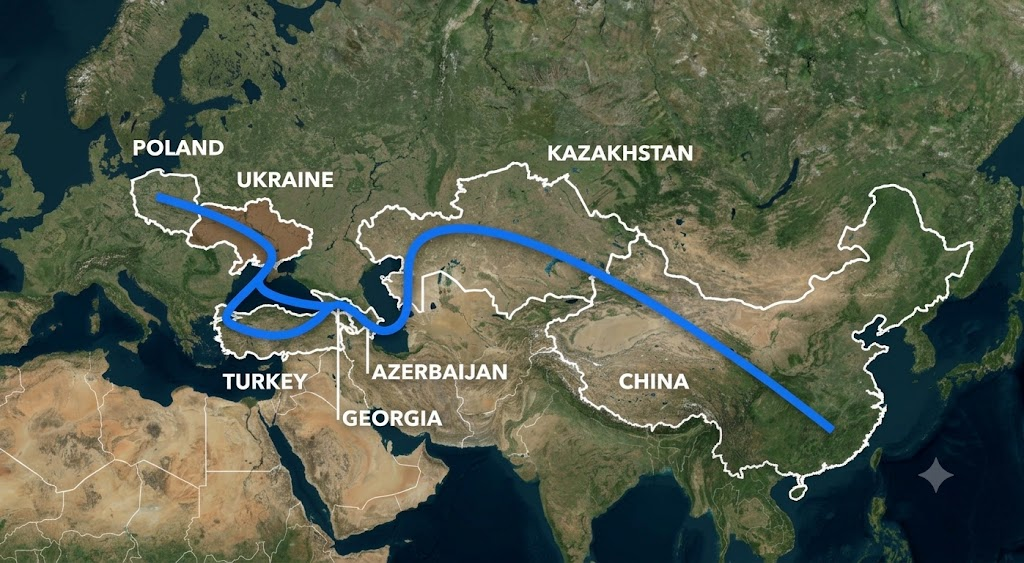
Over the past decade, Azerbaijan has turned its geography into a serious strategic asset. Sitting at the crossroads of Asia, the Caspian and the South Caucasus, it has steadily built itself into the central transit point of the Trans-Caspian International Transport Route (TITR), also known as the Middle Corridor. Cargo volumes on the corridor have roughly quintupled since 2019, and the ports, railways and fleet that carry that traffic keep breaking their own records. The Zangezur Corridor, set in motion by the Washington agreements of August 2025, looks set to make that position permanent.
How the Corridor Got Its Chance
Middle Corridor grew in importance and operations in the wake of disruptions in traditional transportation routes between Europe and Asia. Russia’s invasion of Ukraine in February 2022 made the Northern Corridor through Russian territory politically toxic for European shippers. Then, from late 2023, Houthi attacks on Red Sea shipping pushed carriers to reroute around the Cape of Good Hope, adding up to two weeks to Asia–Europe transit times and driving freight rates up sharply. The two disruptions together shifted route diversification from a risk-management option to a commercial necessity.
The numbers are straightforward. According to the Kazakh Ministry of Transport, cargo on the TITR grew from 759,000 tonnes in 2019 to 4.48 million tonnes in 2024 — roughly a fivefold increase in seven years. The slight dip to 4.12 million tonnes in 2025 reflects infrastructure limits, not weaker demand: the Caspian ferry fleet and Georgian port facilities were operating near capacity. Container traffic reached approximately 77,000 TEU in 2025 against a 2029 target of 300,000 TEU. The World Bank projects corridor-wide volumes of 10–11 million tonnes by 2030 if investment is properly coordinated — roughly double where things stand now.
Azerbaijan Moves from Transit Country to Connectivity Hub
Among all the countries along the corridor, Azerbaijan had the strongest year in 2025. The Port of Baku at Alat handled a record 107,000+ TEU — up 40 percent year-on-year and the terminal’s best result in two decades — while Azerbaijan Railways (ADY) took in more than 390 container block trains from China, a 37 percent increase, against an ultimate target of 1,000 trains per year. In a national television address in January 2026, President Ilham Aliyev put it plainly: “For the first time, 100,000 containers have already passed through the territory of Azerbaijan. We had thought the infrastructure we were creating would be sufficient for many years, but we see that it is not. Therefore, additional funds are and will be invested.”
Three things drove the record. First, merging the Baku International Sea Trade Port with ADY in 2025 created a single rail–port management structure that cut cargo coordination delays. Second, ADY opened a 20,000-TEU container terminal inside Xi’an Port in July 2025 and stationed a permanent representative there — an unusual move for a small Caucasus railway to have a direct footprint inside China. Third, the Azerbaijan Caspian Shipping Company increased dry-cargo trans-shipment by 45 percent in 2025, with ferry container volumes more than doubling; a ten-vessel Ro-Ro expansion programme is due for delivery by end-2026.
What is notable about these gains is that they rest on support from all directions at once. The EU committed €10 billion under its Global Gateway strategy for Trans-Caspian transport connectivity in January 2024. China formalised a comprehensive strategic partnership with Baku during President Aliyev’s April 2025 visit to Beijing and works with ADY on the Baku-Tbilisi-Kars (BTK) railways capacity planning. The United States, through the TRIPP initiative, gained its first direct commercial stake in a South Caucasus corridor project. Not many transit countries can count Washington, Brussels, Beijing and Ankara as simultaneous backers — and that is essentially the foundation of Azerbaijan’s position.
The Zangezur Corridor: Adding a Second Rail Link
One of the most important developments for the corridor’s future is the opening of the Zangezur Corridor through the territory of Armenia which will connect mainland Azerbaijan with Nakhchivan exclave and afterwards with Türkiye. Under the trilateral agreement signed in Washington on 8 August 2025 by President Aliyev, Armenian Prime Minister Nikol Pashinyan and President Donald Trump, Armenia agreed to allow passage between mainland Azerbaijan and the Nakhchivan exclave. The United States received development rights over the 43-kilometre Armenian section, now branded the Trump Route for International Peace and Prosperity (TRIPP). Armenia’s Prime Minister Pashinyan subsequently told parliament that the parties should finalise the arrangements in the first half of 2026 and “in the second half, begin construction work”.
Azerbaijan’s own section is almost done. The Horadiz–Aghband railway has been under construction since early 2021; President Aliyev confirmed in November 2025 that it was nearly complete and on track to open by end-2026. President Aliyev noted that this corridor will turn Armenia into a transit country for the first time since independence. At the Organisation of Turkic States (OTS) summit in Turkistan, Kazakhstan in May 2026, he said the Zangezur Corridor “will become one of the key segments of the Middle Corridor,” and linked it to the OTS-wide e-Permit electronic transit system — digital infrastructure to go alongside the physical.
When fully operational, the Zangezur Corridor will do more than add a second rail exit westward — it will make the Middle Corridor measurably faster. Turkish Transport and Infrastructure Minister Abdulkadir Uraloğlu, speaking at the groundbreaking ceremony for Turkey’s 224-kilometre Kars–Iğdır–Aralık–Dilucu railway in August 2025, put a specific figure on it: the completion of the Zangezur link is expected to reduce China-to-Europe transit time from 18 days to 14. The gain comes from geometry. The current BTK route runs 250 kilometres through Georgian territory to reach Turkey; the Zangezur passage covers only 43 kilometres through Armenian territory, cutting distance, reducing transfer points, and bypassing the congestion that has been building at Georgian ports and customs crossings. Turkish Trade Minister Ömer Bolat made the commercial logic equally plain: the opening of the Zangezur Corridor will integrate services of the Turkic world and revitalise the Middle Corridor, strengthening transit trade along the full length of the route from the Far East to Europe. For Azerbaijan, the implication is direct: a shorter, faster corridor means a more competitive one, and a more competitive corridor means higher sustained volumes through Baku.
The Corridor Is Real Now
The Middle Corridor has moved from potential to reality. Cargo volumes have quintupled. Container records are being broken every year. A dense network of agreements — stretching from Brussels to Beijing, from Washington to Ankara — has turned the route from a crisis-driven shortcut into a permanent feature of Eurasian trade. Azerbaijan sits at the centre of it, essential by geography and increasingly by deliberate design.
That said, the position is not secure by default. The Caspian crossing remains the main bottleneck; the Ro-Ro fleet expansion and dredging work need to keep ahead of falling sea levels and weather disruptions. The cost gap with rival routes needs to narrow if the corridor is to hold volumes once the crisis conditions that initially drove traffic here ease. And TRIPP needs to move from signed agreement to actual construction on schedule. If all that happens, Azerbaijan enters the 2030s in a position the South Caucasus has never seen before: the operational centre of Eurasia’s most significant new trade route, with every major outside power that has interests in the region behind it.
Vasif Huseynov
AIR Center (Center of Analysis of International Relations)