
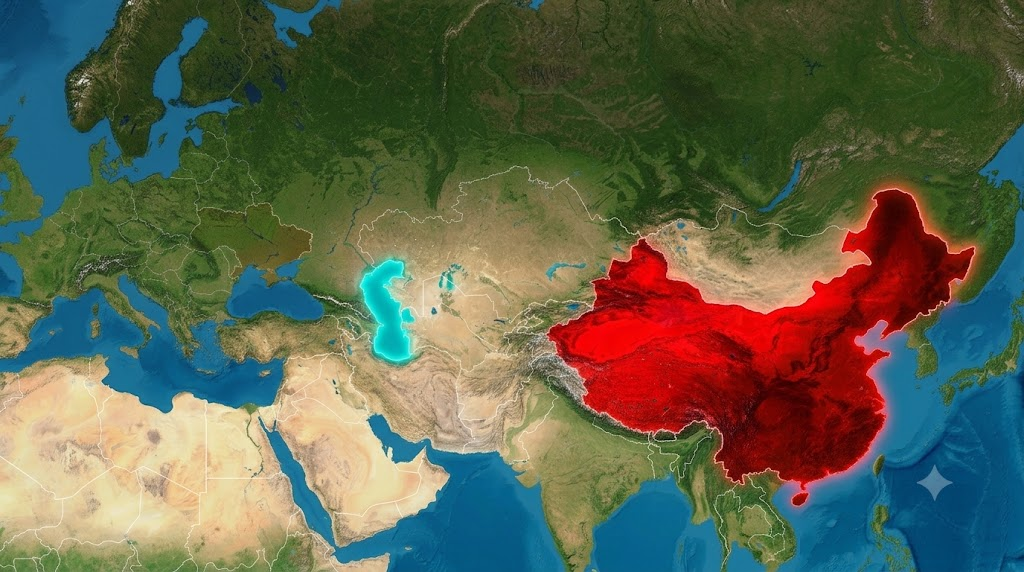
Competing Regional Visions around the Caspian
Kazakhstan, Azerbaijan, and Turkmenistan: East-West Connectivity
For much of the post-Soviet period, an implicit assumption existed that Central Asian states, including the Caspian littoral states of Kazakhstan and Turkmenistan, could not export energy resources without transiting Russian territory. The continued dependence of Central Asian exports on Russian routes stems less from geography itself than from the path-dependent infrastructure inherited from the Soviet period. Although Kazakhstan, Uzbekistan, and Turkmenistan possess alternative outlets through China, Iran, and the Caspian Sea, most existing pipeline, railway, and energy networks were originally designed to connect with Russia. As a result, Russian transit routes have continued to serve as the principal export channels for the region.
Kazakhstan, in particular, remains heavily dependent on Russian transit infrastructure for oil exports, including the Caspian Pipeline Consortium (CPC) system (Figure 4). Uzbekistan and Turkmenistan have likewise relied on pipeline and transportation networks connected to Russia for the export of energy resources and other goods. Although Turkmenistan has recently diversified part of its export structure through growing exports to China, Russia continues to occupy a central position within the region’s export infrastructure. This pattern reflects the persistence of inherited infrastructure, institutional arrangements, and contractual networks rather than simple geographical proximity.
Against this backdrop, Kazakhstan and Azerbaijan have sought to reduce their dependence on Russia through greater cooperation with external partners, including the European Union and China. The Trans-Caspian International Transport Route (TITR), commonly referred to as the Middle Corridor, is a multimodal east-west transportation corridor connecting China and Europe through Kazakhstan, the Caspian Sea, Azerbaijan, Georgia, and Türkiye. Combining rail and maritime transportation, the route bypasses both Russia and Belarus and therefore represents a strategically significant alternative to the Northern Corridor.
The geopolitical significance of the Middle Corridor increased considerably after the outbreak of the Russia–Ukraine War. As political uncertainty and sanctions-related risks associated with Russian transit routes intensified, the corridor emerged as an increasingly attractive alternative for Central Asian and South Caucasus states. Cargo volumes along the route have risen substantially in recent years, while European countries have also shown growing interest in utilizing the corridor as a trade route linking Europe and Asia.
The expansion of the Middle Corridor aligns closely with the strategic objectives of Caspian littoral states, particularly Kazakhstan, Azerbaijan, and Turkmenistan, to reduce dependence on Russia and strengthen their strategic autonomy. Kazakhstan serves as the principal overland segment connecting China and Europe and provides the maritime transition point across the Caspian Sea. Azerbaijan functions as a logistics hub on the western shore of the Caspian through the ports of Baku and Alat, reinforcing its role as a gateway to European markets. Turkmenistan also maintains westward connectivity through the port of Turkmenbashi. Collectively, these developments have contributed to the institutional foundation of an east-west transportation corridor across the Caspian region.
Nevertheless, the TITR remains a multimodal network rather than a fully integrated railway system. Because it depends on a combination of railways, ports, and ferry transportation across the Caspian Sea, the corridor continues to face structural bottlenecks and higher transportation costs.
Consequently, it is generally regarded as a complementary route rather than a full substitute for the traditional Russian transit corridor. In the energy sector, the proposed Trans-Caspian Pipeline (TCP) represents the most prominent example of an east-west connectivity initiative centered on the Caspian Sea. The project aims to transport Turkmen natural gas across the Caspian Sea to Azerbaijan and onward to European markets, bypassing both Russia and Iran. Despite its strategic significance, the TCP has yet to be realized due to legal disputes, insufficient investment, and opposition from Russia and Iran.
Taken together, the TITR and TCP constitute the principal transportation and energy components of a broader east-west connectivity strategy centered on the Caspian Sea. However, infrastructure constraints and limited transport capacity continue to restrict their operational scale. At present, both initiatives function primarily as complementary alternatives that are gradually expanding rather than as complete replacements for existing Russian transit routes.
Russia & Iran: North-South Connectivity (INSTC)
Prior to the emergence of alternative east-west corridors, the Northern Corridor served as the primary overland route connecting China and Europe through Russia, including the Trans-Siberian Railway. Because the corridor traverses Russian territory, Russia has long benefited from transit revenues and its position as a key logistical hub in Eurasia. However, the growing development of the Middle Corridor, which is explicitly designed to bypass Russian territory, has the potential to reduce Russia’s economic and geopolitical advantages derived from transit activities.
Even before the expansion of the Middle Corridor, Russia had sought to develop an alternative transportation network linking Russia to Iran and, ultimately, India through the Caspian region. This initiative is known as the International North–South Transport Corridor (INSTC), a multimodal transportation network of approximately 7,200 kilometers connecting the Indian Ocean and the Persian Gulf with Iran, the Caspian Sea, Russia, and onward to Northern Europe and broader Eurasian markets. The INSTC combines maritime, rail, and road transportation. Compared to the traditional route through the Suez Canal, the corridor is expected to reduce transportation costs by approximately 30–40 percent while also shortening delivery times.
The strategic importance of the INSTC increased significantly following the outbreak of the Russia–Ukraine War in 2022. As Western sanctions heightened uncertainty surrounding Russia’s traditional transportation routes, India and several Eurasian countries seeking to maintain trade relations with Russia began to view the INSTC as an alternative corridor less vulnerable to sanctions-related disruptions. From Russia’s perspective, the corridor also became increasingly important as a means of maintaining access to southern and non-Western markets while mitigating the effects of Western sanctions.
At present, the INSTC does not operate as a fully integrated transportation corridor. Rather, different segments of the route are utilized to varying degrees. Nevertheless, actual freight movements along the corridor have increased in recent years. Since 2022, both pilot shipments and commercial cargo movements have been conducted from Russia through the Caspian Sea and Iran before reaching India.
Despite these developments, the share of Eurasian trade transported through the INSTC remains relatively limited. The corridor continues to face a number of operational constraints, including incomplete infrastructure, regulatory differences among participating states, logistical bottlenecks, and inefficiencies associated with transshipment across the Caspian Sea. As a result, the INSTC has yet to function as a major global transportation corridor. Accordingly, the INSTC is best understood not as a mainstream Eurasian trade route but as a strategic supplementary corridor whose importance increases under specific geopolitical conditions.
Sunghwah Ko
Cheongju University