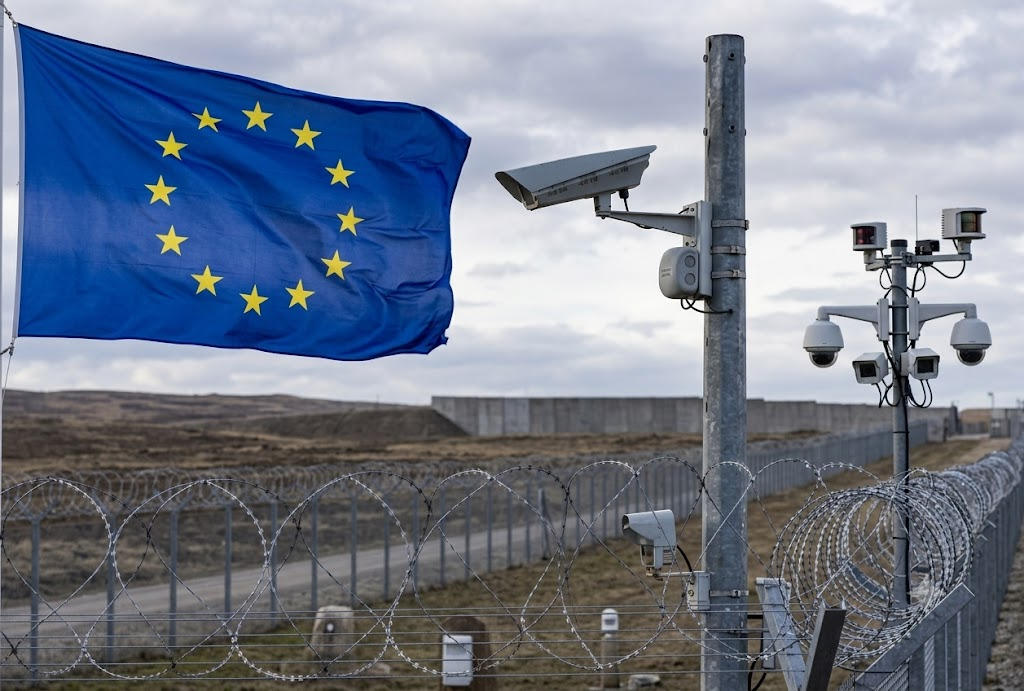

From Checkpoints to Code: The Transformation of the European Border
For much of modern history, borders have been tangible sites of encounter. Travelers presented documents to human officials, whose decisions-however imperfect-were grounded in discretion, context, and accountability. This traditional image of border governance is now rapidly dissolving. Across Europe, a profound shift is underway: the replacement of human-centered border control with algorithmic systems that preemptively evaluate, categorize, and regulate mobility. This transformation reflects a broader digitalization of governance, but at the border, its implications are especially acute.
Systems such as large-scale biometric databases and predictive risk-scoring tools now operate long before individuals physically reach European territory. This is explicitly manifested in the European Union’s interoperable data architecture, which links the Schengen Information System (SIS), the Visa Information System (VIS), and the Eurodac database. Together, these systems hold tens of millions of biometric records, transforming the physical border into a distributed digital matrix. The border is no longer a line; it is a process-continuous, distributed, and largely invisible. Under forthcoming frameworks like the European Travel Information and Authorisation System (ETIAS), travelers from visa-exempt non-EU countries must submit data to automated screening systems before departure. Consequently, travelers are assessed not at the gate, but within data infrastructures that anticipate their arrival.
This shift fundamentally alters the relationship between the state and the individual. Where once decisions could be questioned, appealed, or even negotiated, algorithmic outputs often appear as final and unquestionable. Border guards increasingly act as executors of machine-generated assessments rather than independent decision-makers. In this sense, authority is not eliminated but displaced-embedded within code and shielded from scrutiny. The promise of efficiency and security has driven this transition, yet it raises troubling questions about fairness and accountability. When decisions are made by opaque systems trained on historical data, they risk reproducing and amplifying existing biases. The result is a border that appears technologically neutral but is deeply political in its effects, systematically privileging some while excluding others.
The Digital Body: Biopolitics and the Logic of Datafication
To understand the deeper implications of algorithmic borders, one must move beyond technical descriptions and engage with their theoretical foundations. At the core of this transformation lies a biopolitical logic: the management of populations through the classification, measurement, and regulation of bodies. In the digital age, this logic is intensified through datafication. Modern border systems translate human beings into data points-fingerprints, facial images, travel histories, and behavioral indicators.
A poignant example of this is the EU’s expansion of the Eurodac Database, which has shifted from a system solely for asylum seekers to a broader law enforcement tool that collects biometric data from irregular migrants as young as six years old. These digital representations are then processed by algorithms that assign risk scores and determine access. In this process, complex human experiences are reduced to simplified categories such as “low-risk traveler” or “potential threat.”
This reduction is not merely technical but deeply political. It reflects and reinforces historical patterns of exclusion, particularly in relation to migrants from non-European regions. The supposed objectivity of algorithms masks the fact that they are trained on datasets shaped by past decisions, institutional biases, and unequal power relations. Rather than eliminating discrimination, these systems often encode it into automated processes.
Moreover, the increasing reliance on biometric technologies raises profound ethical concerns. Under the auspices of Frontex (the European Border and Coast Guard Agency), aerial drone surveillance and satellite monitoring in the Mediterranean operate alongside biometric processing to intercept movement before it reaches European shores. The body itself becomes a site of surveillance, continuously monitored and analyzed. This “readable body” is not neutral; it is constructed within a framework that prioritizes security over dignity. As a result, the digital border functions as a filter that sorts populations into those who can move freely and those who are subject to intensified scrutiny and control.
A Legal Paradox: High-Risk Systems and the Rights Vacuum
The European Union has positioned itself as a global leader in regulating artificial intelligence, most notably through its landmark EU AI Act. On paper, this framework acknowledges the risks posed by AI systems, particularly in sensitive areas such as migration and border control. These applications are classified as “high-risk,” requiring transparency, oversight, and strict safeguards.
Yet in practice, a striking IR paradox emerges. While certain intrusive technologies-such as real-time biometric categorization and emotion recognition-are tightly restricted within domestic European contexts, they remain permissible at the external borders. This dynamic was clearly illustrated by pilot programs like iBorderCtrl – an EU-funded project archived under Grant ID 700626 that tested AI-powered “micro-expression” analysis and deception detection systems on travelers at the land borders of Greece, Hungary, and Latvia. This creates a dual standard of rights protection, where non-citizens are subjected to forms of surveillance deemed unacceptable for citizens.
This divergence produces what can be described as a geopolitical “rights vacuum.” At the geographical and legal margins of Europe, fundamental protections are weakened or suspended. Migrants, already in vulnerable positions, face systems that are difficult to understand, challenge, or contest. The promise of regulation thus coexists with a reality of exception.
The implications of this legal architecture are far-reaching. By embedding inequality into regulatory frameworks, the EU risks institutionalizing a two-tier system of human rights. Citizenship becomes not just a legal status but a determinant of one’s exposure to surveillance and control. In this sense, the border is not only a site of exclusion but also a space where the very meaning of rights is redefined.
Opacity and Accountability: The Politics of Algorithmic Secrecy
One of the most troubling features of algorithmic border governance is its opacity. Key systems operate as “black boxes,” where inputs and outputs are visible, but the processes linking them remain hidden. This lack of transparency undermines accountability and erodes the foundations of democratic oversight.
Cases involving data collection programs and experimental technologies illustrate this dynamic. For instance, the deployment of Frontex’s predictive analytics programs and maritime surveillance software has frequently proceeded despite legal objections from digital rights organizations. Authorities regularly invoke national security imperatives and state sovereignty to justify withholding the operational logic of these systems. At the same time, public-private partnerships with defense and private technology firms introduce additional layers of opacity, as corporate intellectual property interests are used to block civil society and oversight bodies from accessing crucial information regarding how risk profiles are generated. This absolute shield of proprietary secrecy was heavily reinforced by the European Court of Justice in Case T-158/19, where the Court explicitly ruled that corporate commercial interests ruled out public access to the internal operational metrics, error rates, and risk configurations of border screening technologies. This convergence of state power and corporate secrecy creates a governance model that is difficult to scrutinize and even harder to challenge.
When individuals are denied entry or flagged as risks by automated screening, they are rarely given meaningful explanations. The burden of proof shifts onto them, yet the tools needed to contest decisions are withheld. The consequences extend beyond individual cases. At stake is the transformation of law itself. Traditional administrative law, based on reasoned decisions and procedural fairness, is increasingly replaced by code-based systems that operate outside conventional frameworks of accountability.
If left unchecked, this shift could normalize a form of governance where decisions are automated, responsibility is diffused, and rights are subordinated to technological imperatives. In confronting this future, the central question is not whether technology should be used at the border, but how it can be governed in a way that preserves human dignity and democratic principles. Without robust transparency, meaningful oversight, and clear limits, the invisible border risks becoming an unaccountable space where power is exercised without restraint.