South Korea’s foreign policy has long been shaped by a structural tension that no administration has fully resolved. The tension is known as the imperative of maintaining the US-ROK alliance as the foundation of national security, and the equally pressing need to avoid being pulled into the full logic of US-China rivalry at the cost of its own economic and diplomatic interests. This tension did not begin with the Lee Jae-myung administration, but it has become considerably harder to manage under one. President Trump’s partial redeployment of the Terminal High Altitude Area Defense (THAAD) system from Seongju to the Middle East that could be a destabilizing strategic even. At the same time, Washington has signaled, with increasing directness, that it expects Seoul to limit economic dependence on China and align more closely with American strategic objectives. So, South Korea finds itself navigating between two powers that are each, in different ways, asking it to choose. It is against this backdrop that France’s “third way” strategy in the Indo-Pacific has acquired a new kind of relevance for Seoul.
Seoul’s Strategic Dilemma: Between Alliance and Autonomy
The Lee administration has articulated its response to this dilemma through a doctrine it describes as “pragmatic diplomacy centered on national interests.” This diplomacy means pursuing three objectives simultaneously: deepening defense cooperation with Washington to maintain alliance credibility, rehabilitating and stabilizing ties with Beijing after the strains of the Yoon era, and diversifying partnerships with third parties in order to expand South Korea’s diplomatic maneuverability. In other words, the goal is not to abandon existing commitments but to create enough space that Seoul is not wholly dependent on any single relationship for its security or its prosperity. This is what is called resilience, yet sustaining this resilience is challenged. Washington has already signaled discomfort with Seoul’s measured approach to China, and Beijing remains uncertain about its willingness to engage with South Korea. This makes the diversification of partnerships with third parties not merely a diplomatic preference but a necessity.
This is not, of course, a coincidence. France and South Korea are arriving at the same regional moment from very different directions, yet finding that their interests point in the same general way. Both have strong reasons to resist an Indo-Pacific order that forces every state to pick a side. This is a pressure that neither can easily afford to ignore, nor is willing to simply accept.
France and its “Third Way”
The concept of a third way in French foreign policy derived from the Gaullist tradition of strategic autonomy, which means that France defines and pursues its own interests independently of any single great power. During the Cold War, this principle expressed itself in nuclear independence and withdrawal from NATO’s integrated command structure. In the contemporary Indo-Pacific context, it translates into a deliberate refusal to be drawn into the logic of forced alignment between Washington and Beijing, and into an effort to promote a multipolar regional order grounded in multilateral institutions rather than bloc politics. France does not seek to displace American influence in the region, nor does it offer compromise to China. This matters because it defines what kind of partner France can credibly be South Korea that is searching for engagement without conditionality.
What distinguishes France’s third way from mere rhetorical positioning is the material foundation on which it rests. France is not a distant European power projecting influence into a region where it does not reside. France has sovereign territory and permanent military installations across the Indo-Pacific, which are French Polynesia, New Caledonia, and Réunion. Ninety-three percent of France’s Exclusive Economic Zone lies within Indo-Pacific maritime territory. France’s ability to claim its legitimate interests in regional governance was not merely a diplomatic aspiration. It lies on a legal and geographic reality. Within the European Union, no other member state combines this territorial legitimacy with a carrier strike group, nuclear capability, and the sustained diplomatic influence that is essential for the practical implementation of the EU’s Indo-Pacific strategy. France is not merely Europe’s representative in the region. It is the only EU actor capable of making European engagement militarily and diplomatically credible on the ground.
Convergence in Practice: Where Interests Meet
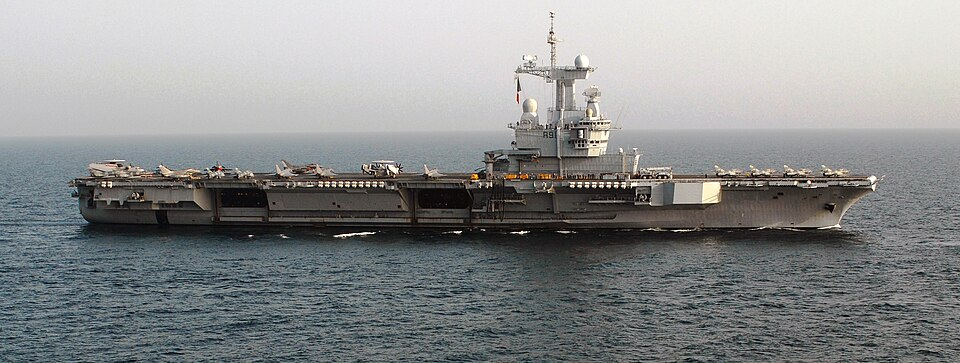
The practical dimensions of France-Korea convergence became visible most clearly through developments in late 2024 and early 2026. Mission Clemenceau 25, the five-month deployment of the Charles de Gaulle carrier strike group from November 2024 to April 2025, engaged more than twenty allied and partner navies through multilateral exercise formats, including La Perouse and Pacific Steller. This multilateral approach is analytically significant because it reflects the operational logic of France’s third way. Security contributions are anchored in shared frameworks rather than in exclusive bilateral arrangements. The mission does not ask participating partners to align with France. It asks them to participate in a collective commitment to freedom of navigation and rules-based maritime governance. This is precisely the kind of engagement that South Korea finds compatible with its own interests, not being bound to any single great power’s strategic framework.
More specific to the Korean Peninsula was the November 2024 port call by the French frigate Prairial at Busan, as part of the Enforcement Coordination Cell (ECC), a multilateral mechanism for monitoring North Korea’s circumvention of UN Security Council sanctions. That France chose to engage through the ECC rather than independently says something important about how it understands its own role. Enforcement, in France’s view, derives its legitimacy from collective authorization, not from the weight of any single country’s navy. South Korea has long held a similar view about how North Korean provocations should be managed. So, the alignment here is less about formal coordination than about two states that happen to read the same situation the same way.
The April 2026 summit extended this logic into civilian domains. Eleven agreements covering artificial intelligence, critical minerals, semiconductors, and nuclear energy were signed alongside new defense commitments. The two governments also confirmed plans for France’s Pégase air mission, involving periodic deployments of Rafale combat aircraft, to include a stopover in South Korea in autumn 2026. Although these steps are gradual and not a transformative change, these steps can be described as an initiative, not as a concrete operational plan. The joint condemnation of Russia-North Korea military cooperation in the summit statement also reflects a shared normative position grounded in the UN Charter, a position that both countries can hold without requiring either to compromise their broader diplomatic relationships with third parties.
Conclusion
It would be an overstatement to describe the France-South Korea relationship as a strategic counterweight to the US-ROK alliance, or to present it as evidence that Seoul is shifting away from its foundational security commitments. The alliance with the United States remains the bedrock of South Korean security, and the Lee administration has been careful to frame its engagement with France as complementary rather than alternative. However, it would be equally misleading to dismiss this relationship as merely symbolic.
The France-Korea case also speaks to a broader pattern that is becoming increasingly visible across the Indo-Pacific. Middle powers on both sides of the Atlantic and the Pacific are finding themselves caught in the same structural dilemma. Aligning too closely with Washington risks alienating Beijing, while moving closer to Beijing invites pressure from Washington. Neither option is cost-free. So, rather than accepting this as two-way choice, more and more states are pursuing what could be described as prioritizing national interest through strategic diversification rather than bloc alignment. France and South Korea represent two variants of the same response. This partnership extends beyond the bilateral level. It is one example of how middle powers are beginning to construct the diplomatic framework of the multipolar order, not by rejecting existing alliances, but by refusing to be defined entirely by them.
The convergence between France’s third way and South Korea’s pursuit of strategic autonomy is grounded in compatible interests, shared normative commitments, and a growing institutional framework that spans defense, technology, and economic cooperation. Whether this convergence can deepen further will depend on how effectively both governments can translate their declared commitments into operational reality, and on whether South Korea can sustain its strategy of resilience as pressure from Washington and Beijing continues to intensify. The Pégase mission later this year will be an early and revealing test of both questions.
Waranphat Kiranawat
Researcher
King Prajadhipok’s Institute