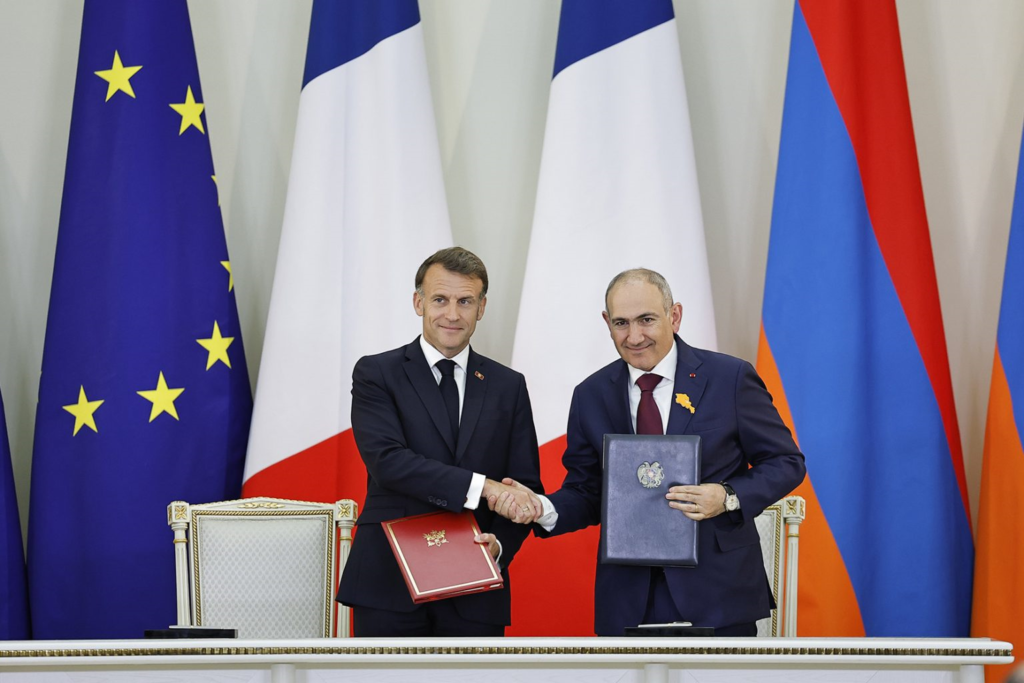

Macron’s visit to Armenia in early May 2026 should not be viewed merely as a courtesy visit. It came in the wake of the European Political Community (EPC) summit, in which both Armenia and Azerbaijan participate, and was followed the next day by an EU-Armenia summit. In this sense, the presence of the French head of state should be understood within overlapping European, bilateral, and regional contexts. More importantly, the visit signals a broader transformation in France-Armenia relations: from a relationship historically shaped by cultural ties and humanitarian engagement toward a more strategic partnership built around European integration, defense cooperation, economic connectivity, and regional stabilization.
With France being home to the third-largest Armenian diaspora in the world, after Russia and the United States, with around 500,000 people as of 2024, the two countries share a strong historical and emotional proximity. However, Macron’s visit was not aimed solely at consolidating these ties. More importantly, it sought to support Armenia’s rapprochement with the European Union and, in doing so, to send a clear message to Moscow.
The recent peace dynamic between Armenia and Azerbaijan after the Nagorno-Karabakh conflict was also part of the visit’s broader context, with France seeking to position itself as a central European actor in regional stabilization. Indeed, in a geopolitical environment marked by tensions among major powers and the risk that local conflicts may turn into proxy confrontations, it is in Europe’s interest, and especially in the interest of leading European actors such as France, to address conflicts in sensitive regions before other powers, particularly Russia, deepen their involvement.
For Paris, this visit is therefore a public sign of political support, but also a way to demonstrate France’s presence in the Caucasus. Located between the Black and Caspian Seas, Iran and Russia, and Europe and Asia, Armenia occupies a sensitive geographical and diplomatic position. By travelling to Yerevan, Macron is showing that France remains active in the region and intends to maintain its partnership with Armenia, both in supporting its strategic choices and in assisting efforts to stabilize the region.
Armenia is turning towards Europe
One of the main purposes of this state visit is to consolidate the growing ties between Armenia and the EU, which represent an important historical shift for Yerevan. However, such a transformation will not take place within a matter of days.
As a former member of the Soviet Union and still formally part of the Collective Security Treaty Organization (CSTO), Armenia retains important ties from the past. Russia also remains one of its primary sources of imports, which illustrates the ambiguity of the current situation: Armenia has not fully broken with its historical bonds, but it is clearly opening the door to future European prospects.
In this context, Macron’s role can be understood as that of a facilitator: an actor supporting dialogue between Yerevan and Brussels while keeping attention and visibility on this emerging relationship. The aim is also to show that France is not looking only toward Ukraine or the Mediterranean, but also toward the Caucasus, a region of strategic importance for diplomatic, commercial, and energy-related stabilization. This new approach will probably not advance quickly, but it is deeply tactical for both sides: for Armenia, it may offer a response to the uncertainties and tensions surrounding it; for Europe, it represents a way to open new perspectives in a crucial region while dealing with Russia on other fronts.
But why Europe? Following the CSTO’s failure to provide effective protection during Armenia’s conflicts and tensions with Azerbaijan, especially in 2020 and 2023, Armenia did not entirely cut its ties with the organization but began searching for alternative partnerships beyond the “post-Soviet” security framework. Yerevan could have chosen other options, such as focusing more heavily on its growing military cooperation with India, from which it has purchased systems including Pinaka multi-barrel rocket launchers, anti-drone platforms, and missiles, or deepening its partnership with Iran, one of the few neighboring countries with which Armenia has an open border and direct economic links. However, among these alternatives, the EU appears to be the partner most capable of filling multiple gaps for Armenia at once, which helps explain Yerevan’s strategic decision.
Emergence of Strategic Partnership
Regarding bilateral matters between France and Armenia, the two countries signed and exchanged a series of cooperation agreements, particularly in the fields of artificial intelligence, defense-related research and innovation, cybersecurity, and semiconductors.
For example, one of the documents exchanged in the presence of French President Emmanuel Macron and Armenian Prime Minister Nikol Pashinyan was an equipment supply agreement between Armenia’s Ministry of Defense and Sofema Group, a French company. Another document exchanged during the ceremony was an agreement with Airbus for the supply of transport helicopters.
Yet these partnerships are not the first defense agreements signed between the two countries. Since late 2023, Armenia has signed several contracts with French companies to strengthen its defense capabilities. It has purchased GM200 radar systems from Thales, Mistral short-range air-defense systems from MBDA, Bastion armored vehicles produced by Arquus, and CAESAR self-propelled howitzers from KNDS France, the latter contract being signed in June 2024.
This gradual increase in military purchases shows Armenia’s effort to diversify its defense procurement, moving away from reliance solely on former Soviet and Russian suppliers and drawing closer to Western ones.
Returning to the recent 2026 agreements, Macron’s signing of the joint declaration on strategic partnership, together with the exchange of several cooperation documents, marks a transformation in France-Armenia relations. A relationship once largely shaped by cultural ties and humanitarian engagement is now moving toward a more strategic and economic model. This paradigm shift opens new opportunities for both countries and brings the two governments, nations, and societies closer to a more balanced relationship. Until recently, the cultural and humanitarian dimension of the relationship often made it appear asymmetrical: France, a sovereign state and major power, engaging with a post-Soviet country whose foreign and security policy remained heavily shaped by its dependence on Russia.
Looking ahead, Paris’s interest in the Caucasus region can be expected to increase, in parallel with Washington’s growing engagement. In the current geopolitical context of power balancing, the region is likely to attract greater foreign attention. This raises an important question: how will Russia react? Given Moscow’s long-standing sensitivity toward the post-Soviet space and its desire to preserve influence in its former sphere of dominance, it remains uncertain whether Russia will tolerate former Soviet states moving closer to Western countries and bringing their strategic resources and partnerships with them.
