
Historical Context and Structural Foundations
The decades of the 1960s and 1970s marked a critical turning point in the evolution of the Middle East. During this period, Israel underwent profound transformation, achieving decisive military victories while also facing internal political tensions, demographic shifts, and increasing international scrutiny. These developments fundamentally altered the regional balance of power and redefined the nature of the Arab–Israeli conflict.
The origins of these transformations lie in the establishment of Israel in 1948 and its immediate consequences, particularly the Nakba, which resulted in the displacement of hundreds of thousands of Palestinians and the emergence of a protracted refugee crisis. In the decades that followed, the conflict remained unresolved, contributing to the Middle East’s position as one of the most volatile regions in the international system. At the same time, Cold War rivalries intensified regional dynamics, as Israel deepened its strategic partnership with the United States while several Arab states aligned more closely with the Soviet Union.
The 1967 War and the Reconfiguration of Regional Power
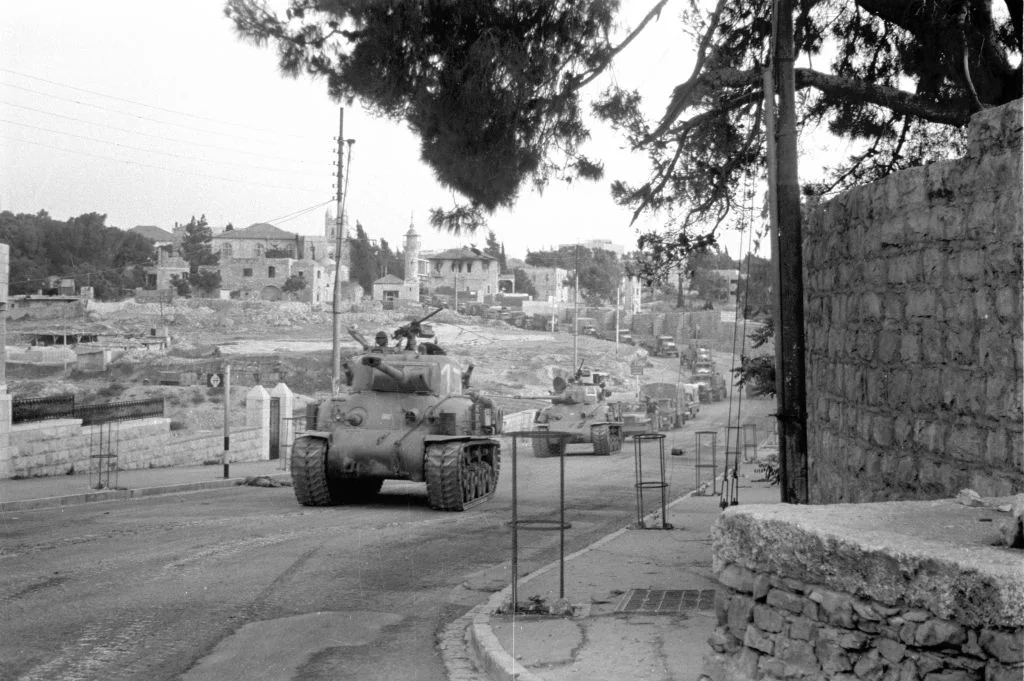
The Six-Day War constituted a watershed moment in the history of the Arab–Israeli conflict. Although brief, the war produced far-reaching consequences that reshaped both the territorial and political landscape of the region.
In the years preceding the war, rising Arab nationalism—led by Gamal Abdel Nasser—contributed to escalating tensions with Israel. The closure of the Straits of Tiran and the withdrawal of United Nations forces from the Sinai Peninsula heightened Israeli perceptions of imminent threat. In response, Israel launched a preemptive strike on June 5, 1967, quickly achieving military superiority over Egypt, Syria, and Jordan.
The outcome dramatically altered regional geopolitics. Israel’s occupation of the Sinai Peninsula, Gaza Strip, the West Bank (including East Jerusalem), and the Golan Heights established it as the dominant military power in the Middle East. However, these territorial gains also deepened the Palestinian refugee crisis and introduced enduring political and legal complexities associated with prolonged occupation.
The Arab defeat prompted widespread political reassessment, undermining the credibility of pan-Arab nationalism and encouraging a gradual shift toward diplomatic strategies. For Palestinians, however, the war marked a decisive turning point, catalyzing the emergence of a more organized and independent national movement.
The Emergence of Palestinian Nationalism
The 1960s witnessed the consolidation and expansion of Palestinian political identity. The establishment of the Palestine Liberation Organization in 1964 reflected a growing demand for independent representation and national self-determination. Following 1967, Palestinian resistance movements gained increased prominence and legitimacy.
Organizations such as Fatah adopted guerrilla warfare as a principal strategy, conducting operations against Israeli targets from neighboring states. These activities intensified regional tensions and complicated relations among Arab states.
At the same time, Palestinian nationalism began to evolve beyond the framework of broader Arab politics, asserting itself as an autonomous political force. Symbolic moments such as the Battle of Karameh reinforced the visibility and legitimacy of Palestinian resistance. Meanwhile, Israeli settlement expansion in the occupied territories introduced structural obstacles to conflict resolution, embedding territorial disputes more deeply within the political framework of the conflict.
Conflict, Realignment, and Diplomacy in the 1970s
The 1970s represented a period of transition characterized by the coexistence of military confrontation and diplomatic engagement. The aftermath of the 1967 war produced a prolonged condition often described as “no war, no peace,” in which territorial disputes persisted without comprehensive resolution.
Following the death of Nasser in 1970, Anwar Sadat pursued a dual strategy that combined military initiatives with diplomatic efforts aimed at recovering lost territories. At the same time, tensions between Palestinian organizations and the Jordanian state culminated in Black September, resulting in the expulsion of the PLO from Jordan and its relocation to Lebanon. This development contributed to increased instability in Lebanon and further regionalized the conflict.
At the international level, the Middle East remained a key arena of Cold War competition. Despite broader policies of détente, both the United States and the Soviet Union continued to support their respective allies, shaping the trajectory of regional conflicts.
The 1973 War and the Expansion of U.S. Influence
The Yom Kippur War marked a critical turning point in both military and political terms. The coordinated Egyptian and Syrian attack in October 1973 challenged the perception of Israeli military invincibility and reshaped strategic calculations across the region.
During the conflict, Henry Kissinger played a central role in crisis management, while the United States provided extensive military support to Israel. The risk of direct confrontation between the United States and the Soviet Union underscored the global stakes of the conflict and contributed to the eventual ceasefire.
In the aftermath, Kissinger’s “shuttle diplomacy” facilitated disengagement agreements between Israel, Egypt, and Syria, strengthening U.S. influence while reducing that of the Soviet Union. Concurrently, the Palestinian issue gained increased international recognition, particularly after Yasser Arafat addressed the United Nations General Assembly in 1974.
Political Transformation and the Move Toward Partial Peace
The latter half of the 1970s witnessed significant political change within Israel and across the region. In 1977, the electoral victory of the Likud under Menachem Begin marked a shift toward more hardline positions on territorial and security issues.
At the same time, diplomatic initiatives began to reshape regional dynamics. Anwar Sadat’s historic visit to Jerusalem in 1977 paved the way for the Camp David Accords and the 1979 Egypt–Israel Peace Treaty. These agreements removed Egypt from direct military confrontation with Israel, significantly altering the strategic balance in the Middle East, while also generating divisions within the Arab world.
Synthesis and Implications
The developments of the 1960s and 1970s fundamentally transformed the structure and dynamics of the Arab–Israeli conflict. This period witnessed a gradual shift from large-scale interstate warfare toward a more complex pattern of limited conflict, diplomatic negotiation, and international mediation.
At the same time, core issues—including Palestinian self-determination, Israeli occupation, and settlement expansion—remained unresolved, ensuring the persistence of the conflict. The influence of Cold War alignments further embedded regional tensions within a broader global framework.
These intertwined dynamics laid the structural foundations of the contemporary Middle East. The legacies of this era—territorial disputes, competing nationalisms, and external intervention—continue to shape both the persistence and the evolving character of the Arab–Israeli conflict.