
Introduction: A Shifting Security Landscape
Since 2022, the international security environment has undergone a structural transformation. The war in Ukraine revealed the depth of interdependence between European and Indo-Pacific security dynamics, accelerating a shift in how major multilateral institutions define their geographic scope and partnerships. The United States continues to affirm its commitment to NATO, while debates over burden-sharing and shifting strategic priorities have encouraged European policymakers to reflect more carefully on the long-term stability of transatlantic cooperation. The 2025 Hague Summit agreement to raise defence spending to 5% of GDP can be understood in this broader context. The decision was not solely about increasing military budgets; it also highlighted the importance of strengthening industrial capacity, innovation, and supply chain resilience, elements increasingly seen as integral to deterrence credibility.
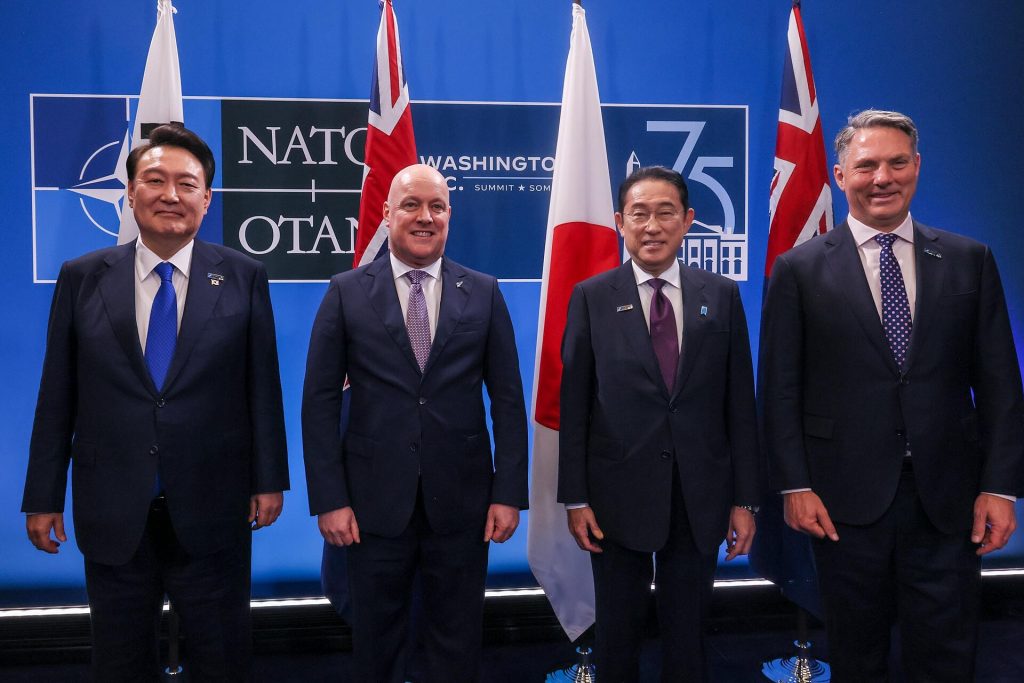
In parallel, NATO has expanded structured engagement with the Indo-Pacific 4 (IP4), comprising South Korea, Japan, Australia, and New Zealand. This development reflects growing recognition that security challenges in Europe and the Indo-Pacific are more closely linked than in the past. Developments involving North Korea, China, and Russia suggest that regional crises carry cross-regional implications, and NATO–IP4 cooperation can therefore be viewed as part of a broader effort to respond to an evolving and interconnected threat landscape.
For South Korea, this moment presents both an opportunity and a test. Korea is no longer simply an alliance partner of the United States; it is emerging as a structurally significant actor within a broader transatlantic-Indo-Pacific security architecture. This article examines the key dimensions of that role, with particular attention to Korea’s defence industrial contributions, its integration into the EU’s research ecosystem through Horizon Europe and FP10, and the potential of a Korean Hub as a coordination interface between NATO, the EU, and Korea’s own industrial and policy capabilities.
European Dynamics: Horizon Europe, FP10, and Security Convergence
European research and innovation policy has undergone a significant reorientation in recent years, with security implications that extend well beyond traditional defence policy frameworks.
Horizon Europe, with a budget of €95.5 billion for 2021–2027, is often described primarily as a research funding programme. In practice, more than half of its funding under Pillar II is directed toward digital technologies, industry, climate, energy, and space—domains that overlap significantly with NATO’s priorities in emerging and disruptive technologies. The distinction between civilian research and defence-relevant innovation has become harder to draw, and EU policy is adjusting accordingly.
The European Commission’s White Paper on European Defence (March 2025) made this connection more explicit, linking R&I investment to defence readiness in terms that would have been unusual in EU research policy a decade ago. Amendments to the Horizon Europe regulation now allow greater flexibility for dual-use technologies under the European Innovation Council Accelerator, signalling a shift that is likely to become more pronounced in the next framework programme.
FP10 (2028–2034), with a proposed budget of €175 billion, is designed to deepen the connection between research, industrial deployment, and market implementation. Its large-scale initiatives in artificial intelligence, quantum technologies, space systems, and advanced communications align closely with NATO’s technology agenda, and notably with the areas where Korea holds demonstrated industrial strengths.
Korea’s 2025 accession as an Associate Country to Horizon Europe Pillar II should be read in this context. Participation in Horizon is no longer solely a matter of research collaboration; it also means engagement with an institutional framework that is being progressively aligned with economic security objectives. Korea’s participation was strongest in Cluster 4 (Digital, Industry, Space) and Cluster 5 (Climate, Energy, Mobility)—areas that correspond closely to NATO’s technology priorities and to the dual-use focus of the evolving Horizon framework. In this sense, European research and industrial policy provides a longer-term institutional foundation that may help sustain NATO–IP4 cooperation beyond the current political moment.
Defence Industrial Cooperation at the Core of NATO–IP4 Engagement
While political dialogue remains a central feature of the NATO–IP4 relationship, defence industrial cooperation has become its most concrete and operationally relevant dimension.
The 2025 Hague Summit reinforced this direction. A portion of the new defence spending target was specifically directed toward innovation, cyber resilience, and industrial capacity. The NATO Defence Production Action Plan identified supply chain resilience and joint R&D as priorities, and explicitly referenced cooperation with Indo-Pacific partners as part of that effort.
For Korea, this is not yet a fully institutionalized relationship, but it is already a practical one. Korean K9 howitzers, K2 tanks, and ammunition have supplied NATO members whose stockpiles were drawn down by assistance to Ukraine. The September 2025 launch of the NATO–South Korea Dialogue on Defence Industrial Cooperation formalized discussions in areas including land systems, space, munitions co-production, and joint R&D. Korea also joined NATO’s Science and Technology Organization enhanced partnership programme in March 2025, creating a platform for cooperation in propulsion, artificial intelligence, and cybersecurity research.
These are meaningful steps. At the same time, much of the NATO–IP4 relationship still operates through dialogue frameworks and individual partnership programmes rather than coordinated operational planning. Moving toward more structured defence industrial arrangements, including joint production, procurement coordination, and shared standards, remains an open question rather than an accomplished fact.
Korea’s Strategic Position and the Korean Hub as Interface
Korea’s position within this evolving framework warrants examination on its own terms, rather than solely as one of four IP4 partners.
Korea maintains a formal alliance with the United States while also participating in the EU’s Horizon Europe framework as an associate member. This dual engagement situates Korea within both NATO’s political-security orbit and the EU’s research and industrial ecosystem. Among the IP4 countries, this combination is distinctive. It places Korea at a potential intersection between transatlantic security coordination and European technological governance.
Korea also possesses demonstrated defence production capacity at scale. The open question is whether this capacity remains primarily structured through bilateral export relationships, or whether it gradually becomes integrated into longer-term multilateral arrangements, including joint production, shared procurement, and co-development frameworks, that serve both Korean and allied interests.
Korea’s technological strengths in semiconductors, 6G, artificial intelligence, battery systems, and advanced manufacturing overlap with NATO’s emerging technology priorities and FP10’s anticipated investment focus. This alignment suggests a degree of structural complementarity. However, realising this potential would require more deliberate coordination than currently exists.
A further limitation is visible in Korea’s Horizon participation profile. Korean institutions did not assume coordinator roles in any of the selected projects. Participation without coordination restricts Korea’s ability to shape research agendas. Strengthening coordinator capacity, particularly in Cluster 4 and in areas connected to FP10’s Moonshot initiatives, represents a practical area for influence to expand.
Against this background, the Korean Hub may be understood less as a standalone initiative and more as a coordination mechanism. Its relevance lies in connecting NATO engagement, EU research participation, and Korea’s industrial and policy capabilities in a more systematic manner. Several areas appear particularly suited for such coordination. The most immediate is defence industrial cooperation: moving beyond individual procurement contracts toward joint production arrangements and shared supply chain resilience. Closely related is the need to link Korea’s Horizon and FP10 participation more directly to NATO’s DIANA programme, so that research investment and security priorities reinforce rather than run parallel to each other. Cooperation on artificial intelligence and dual-use governance represents a third area of growing importance, given the increasing overlap between NATO capability requirements and EU regulatory frameworks. Two further domains merit attention: expanded coordination on cyber and hybrid threats affecting Korean and NATO member infrastructure alike, and maritime and autonomous systems cooperation that could draw on Korea’s considerable shipbuilding expertise.
Advancing these areas would likely benefit from strengthened institutional arrangements. Possible measures include a dedicated Korea–NATO liaison presence in Brussels, regular working-level dialogue among Korea, NATO, and the EU on technology and industrial policy, and more structured coordination mechanisms across IP4 partners.
Conclusion: Toward a More Structured Partnership
The NATO–IP4 framework is still evolving, and Korea’s place within it is not yet fully defined. But the direction of travel is clear. Security cooperation is deepening, research and industrial policy are converging with defence priorities, and the distinctions between bilateral and multilateral engagement are becoming less sharp.
Korea’s distinctive position as a US ally, a Horizon Europe associate, and a major defence producer gives it a structural role that none of the other IP4 partners fully replicates. Whether that role is realised depends on whether Korea can move beyond participation toward coordination: shaping research agendas, anchoring multilateral production arrangements, and building the institutional linkages that make sustained engagement possible.
In this sense, the establishment of a Korean Hub does not in itself resolve the broader strategic questions at stake. Rather, its significance lies in whether it can facilitate more consistent and institutionalized engagement between Korea and its transatlantic partners over time. The foundation is in place; the architecture remains to be built.