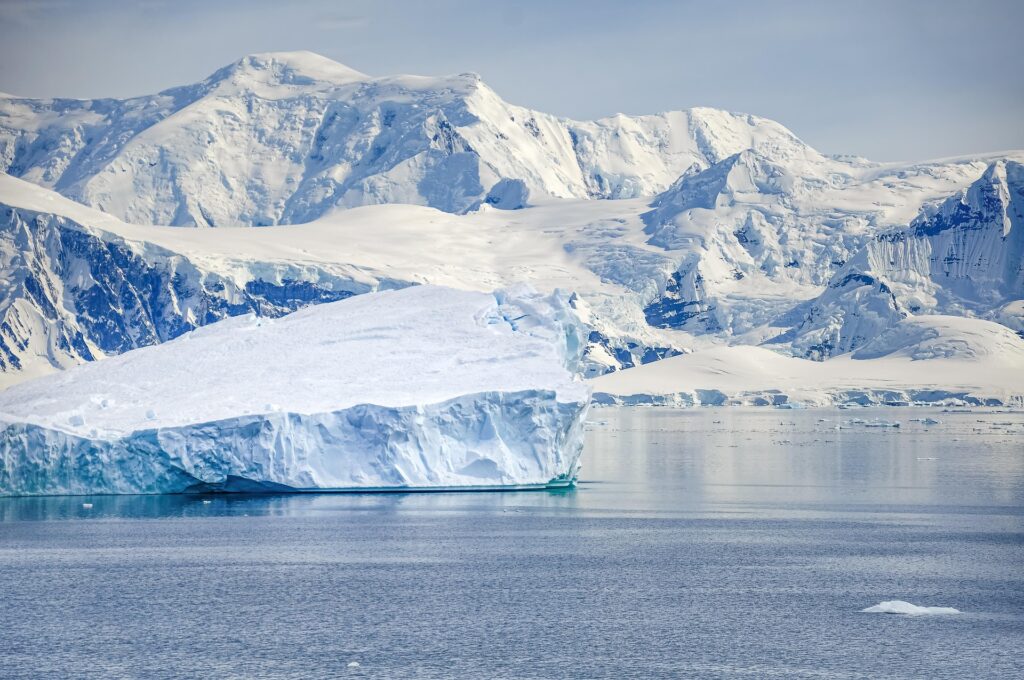

1. The Polar Regions at a Crossroads: Environmental Challenges and Geopolitical Interests
The polar regions, comprising the Arctic and the Antarctic, are characterized by extreme climatic conditions, geographical remoteness, and ecological fragility. Despite these challenges, advances in science and technology and growing economic interests have significantly increased human engagement with these regions. As a result, the polar areas are no longer isolated frontiers but have become central to global environmental and geopolitical dynamics.
The Arctic, located north of the Arctic Circle (approximately 66°N), includes the Arctic Ocean and surrounding territories of states such as Russia, Canada, Norway, and the United States. The Antarctic, situated south of the Antarctic Circle (approximately 66°S), is governed under a distinct international legal regime extending to 60°S latitude. Both regions play a critical role in regulating the Earth’s climate due to their high albedo, yet they are increasingly vulnerable to climate change, which is accelerating ice melt, raising sea levels, and disrupting global ecosystems.
At the same time, diminishing ice coverage—particularly in the Arctic—is opening new maritime routes and access to natural resources, intensifying geopolitical competition. While the Arctic is governed through a combination of national jurisdiction and cooperative frameworks such as the Arctic Council, the Antarctic is regulated by the Antarctic Treaty System, which emphasizes peaceful use and scientific cooperation.
Against this backdrop, international law plays a crucial role in balancing environmental protection, economic interests, and political competition. This paper aims to classify international legal regimes applicable to the polar regions in order to better understand their structure, scope, and function. Through this classification, it seeks to highlight both the strengths and limitations of current legal frameworks in addressing emerging challenges.
2. Typology of International Legal Regimes in the Polar Regions
International legal regimes governing the polar regions can be systematically classified according to several criteria, including their scope of application, geographical coverage, and participation structure.
2.1. General Treaties vs. Polar-Specific Treaties
The first classification distinguishes between general international treaties and those specifically designed for the polar regions.
(1) General Treaties Applied to the Polar Regions
Examples include the United Nations Convention on the Law of the Sea (UNCLOS) and the International Convention for the Prevention of Pollution from Ships (MARPOL).
These treaties were not originally created for polar governance but have significant applicability to polar conditions. UNCLOS provides a comprehensive legal framework for maritime zones, resource management, and environmental protection, while MARPOL regulates pollution from ships operating in sensitive marine environments, including polar waters.
(2) Polar-Specific Treaties
Examples include the Svalbard Treaty and the Antarctic Treaty.
These treaties were specifically designed to address the unique geopolitical and environmental characteristics of the polar regions. They establish specialized legal regimes tailored to regional conditions, including sovereignty arrangements and restrictions on resource exploitation.
2.2. Classification by Geographical Scope
A second classification is based on the geographical scope of application.
(1) Treaties Applicable to Both Polar Regions
Examples include MARPOL, the International Convention for the Regulation of Whaling, and the Polar Code adopted by the International Maritime Organization.
These treaties address global environmental and maritime issues and are therefore applicable to both the Arctic and Antarctic regions.
(2) Arctic-Specific Treaties
Example: the Svalbard Treaty.
This treaty governs the Svalbard archipelago and represents a unique legal arrangement balancing national sovereignty with international economic access.
(3) Antarctic-Specific Treaties
Examples include the Antarctic Treaty and the Protocol on Environmental Protection to the Antarctic Treaty.
These agreements form part of a comprehensive legal system that designates Antarctica as a zone for peaceful purposes, scientific research, and environmental protection.
2.3. Classification by Participation and Legal Structure
A third classification focuses on the number and distribution of participating states.
(1) Multilateral Treaties
Examples include MARPOL, the Svalbard Treaty, and the Antarctic Treaty.
These agreements involve multiple states and often establish broad legal frameworks with global or regional significance.
(2) Regional Agreements
Examples include the Ottawa Declaration and the Ilulissat Declaration.
Regional agreements typically involve states with direct geographical or strategic interests in the polar regions and focus on cooperation and coordination.
(3) Bilateral Agreements
Examples include the Alaska Purchase Treaty and Norway–Russia agreements concerning the Barents Sea and the Arctic Ocean.
These agreements address specific issues between two states, such as territorial delimitation, resource management, and environmental cooperation.
3. Evaluation and Implications of the Classification
The classification of international legal regimes in the polar regions reveals both the complexity and fragmentation of the existing legal framework. While general treaties provide broad and flexible rules applicable across regions, polar-specific treaties offer more tailored and effective governance mechanisms. Similarly, geographical distinctions highlight the contrast between the relatively integrated legal regime of Antarctica and the more decentralized and state-driven governance structure of the Arctic.
However, this classification also exposes important limitations. The coexistence of multiple legal regimes can lead to overlaps, inconsistencies, and gaps in regulation. In particular, the Arctic lacks a single comprehensive legal framework comparable to the Antarctic Treaty System, resulting in weaker enforcement and greater reliance on state cooperation. Furthermore, increasing geopolitical competition and climate change pose significant challenges that existing legal instruments may not fully address.
Therefore, while current international legal regimes provide an essential foundation for polar governance, there is a growing need for enhanced coordination, stronger enforcement mechanisms, and greater harmonization between international and domestic legal systems. Such efforts will be crucial to ensuring sustainable development, environmental protection, and peaceful coexistence in the polar regions.