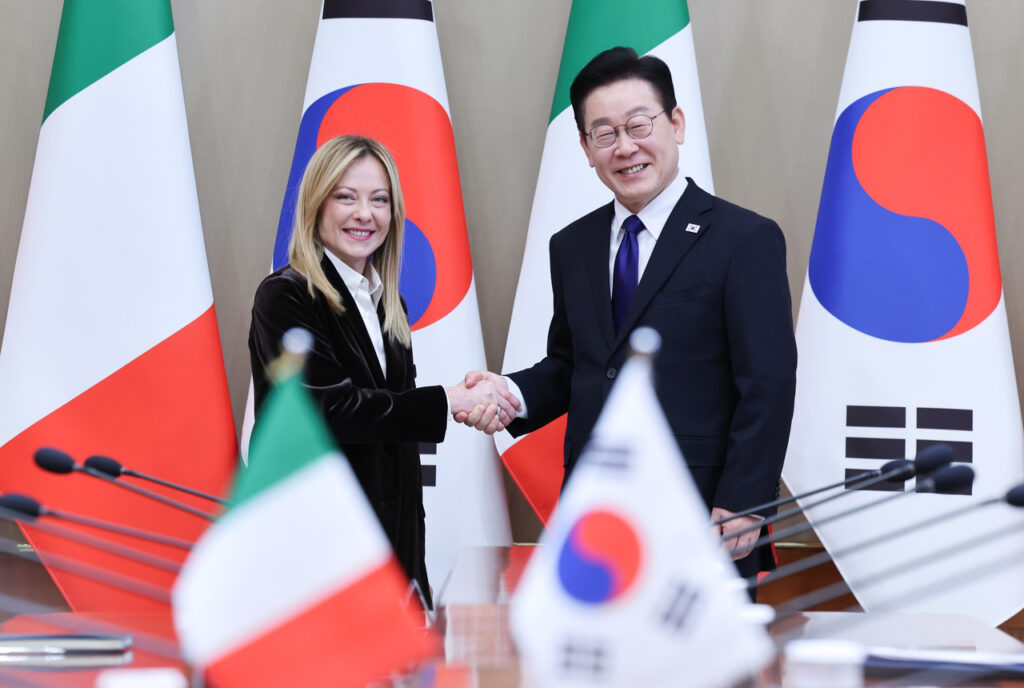

While the eyes of the world are on turmoil in the Middle East and the Persian Gulf, and on Russia’s ongoing war of aggression against Ukraine, the relevance of an assessment of relations between a European and an East Asian middle power is not immediately evident. Now does not seem to be the opportune moment to focus on bilateral relations between comparatively stable liberal democracies that are not directly involved in the attacks on Iran despite their traditional alliance with the United States.
There are, however, good reasons to take a closer look and develop a better understanding of these relations, both as a result of the particular political agenda at this time, but also for much more profound reasons related to the profound transformation that the international system is undergoing. With regard to the former, there is the intensification of bilateral diplomacy, with the state visit of Italy’s Prime Minister to South Korea in January 2026, and a possible visit by the Korean President Lee Jae Myung to Italy later in the year. As a matter of fact, Meloni reaffirmed the invitation to the Korean President after her return to Rome.
One reason for this intensification of top-level contacts between the two countries is likely the growing strategic relevance of middle powers developing closer direct links beyond and outside the traditional alliance structures and multilateral regimes. As a matter of fact, it is precisely because countries such as Italy and South Korea are not directly involved in unilateral actions of their long-time ally, the United States, that there would seem to be growing scope, and arguably a pressing need, to coordinate their foreign and security policy directly with one another.
South Korea and Italy: Middle Powers in the Same Geopolitical Boat
In many ways Italy and South Korea are in the same geo-strategic boat: militarily, both are traditional allies of the united states, with US troops, assets and bases on their territory, beneficiaries of long-standing US security guarantees and the so-called nuclear umbrella; economically, both are advanced, industrial and export-oriented economies that have been targeted by the tariff war unleashed by the second Trump administration, and that are also likely suffering the consequences of the oil price shock and energy crisis resulting from attacks on, and counter-attacks from, the Islamic Republic of Iran; diplomatically, both are long-standing advocates of international law, global governance and multilateralism through institutions such as the EU, NATO (incl IP4), G7 and G20 as well as the broader support they give to the United Nations and its agencies.
It is the crisis of the latter – the demise of the rules-based international order and even the prospect of a ‘death of international law’ – that is of great concern to all middle powers that benefitted from the stability and prosperity provided by the international system over the past 50 years or more. They are bound to be losers in a new era of realpolitik in which a small circle of unaccountable global leaders hold unrivalled power and take unilateral action that only benefits themselves, and where the costs – economic, humanitarian or normative – are borne by everyone.
For traditional US allies such as Italy and South Korea, unilateral American actions and threats, in particular those that contravene international norms, create difficult choices in their foreign policy and even impacting on their domestic politics. Confronted with the economic coercion inherent in the Trump administration’s trade policy – the imposition of punitive tariffs following the so-called “Liberation Day”, the American demand for financial ‘compensation’ for their trade deficit and the transactionalist – some might say extortionist – shift in US foreign policy has been met by a twofold response by the US’s traditional allies in Europe and East Asia: first, to reaffirm the commitment to, respectively, the transatlantic and transpacific alliances and the engagement in discourses about the need to maintain US security guarantees in the face of latent threats from Russia (in Europe), China and North Korea (in East Asia). Such responses to explicit US hostility in trade matters result from the far-reaching dependency of countries such as Italy and South Korea on defence cooperation with the US, and their inability, at least in the short- or medium-term, to envisage any independent security policy. Beyond the harsh reality of military needs there also seems to be a deep-seated cognitive inability for policy-makers in these countries to conceive of a future strategic arrangement for their countries without the continuation of the US alliance, regardless of the contrary signals being emitted by Washington in this regard, and European and East Asian reactions to economic coercion has essentially been couched in terms of efforts to keep the Americans on board.
Second, and essentially on the basis of this reasoning, individual countries and the EU as a whole have sought to negotiate trade ‘deals’ with the US that would minimize the economic damage, maintain a degree of access to the US market and allow the confrontation to be resolved in a way that can then be presented as an “agreement” between the two sides, and hence the continuation of the alliance. In the case of Europe, the deal resulting from these negotiations – the so-called Turnberry Agreement – involved an agreement on asymmetrical tariffs, albeit reduced to 10% from the initially threatened 25% by the US, as well as commitments about future European imports that would help to balance the deficit in the goods trade between the two sides. In the case of South Korea, an even less favorable deal involved the reduction of US tariffs to 15% (from the threatened 25%) as well as the Korean commitments of investments to the tune of hundreds of billions in the US.
In both cases – South Korea and the European Union – the ultimate outcome of these ‘deals’ remains uncertain in early 2026, due to domestic opposition, delays in parliamentary approval and other distractions such as the US Supreme Court judgement ruling the Trump administration’s unilateral tariff rises unconstitutional. What is evident, nevertheless, on the basis of the developments so far, is that middle powers in both East Asia and in Europe have been struggling to complete the domestic ratification of their agreements with the US, and that the eventual implementation is far from assured.
The situation facing South Korea and Italy then is very similar, both in terms of the challenges they face in the current era of global politics, and with regard to their responses in navigating these risks. The situation for other East Asian countries such as Japan and Taiwan, and for the European Union as a whole, is also comparable. Indeed, all middle powers that are traditional allies of the United States, and that have a shared interest in, and have declared their support for, the rules-based international system, find themselves in the same boat – raising the question to what extent these ‘friends of multilateralism’ might coalesce around a common strategy to uphold global norms and confront economic coercion from great powers.
Before addressing this question with some hypothetical answers, it will be useful to take a closer look at the state of play of the bilateral relations between South Korea and Italy, in order to establish the foundation from which closer cooperation and a common purpose vis-à-vis great powers could develop.
Bilateral Relations between South Korea and Italy: Areas and Frameworks of Cooperation
Relations between South Korea and Italy increasingly unfold within the broader institutional framework of the European Union. While bilateral diplomacy and economic exchange remain important, the most significant dimensions of the relationship are shaped by EU-level trade policy, regulatory frameworks, industrial strategies, and geopolitical positioning in the Indo-Pacific. In addition, external pressures—particularly shifts in US trade and industrial policy under the administration of Donald Trump—have influenced how both the European Union and South Korea approach economic and technological cooperation. These dynamics create both opportunities and challenges for South Korea–Italy relations.
The central institutional framework shaping economic relations between South Korea and Italy is the EU–South Korea Free Trade Agreement, which entered into force in 2011. The agreement significantly reduced tariffs on goods and created mechanisms for regulatory cooperation in areas such as intellectual property protection, services, and public procurement.
For Italy, the agreement has facilitated exports of high-value industrial products, including machinery, chemicals, and automotive components, as well as luxury goods and fashion. South Korean exports to the European market, including automobiles, electronics, and industrial equipment, have also expanded substantially.
However, because trade policy is an exclusive competence of the European Union, Italy cannot independently negotiate trade arrangements with South Korea. While the EU framework provides a large integrated market and strong negotiating power, it also means that bilateral economic diplomacy operates within the constraints of EU-level policy decisions. The European Union plays a major role in shaping global regulatory standards, often described as the “Brussels effect.” EU rules on data protection, environmental regulation, consumer safety, and competition policy shape the operating environment for South Korean firms in Europe.
Large Korean companies such as Samsung Electronics, LG Electronics, and Hyundai Motor Company must therefore adapt their products and corporate strategies to EU regulatory frameworks when operating in the European market. Italy, as one of the largest EU economies and a major manufacturing hub in Southern Europe, plays a key role in implementing these regulatory regimes and hosting European operations of Korean firms.
Technological competition has become a defining feature of contemporary international relations. Both South Korea and the European Union are seeking to strengthen their positions in strategic sectors such as semiconductors, artificial intelligence, and electric vehicle batteries. South Korea remains a global leader in semiconductor manufacturing through firms such as SK Hynix and Samsung Electronics, while the European Union has launched initiatives aimed at strengthening its own technological capabilities and reducing supply chain vulnerabilities.
Italy participates in these EU initiatives through industrial partnerships, research funding, and participation in European innovation programs. Cooperation with Korean firms in areas such as battery production, advanced manufacturing, and green technologies offers significant potential benefits. Italian industrial clusters—particularly in automotive supply chains and precision manufacturing—could complement Korean technological capabilities. Nevertheless, industrial policy coordination remains complex. The EU’s growing emphasis on technological sovereignty and strategic autonomy may occasionally create tensions with external partners, including technologically advanced countries such as South Korea.
Beyond economic issues, the relationship between South Korea and Italy is also influenced by evolving geopolitical dynamics. The European Union has developed an Indo-Pacific strategy aimed at strengthening engagement with key partners in the region. South Korea is a natural partner in this context due to its technological capabilities and its strategic location in Northeast Asia.
Italy supports EU engagement with the Indo-Pacific and participates in diplomatic initiatives and economic cooperation frameworks in the region. Security challenges related to North Korea’s nuclear program also remain relevant, as Italy participates in international sanctions regimes coordinated through the United Nations.
Cultural exchange represents another important dimension of South Korea–Italy relations. The global expansion of Korean popular culture has significantly increased interest in Korean society and culture across Europe. Cultural phenomena such as the television series Squid Game and internationally successful music groups like BTS have contributed to growing awareness of Korean culture in Italy.
At the same time, Italian cultural influence remains strong in South Korea, particularly in areas such as fashion, design, cuisine, and architecture. Italian luxury brands and cultural institutions continue to enjoy high prestige among Korean consumers. Educational and cultural exchange programs supported by European initiatives such as Erasmus+ further strengthen long-term societal connections between the two countries.
Conclusion
As the above discussion shows, South Korea–Italy relations are deeply embedded in the broader framework of EU–Asia relations. Trade agreements, regulatory standards, industrial policies, and geopolitical strategies developed at the European Union level shape the conditions under which bilateral cooperation takes place. Within this broader inter-regional framework, the specifics of South Korea-Italy relations play out, and have so far been characterized by targeted cooperation and the search for mutual benefit.
External developments—particularly the risks and threats emanating from oscillations in US trade policy during the second Trump administration—have further influenced this relationship by encouraging both the European Union, and with it Italy, and South Korea to diversify economic partnerships and defend the rules-based trading system. In this evolving global environment, Italy can play an important role in strengthening EU engagement with South Korea in areas such as advanced technologies, sustainable development, and cultural exchange.
As global economic and geopolitical dynamics continue to evolve, and geopolitical threats multiply, the interaction between EU policies, transatlantic trade tensions, and Indo-Pacific strategic developments will remain central to the future trajectory of South Korea–Italy relations. Beyond the strengthening of their bilateral relationship that also has potentially far-reaching implications for deeper cooperation with other middle powers globally. While on the European side, the Trump administration’s policies have further accelerated the search for strategic autonomy combined with selective connectivity, South Korea has embarked on a policy of “diversifying strategic partnerships”, specifically targeting closer cooperation with other middle powers such as Canada and Australia. Arguably, on both sides, for South Korea and for Italy, these are the seeds for a new departure in global politics where middle powers come together in defense of the rules-based international system and collectively confront the coercive policies of the great powers they currently face individually – a classic case of what Benjamin Franklin’s adage that “if we don’t hang together, we will all hang separately”.
