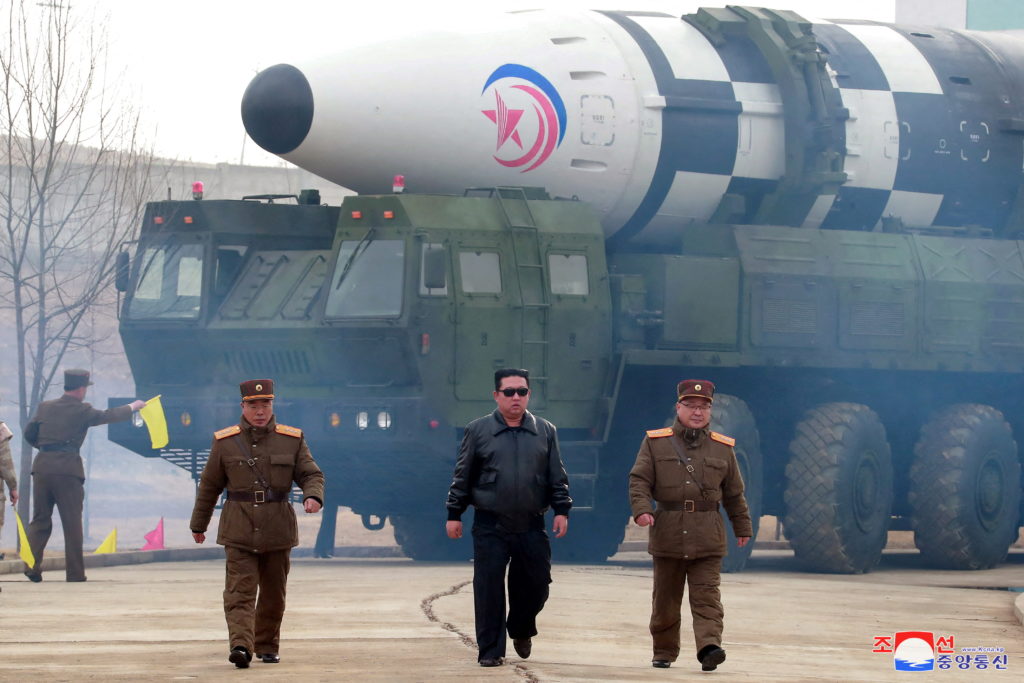

South Korea has a new president openly willing to talk to North Korea. The United States has a president who has never hidden his desire to sit across from Kim Jong-un. And yet, North Korea trusts neither of them. This is the central paradox confronting the Korean Peninsula in 2026 — and it is precisely why the upcoming U.S.–China summit matters far more to Seoul than it might initially appear.
The Lee Jae-myung administration has staked its North Korea policy on a phased, dialogue-first approach: reduce hostility first, build trust incrementally, and address the nuclear question from a more stable foundation. It is a coherent strategy. But its success depends on a precondition the administration cannot deliver alone — getting North Korea back to the table. Pyongyang, burned by the failed summits of 2018 and 2019 and currently treating South Korea as a hostile state, has little incentive to engage on Seoul’s terms or Washington’s. That leaves Beijing as the one actor with both the access and the leverage to change North Korea’s calculus. Whether the U.S.–China summit creates the conditions for China to play that role will, in large part, determine the diplomatic space available to the Lee administration in the months ahead.
The Policy Orientation of the Lee Jae-myung Administration on North Korea
Three key conceptual pillars are explicitly identifiable in the Lee administration’s approach to North Korea. The first is a phased approach, a strategy under which improvements in inter-Korean relations and progress on the nuclear issue are pursued incrementally rather than simultaneously, proceeding through successive stages of trust-building, tension reduction, cooperative engagement, and long-term resolution. This approach has been a recurring feature of progressive South Korean governments’ engagement with the nuclear question. Given the structural complexity of the problem and the demonstrated inadequacy of comprehensive single-step solutions, phased agreements and staged implementation measures are regarded as indispensable. The Lee administration’s prioritization of dialogue reflects this logic. In light of the sharply deteriorating and ultimately hostile character of inter-Korean relations under recent administrations, the administration’s judgment is that the initial prerequisite for improvement is the establishment of mutual understanding through official-level contacts. From this basis of tension reduction, a more evidence-grounded approach to the nuclear question can then be pursued.
The second pillar is peaceful coexistence, which prioritizes recognition of the North Korean regime and the management of adversarial relations through stabilization rather than transformation. The emphasis is on reducing military tensions and sustaining stable inter-Korean relations as ends in themselves. Like his predecessor President Moon Jae-in, President Lee has stated his commitment to preserving the North Korean regime and his categorical rejection of reunification by force. The administration thus seeks to manage hostile relations through dialogue and to sustain the status quo through coexistence. While the long-term question of how peaceful coexistence is to be maintained absent denuclearization remains unresolved, the immediate goal is the minimization of hostility. The Moon administration’s experience is instructive in this regard: although no substantive denuclearization progress was achieved, inter-Korean hostility was substantially reduced and, through military confidence-building agreements, provocations were meaningfully contained. The Lee administration appears to aim at least partially to restore the conditions achieved under that precedent.
The third pillar is an engagement- and cooperation-focused approach, which emphasizes the resumption of dialogue, the provision of humanitarian assistance, and the promotion of economic and social exchanges as instruments for building mutual trust and progressively normalizing inter-Korean relations. The Lee administration accordingly intends to maximize efforts toward normalization by combining renewed dialogue with sustained exchanges and cooperation. While North Korea’s willingness to engage — given its current posture of designating South Korea as a hostile state — is the decisive variable, a constructive response from Pyongyang would offer the potential for sustained contact of the kind observed under the Moon administration. Although no further denuclearization progress was achieved during the previous administration, considering the inherent difficulty of reducing hostility and achieving denuclearization, consistent efforts indicate a clear intention to maintain, at least partially, a peace regime, even if not permanent.
The Practical Implications of the U.S.–China Summit
Although inter-Korean hostility persists, the inauguration of the Lee administration constitutes a positive structural opportunity for initiating change. Concurrently, President Trump has consistently signaled a willingness to engage with North Korea independent of denuclearization preconditions, thereby raising the prospect of resuming dialogue within a trilateral framework involving South Korea, North Korea, and the United States. Yet, as noted above, North Korea is unlikely to extend meaningful trust to the Trump administration at this juncture, which underscores the potential indispensability of China’s diplomatic role. Notably, North Korean Chairman Kim visited China prior to each of the inter-Korean and U.S.–North Korean summits of 2018 and 2019, engaging with President Xi Jinping on three separate occasions. This pattern confirms that China retains the capacity to function as a key diplomatic actor capable of influencing the trajectory of Korean Peninsula affairs.
Should China succeed in bringing North Korea to the negotiating table, even in a limited capacity, the prospect of establishing a four-party dialogue channel involving South Korea, North Korea, the United States, and China—alongside direct U.S.–North Korea negotiations—would become viable. Although questions regarding the durability of such a mechanism would inevitably arise, paralleling historical uncertainties surrounding the Six-Party Talks, the act of initiating dialogue and convening the principal stakeholders to address the nuclear issue carries considerable intrinsic significance.
President Lee has already held bilateral meetings with President Xi during his visit to China, and the anticipated U.S.–China summit during President Trump’s visit would complete preliminary contacts among the major stakeholders, with North Korea as the sole remaining party. Given that President Lee reaffirmed his willingness to resume dialogue with North Korea during his early meeting with President Trump at the White House, the critical next step is for the United States to leverage its dialogue with China to create conditions conducive to North Korean re-engagement. Whether North Korea will respond positively to South Korea’s proposals for dialogue and cooperation remains uncertain; however, the potential for movement exists if China is able to serve as an effective intermediary. The U.S.–China summit therefore carries inherent strategic significance for South Korea and will inevitably shape the operating environment of the Lee administration’s North Korea policy. Since President Lee has already communicated his approach toward North Korea to both Presidents Trump and Xi, the degree to which that approach finds expression in actual policy outcomes will ultimately depend on the diplomatic dispositions of both Washington and Beijing.
The upcoming summit could affect the Lee administration’s approach to the North Korean nuclear issue through several distinct channels. First, if the summit produces substantive discussions on North Korea-related cooperation and management frameworks, South Korea would gain diplomatic space in which to calibrate its phased approach and peaceful coexistence strategy. Second, depending on the outcomes, if it triggers a shift in U.S. deterrence posture on the Peninsula, the robustness of the U.S.–South Korea alliance itself becomes a key consideration — one that both enables and constrains South Korea’s range of policy options. Third, if China is able to exercise meaningful influence over North Korea, the South Korean government would gain strategic flexibility to pursue its engagement- and cooperation-focused agenda; conversely, heightened U.S.–China strategic competition would make diplomatic balance and risk management the overriding priority.
In sum, the U.S.–China summit is likely to function as a critical variable shaping the diplomatic environment and strategic parameters within which South Korea navigates the North Korean nuclear issue. This influence is inherently dual-faceted: in a favorable scenario, China may act as a key mediator facilitating North Korean engagement with dialogue; in an adverse scenario, a failure of Washington and Beijing to reach common ground—or a narrowing of the summit’s agenda to trade and bilateral positioning—could severely constrain South Korea’s capacity to develop independent policy solutions on the nuclear question in the near term.
Conclusion
The forthcoming U.S.–China summit represents a pivotal variable in shaping South Korea’s approach to the North Korean nuclear issue. Its outcomes will determine the available diplomatic space, inform necessary adjustments to the Lee administration’s phased and engagement-oriented strategies, and define the potential scope of China’s mediating role. Favorable outcomes could facilitate dialogue and contribute to a reduction of hostility on the Korean Peninsula; unfavorable outcomes—particularly a failure to achieve convergence between Washington and Beijing—could significantly circumscribe South Korea’s independent policy options.
Given the considerable structural weight that a U.S.–China summit carries in the contemporary international system, its potential reverberations for the North Korean nuclear issue and the broader range of Korean Peninsula concerns are necessarily significant. This underscores that the summit is not merely a bilateral engagement between the two great powers, but a pivotal event with direct implications for inter-Korean relations, regional stability, and the strategic environment within which the Lee administration formulates and executes its North Korea policy.
