“The Caspian Region Is Entering a New Geopolitical Order”
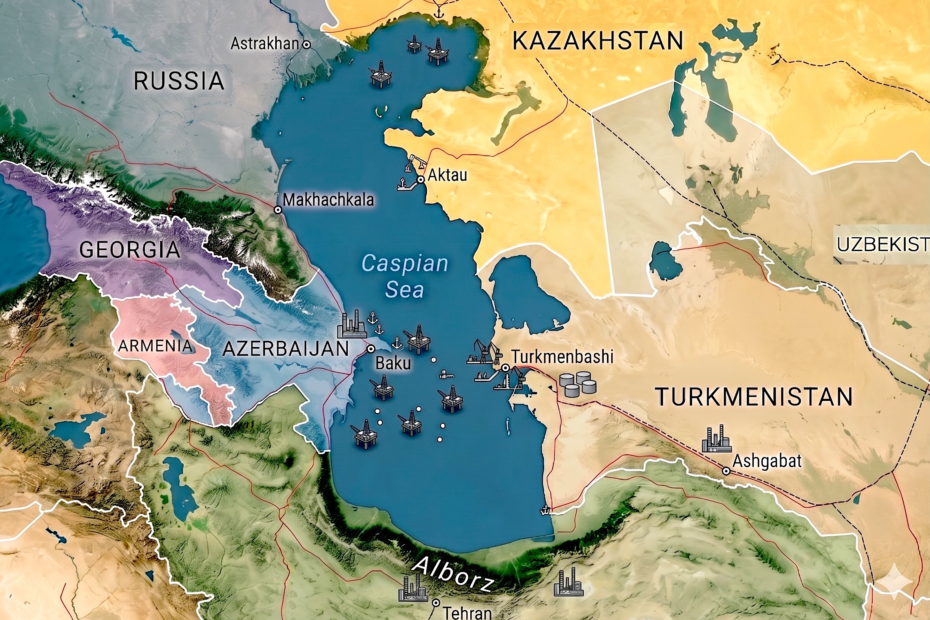
The South Caucasus and the wider Caspian region are experiencing a period of rapid geopolitical transformation shaped by shifting power balances, regional connectivity projects, energy diplomacy, and increasing competition among global and regional actors. Recent developments surrounding the Middle Corridor, post-Soviet regional dynamics, the Russia-Ukraine war, and growing tensions involving Iran have further elevated the strategic importance of Eurasia in international politics. To better understand these developments, we spoke with Dr. Vasif Huseynov, head of department at the Center of Analysis of International Relations (AIR Center), specializing in post-Soviet affairs, regional security, the South Caucasus, and Caspian geopolitics. In this interview, he shares his assessments on the evolving regional order, connectivity initiatives, great power competition, and the broader implications of current crises for the Caucasus and Eurasia. Q1. In recent years, the South Caucasus has undergone major geopolitical transformations following the Second Karabakh War. How do you assess the current regional order emerging between Azerbaijan, Armenia, and external powers?The Second Karabakh War of 2020 and, even more decisively, the September 2023 restoration of Azerbaijan’s full sovereignty over the territories formerly occupied by Armenia, fundamentally reset the structural parameters of regional politics. For three decades, the unresolved conflict served as the central organizing principle around which every other regional dynamic, including security alignments, infrastructure choices, external power engagement, was calibrated. That era is over. What we are witnessing now is an accelerated but still incomplete transition toward a genuinely new regional order, one whose final contours are not yet settled. The most consequential shift has been in the balance between external patrons and regional agency. Russia, which had positioned itself as the indispensable security guarantor and mediator, has suffered a structural credibility collapse in the region. The CSTO, which existed primarily as a Russian instrument for maintaining Armenian dependency, has been effectively abandoned by Yerevan. The August 2025 Washington Joint Declaration, initialled by Armenia’s Prime Minister Nikol Pashinyan and Azerbaijan’s President Ilham Aliyev under US mediation, confirmed that the peace process has largely escaped Moscow’s control. This is an extraordinary reversal in a region where Russia had been the dominant external actor for the past two centuries. For Azerbaijan, the post-war period has opened strategic options that were structurally unavailable before 2020. The restoration of territorial integrity has removed the principal obstacle to normalization with Armenia and to the operationalization of transport connectivity across Azerbaijani territory, including a land passage (i.e. Zangezur corridor) that will connect mainland Azerbaijan with its Nakhchivan exclave via the southern Armenian territory. Azerbaijan has simultaneously deepened its energy partnership with the European Union — the 2022 Memorandum of Understanding on strategic energy partnership, the subsequent expansion of Southern Gas Corridor supplies, and the emerging Green Corridor renewable energy initiative all reflect a deliberate Azerbaijani strategy of embedding itself as an indispensable European energy and connectivity partner before the post-conflict political architecture fully solidifies. The role of external powers is in rapid flux. The United States has re-entered the South Caucasus as an active diplomatic force, with the TRIPP initiative and the Armenia-Azerbaijan peace process serving as its primary instruments. The European Union remains the region’s largest economic partner but is institutionally divided — the gap between the EU executive’s pragmatic energy and connectivity engagement with Azerbaijan and the European Parliament’s politically driven resolutions has created a structural incoherence that both Baku and Brussels are struggling to manage. Türkiye has consolidated its role as a direct stakeholder through the Shusha Declaration (2021) and deepening military cooperation with Azerbaijan. And China is emerging as a significant commercial player, particularly through Middle Corridor investment and its Anaklia port consortium involvement in Georgia. The emerging regional order is therefore not a return to any prior configuration. It is something genuinely new: a South Caucasus in which the largest unresolved conflict is moving toward conclusion, in which multiple external powers are competing on connectivity, energy, and economic terms rather than primarily through security frameworks. Q2. The Caspian region is increasingly discussed not only as an energy hub but also as a connectivity corridor linking Europe and Asia. Do you think the Middle Corridor can become a sustainable strategic alternative to northern and southern trade routes?I believe the Middle Corridor has already crossed the threshold from a political aspiration to a commercially viable alternative route — and the trajectory is pointing toward further consolidation rather than retreat. The question is no longer whether the corridor can function, but how rapidly its capacity constraints can be resolved and how durably its political foundations can be secured. The numbers speak to genuine momentum. Container traffic through the Middle Corridor reached 76,900 TEU in 2025, a 36 percent increase over 2024. Azerbaijan Railways handled 350 block trains from China via Central Asia in 2025, up 34 percent year-on-year. The Baku International Sea Trade Port at Alat processed nearly 97,000 TEU in the first eleven months of 2025, a 40.8 percent increase on the same period in 2024. The completion of the Baku-Tbilisi-Kars railway’s Georgian segment upgrade has raised line capacity considerably. These are not projections — they are documented throughput figures reflecting real commercial decisions by freight operators who have concluded that the corridor is reliable enough to route business through it. The structural drivers of this growth are durable. The EU ban on cargo transit through Russia, the disruptions to the Red Sea shipping lanes, and European supply chain diversification imperatives have all simultaneously pushed freight operators toward alternatives. The Middle Corridor’s comparative advantage — a sanctions-free, politically stable route that does not depend on Russian infrastructure at any point — becomes more valuable, not less, as the geopolitical environment remains unsettled. The EU Global Gateway initiative has committed €12 billion for Central Asia, with around €3 billion specifically earmarked for Middle Corridor transport connections. The Trump administration’s C5+1 framework and the Kazakhstan tungsten mining agreements signal US commitment to the corridor’s western approach. To answer your question directly: yes, the Middle Corridor can become a sustainable strategic alternative, and it is already … Continue reading “The Caspian Region Is Entering a New Geopolitical Order”
