Beyond the Factory Model: Korea, Vietnam, and Strategic Co-Development
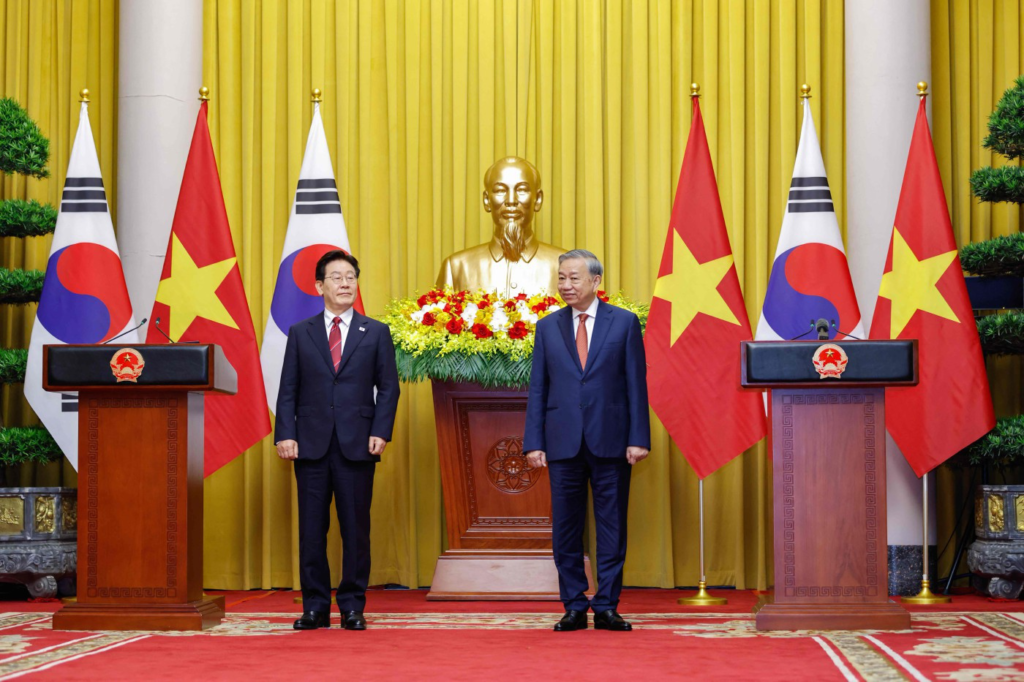
President Lee Jae-myung’s April 2026 state visit to Vietnam was framed by a rare symmetry of diplomatic timing. General Secretary To Lam had been the first state guest received by the Lee administration in Seoul; Lee, in turn, became the first foreign leader to visit Vietnam after Hanoi completed its new leadership lineup. This mutually first-of-its-kind exchange of state visits signaled a high level of political trust. The more consequential question, however, is whether Korea and Vietnam can turn a mature investment relationship into a strategic co-development partnership. Since diplomatic normalization in 1992, Korea–Vietnam relations have grown through trade, investment, production networks, and dense people-to-people ties. During Lee’s visit, the two governments reaffirmed their goal of raising bilateral trade to US$150 billion by 2030 and exchanged 12 cooperation documents covering trade and investment, nuclear energy, power infrastructure, science and technology, digital cooperation, water security, culture, safety, and intellectual property. Dozens of business deals followed in technology, energy, finance, and infrastructure. The number of agreements, however, should not be mistaken for the achievement itself. Memoranda of understanding can create momentum, but they do not guarantee implementation. From Investment Partnership to Strategic Co-DevelopmentThe older model of Korean capital and technology using Vietnam primarily as a low-cost manufacturing base has produced remarkable results. It is also becoming insufficient. The emerging agenda is broader: energy security, technological upgrading, supply-chain resilience, human capital development, institutional capacity, and a more balanced model of industrial partnership. Vietnam’s ambition is stated most clearly in the Political Report to the 14th National Party Congress (Báo cáo chính trị tại Đại hội đại biểu toàn quốc lần thứ XIV của Đảng). The report sets the objective of making Vietnam, by 2030, “a developing country with modern industry and upper-middle income” and, by 2045, “a developed high-income country”. For 2026–2030, it sets targets of average annual GDP growth of at least 10 percent, a digital economy contributing around 30 percent of GDP, manufacturing and processing accounting for about 28 percent of GDP, and total factor productivity contributing more than 55 percent to growth. Vietnam’s 10 percent growth target is best read as a political and developmental aspiration, not as a baseline forecast. External projections remain lower: ADB projects 7.2 percent growth in 2026 and 7.0 percent in 2027, while the World Bank projects 6.3 percent and 7.7 percent for the same years. S&P Global Ratings’ projection of 6.7 percent annual growth over the next three years points to the same gap between ambition and likely trajectory. That gap gives Korea’s role a more concrete meaning. Vietnam’s own political report identifies technological backwardness, the risk of falling into the middle-income trap, institutional bottlenecks, weak infrastructure, and insufficient high-quality human resources as major constraints. It also elevates science and technology, innovation, digital transformation, semiconductors, artificial intelligence, nuclear technology, new energy, space technology, and quantum technology as strategic priorities. Korea cannot make Vietnam’s growth targets achievable by itself. But it can help reduce some of the constraints that make those targets difficult. Vietnam’s expectations of Korea also go beyond additional foreign direct investment. In an interview before the visit, Vietnamese Ambassador to Korea Vu Ho said Vietnam expects not only capital inflows but also substantive technology transfer, high-quality human resource development, stronger domestic capability, deeper links among firms, universities, and research institutes, and more R&D centers in Vietnam. He described the desired shift as moving from “production in Vietnam” toward “co-creation in Vietnam.” The phrase should not be treated as an official doctrine by itself, but it captures an important expectation: Korea should not remain merely an investor; it should become a partner in Vietnam’s industrial upgrading. For Korea, this creates both an opportunity and a test of middle-power diplomacy. Vietnam already has many partners: Japan in infrastructure and development finance, Australia in education and critical minerals, India in technology and strategic cooperation, and China across regional supply chains. Korea’s value proposition is not that it can outspend them or force Vietnam into a geopolitical choice. Its comparative advantage lies in advanced manufacturing, corporate execution, digital governance, energy technology, technical training, and an unusually dense industrial and human presence already embedded in Vietnam. Korea’s broader ASEAN policy gives this bilateral agenda a regional frame. Under its CSP vision — Contributor, Springboard, and Partner — Seoul has sought to organize ASEAN cooperation around people-to-people exchange, growth and innovation, and peace and stability. Vietnam is where those themes become concrete: Korea’s central production base in ASEAN, a major trade and investment partner, and an ASEAN state actively pursuing strategic autonomy and technological upgrading. Lee’s visit therefore offers a practical test of whether Korea’s regional strategy can move from vision to implementation. The Three Pillars of the Next PhaseThe next stage of Korea–Vietnam strategic co-development will depend on three linked areas. Energy and infrastructure come first because Vietnam’s industrial ambitions depend on stable power supply, modern transport, and urban infrastructure. AI data centers, semiconductor facilities, high-tech manufacturing, logistics hubs, and digital services all require reliable electricity. During Lee’s visit, the two sides exchanged documents on possible cooperation in nuclear power development, nuclear project financing, and power infrastructure, while also discussing new cities, airports, and urban rail. Reuters reported that Vietnam is seeking a partner for a nuclear power project with planned capacity of 2–3.2 GW by 2035. Technology and supply chains form the second area. The summit documents included a science and technology innovation masterplan framework, digital cooperation, intellectual property cooperation, and cooperation on food, drug, cosmetics, and medical-device safety. These are directly tied to Vietnam’s ambition to move from assembly-based manufacturing to higher-value segments of semiconductor, AI, digital, and advanced manufacturing ecosystems. A Vietnamese analysis of the visit similarly framed it as a shift from development cooperation and processing-based production toward value creation in core technology, semiconductors, R&D, digital transformation, and supply-chain restructuring. Human capital is the third, and perhaps the most politically durable, dimension of the partnership. Vietnamese workers, students, marriage migrants, multicultural families, Korean residents in Vietnam, and business communities have created a … Continue reading Beyond the Factory Model: Korea, Vietnam, and Strategic Co-Development
