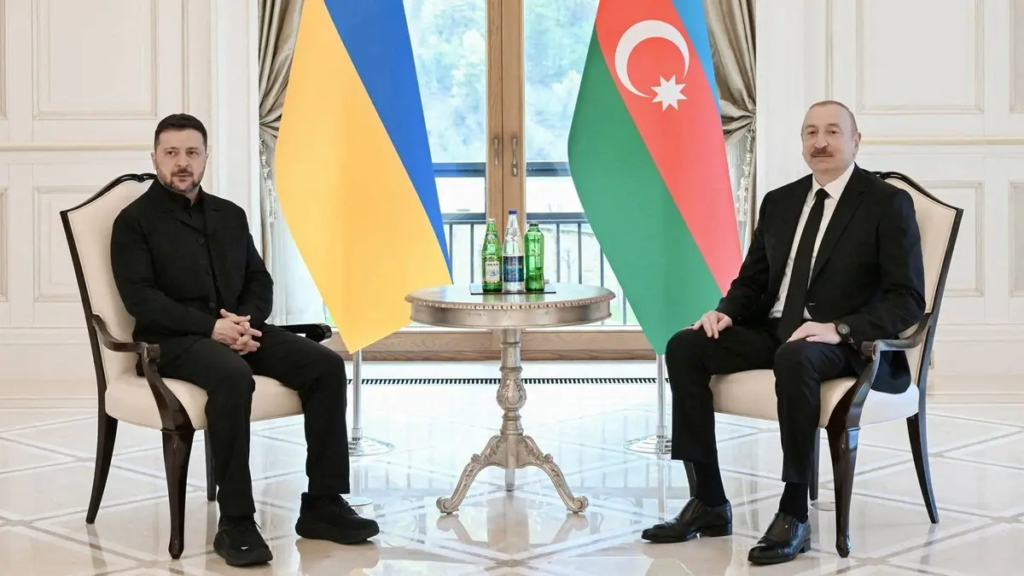
Azerbaijan–Ukraine Rapprochement: The Intersection of Energy, Defense, and Diplomatic Mediation
The meeting between Volodymyr Zelenskyy and Ilham Aliyev in Azerbaijan on April 25, focused on security and energy cooperation, should not be interpreted as a routine continuation of bilateral relations. Marking Zelenskyy’s first visit to the South Caucasus since the outbreak of the Russia-Ukraine War, the encounter signals the emergence of a new axis within Eurasian geopolitics. Its significance is further amplified by Zelenskyy’s exclusive focus on Azerbaijan during this regional engagement. This choice indicates that Kyiv increasingly positions Baku not only as an energy partner but also as a strategic actor with security relevance. The primary areas highlighted during the bilateral talks, namely energy, industry, and defense, point to a hybrid model of strategic partnership that extends beyond conventional forms of cooperation. In particular, the long-standing presence of SOCAR in the Ukrainian energy market demonstrates that Baku functions not merely as a reliable supplier, but also as a stabilizing actor in times of crisis. This role has become especially critical in light of the energy vulnerabilities generated by the Russia-Ukraine War. Zelenskyy’s statement that negotiations with Russia could potentially take place in Azerbaijan reflects Baku’s growing diplomatic profile. In recent years, Azerbaijan has evolved beyond a regional power into a credible diplomatic platform capable of facilitating communication among diverse actors. This capacity is closely linked to the country’s multi-vector foreign policy orientation, which enables it to maintain functional relations across competing geopolitical blocs. Another notable dimension is the role of personal diplomacy between leaders. Zelenskyy’s political style relies heavily on direct leader-to-leader engagement rather than solely on institutional mechanisms. His relationship with Aliyev appears to be grounded not only in pragmatism but also in mutual trust and political alignment. Similar patterns have been observed in his interactions with leaders such as Donald Trump and Vladimir Putin, suggesting that Zelenskyy is particularly adept at establishing rapid and functional ties with power-centric leadership structures. Military-Technical Cooperation: A Joint Laboratory of Next-Generation Warfare The most strategic dimension of Azerbaijan–Ukraine relations lies in military-technical cooperation. Ukraine’s wartime advancements in drone and counter-drone technologies have significantly transformed the nature of modern warfare. Despite initially limited capabilities in this domain, Ukraine has rapidly emerged as one of the leading producers of unmanned systems. Ukraine’s integrated defense model, which combines drones, electronic warfare, and counter-drone systems, has been a key factor in constraining Russian advances along the front line. The cost-effective nature of this model has attracted considerable attention from actors with high threat perceptions but limited interest in unsustainable defense expenditures, particularly in the Gulf region. In this context, Azerbaijan’s role becomes increasingly significant. Drawing on its joint production experience with Türkiye, Baku has developed substantial expertise in unmanned aerial systems. Potential joint production mechanisms with Ukraine would not only enhance the defense capacities of both countries but also create a new model for defense exports targeting third-party markets. The Convergence of Energy and Security: Toward Strategic Depth The integration of energy cooperation with defense industrial collaboration elevates Azerbaijan–Ukraine relations from a conventional economic partnership to a strategically deep alignment. This evolving model points to the formation of a new network of middle powers across Eurasia. Azerbaijan’s energy resources and logistical capabilities, when combined with Ukraine’s wartime-driven military innovation, generate a multilayered framework of cooperation encompassing both economic and security dimensions. This dynamic is particularly consequential in a period marked by the relative contraction of Russian influence in certain parts of the region, thereby accelerating the rise of alternative centers of power. Baku’s Expanding Geopolitical Role The Gabala meeting illustrates that Azerbaijan is no longer confined to the geopolitical boundaries of the South Caucasus, but has emerged as a critical actor within the broader Eurasian landscape. Its growing capacity for diplomatic mediation, coupled with its energy leverage and advancements in the defense industry, positions Baku as a multidimensional power center. From Ukraine’s perspective, Azerbaijan represents a reliable partner under wartime conditions and a strategic gateway for new geopolitical openings. For Azerbaijan, deepening relations with Ukraine constitutes an important component of its broader objective to become a more visible and influential actor within the global system. In this regard, the Azerbaijan–Ukraine axis should be understood not only within the framework of bilateral relations, but also as an emerging structural element in the ongoing reconfiguration of Eurasian geopolitics.
